
Possible
Mirror carp
Cyprinus carpio (form with reduced scales)
A form of common carp with few scales: same water, feeding and growth benchmarks.
See the Common carp guide
Aquaponics
Each species has its own temperature, oxygen needs and pace. First choose the one that can handle your water without ruinous heating costs.
The principle
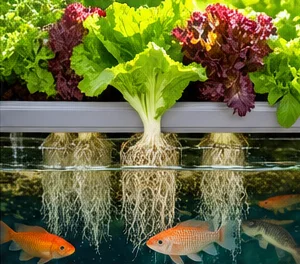
The fish feed the plants, the plants clean the fish’s water.
Guides

Oreochromis spp.

Cyprinus carpio

Cyprinus carpio (ornamental variety)

Carassius auratus

Oncorhynchus mykiss

Perca fluviatilis

Sander lucioperca

Clarias gariepinus
What about the others?
Species often mentioned in aquaponics, with our quick take. Detailed guides are reserved for species for which we have sourced benchmarks.
Cyprinus carpio (form with reduced scales)
A form of common carp with few scales: same water, feeding and growth benchmarks.
See the Common carp guide
Oreochromis (hybrid)
A red-colored tilapia, raised like tilapia: water heated year-round in Belgium.
See the Tilapia guide
Oreochromis niloticus
The most farmed tilapia in the world: same benchmarks as the tilapia guide, with water heated year-round in Belgium.
See the Tilapia guide
Acipenser baerii
A cool-water bottom fish (optimum 17 to 20 °C (63 to 68 °F), TransFarm), peaceful but needs a lot of space. Sturgeons are protected under CITES: buy only from a breeder who provides the paperwork.

Tinca tinca
A local, hardy fish that tolerates poorly oxygenated water; slow growth. Detailed guide coming soon.

Carassius carassius
Close relative of the goldfish, native and very hardy. Detailed guide coming soon.

Ictalurus punctatus (channel catfish)
Raised in aquaponics in North America (SRAC 454). Non-native species: look into it before buying, and don’t confuse it with the black bullhead, an invasive species banned in the European Union.

Oryzias latipes
A small hardy fish for a mini system or a patio tub: it produces too little nitrogen to feed a real vegetable garden.

Osphronemidae family
Tropical aquarium fish that also breathes air at the surface: for a planted aquarium, not for a vegetable garden.

Danio rerio
A very easy small aquarium fish, from 18 to 24 °C (64 to 75 °F) (FishBase): ideal for an indoor aquaponic aquarium, not for producing vegetables.
Indoor aquaponics with aquarium fishPoecilia reticulata
Hardy, from 18 to 28 °C (64 to 82 °F) and pH 7 to 8 (FishBase); breeds very fast. Feeds a few herbs above an aquarium.
Indoor aquaponics with aquarium fishXiphophorus maculatus
Peaceful and hardy, from 18 to 25 °C (64 to 77 °F) and pH 7 to 8 (FishBase): for an indoor aquaponic aquarium.
Indoor aquaponics with aquarium fishPethia conchonius
Likes cool water, 18 to 22 °C (64 to 72 °F) (FishBase), but reaches 14 cm: large aquarium.
Indoor aquaponics with aquarium fishPuntigrus tetrazona
From 20 to 26 °C (68 to 79 °F) (FishBase); a fin nipper: never with guppies or other long-finned fish.
Indoor aquaponics with aquarium fishCorydoras paleatus
A small bottom-dwelling fish that cleans up leftovers, from 18 to 23 °C (64 to 73 °F) (FishBase), kept in a group.
Indoor aquaponics with aquarium fish
Silurus glanis
A large predator that can exceed 2 m: it needs volumes far beyond a hobbyist’s tank.

Ctenopharyngodon idella
A large plant-eating fish: it reaches pond size, and your crops’ roots must stay out of its reach. Best kept for ponds.

Colossoma macropomum
Tropical fish from the Amazon that grows very large and needs heated water: best left to professional setups.

Lates niloticus
A very large tropical predator that has become invasive in Lake Victoria: avoid.

Dicentrarchus labrax
A saltwater fish: it belongs to marine aquaponics, outside the scope of a freshwater garden.

Sparus aurata
A saltwater fish, like sea bass: not suited to a freshwater system.
Benchmarks from TransFarm training materials (Interreg Central Baltic), NMSU (CR-680) and FAO. Commercial stocking densities don't apply to a hobbyist's tank: stay under 10 to 20 kg of fish per 1000 liters.