Part II · Design
Indoor aquaponics with aquarium fish: guppies, platies, danios, barbs
An aquarium of guppies or danios can feed plants set on top of it. Which small fish to choose, at what temperature, what pH, how many plants they can really feed, and how to set up an aquaponic aquarium without making anyone suffer.
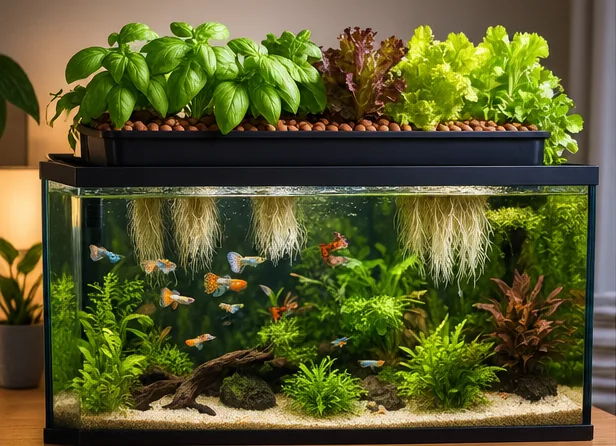
An aquarium of guppies in the living room, a tub of basil on top, and water flowing from one to the other: this is the most accessible version of aquaponics. It works, on one condition: knowing what small fish can really feed. Here is which aquarium fish to choose, at what temperature and pH, how to set up the system, and a calculator to find out how much plant area your fish can feed.
For garden-scale aquaponics, with goldfish, koi or tilapia, see aquaponics, from method to maintenance and the fish guides.
1. The principle, small scale
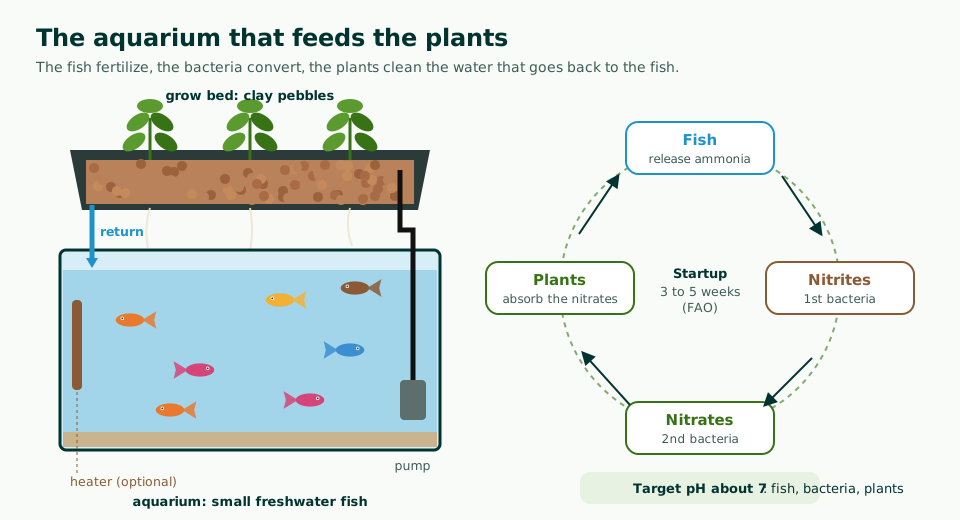
Fish release ammonia. Bacteria, living in the clay pebbles and the filter, convert it into nitrites and then nitrates, which the plants absorb. The cleaned water returns to the aquarium. The FAO sums it up in one useful sentence: it is the nutrients in the feed given to the fish that feed the plants; Oklahoma State University says the same. Hence the real question: how much do your fish eat?
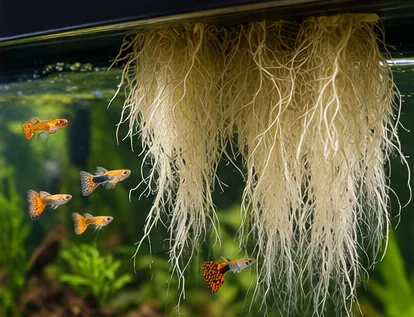
2. What small fish can feed
The FAO sizes an aquaponic system by the feed given each day:
- 40 to 50 g of feed per m² per day for leafy greens (lettuces, herbs).
- 50 to 80 g per m² per day for fruiting vegetables (tomatoes, peppers).
- 20 kg of fish at most per 1,000 liters (264 gal), and 10 to 20 kg to start.
A school of guppies or danios gets a pinch of flakes each day: well under one gram in most aquariums. With the FAO rule, 1 g of feed per day feeds about 200 to 250 cm² (31 to 39 sq in) of leafy greens, the equivalent of a 15 × 15 cm (6 × 6 in) tub. That is perfect for a few plants, not for a vegetable garden. Forget about fruiting vegetables.
3. Which aquarium fish?
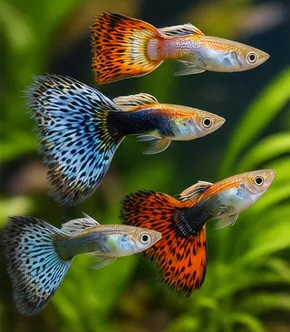
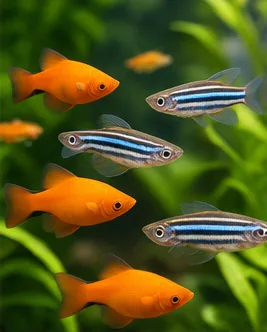
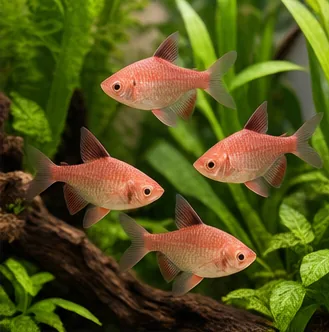
| Fish | Temperature | pH | Good to know |
|---|---|---|---|
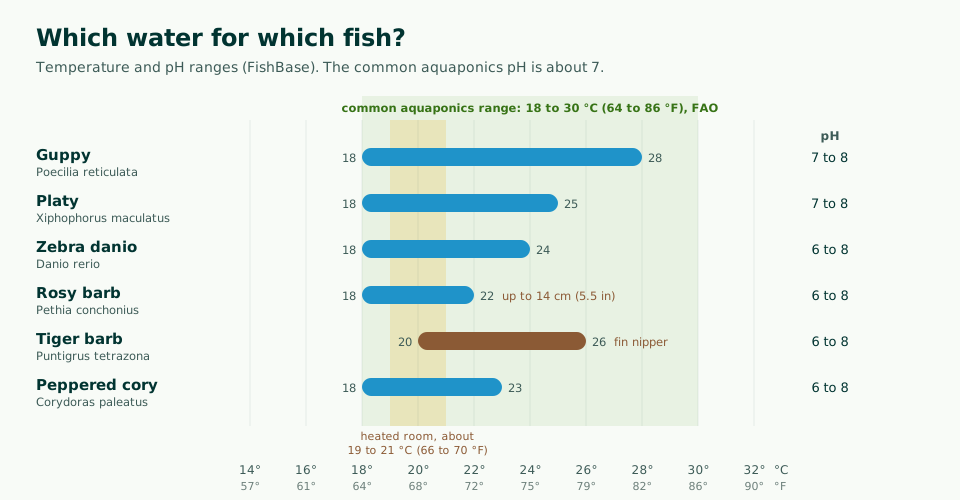
| Guppy Poecilia reticulata | 18 to 28 °C (64 to 82 °F) | 7 to 8 | Hardy; in groups of 5 or more, aquarium at least 60 cm (24 in) long; breeds very fast |
| Platy Xiphophorus maculatus | 18 to 25 °C (64 to 77 °F) | 7 to 8 | Hardy, peaceful, rather hard water; also breeds very fast |
| Zebra danio Danio rerio | 18 to 24 °C (64 to 75 °F) | 6 to 8 | Very easy, lively, comfortable in an unheated room in summer |
| Rosy barb Pethia conchonius | 18 to 22 °C (64 to 72 °F) | 6 to 8 | Likes cool water; grows up to 14 cm (5.5 in): large aquarium |
| Tiger barb Puntigrus tetrazona | 20 to 26 °C (68 to 79 °F) | 6 to 8 | Fin nipper: never with long-finned fish such as guppies |
| Peppered cory Corydoras paleatus | 18 to 23 °C (64 to 73 °F) | 6 to 8 | Bottom dweller, cleans up leftovers; keep in groups |
Ranges from the FishBase species pages. The guppy is the only one on the list that can tolerate 28 °C (82 °F) water long term; the rosy barb and the peppered cory prefer cool water.
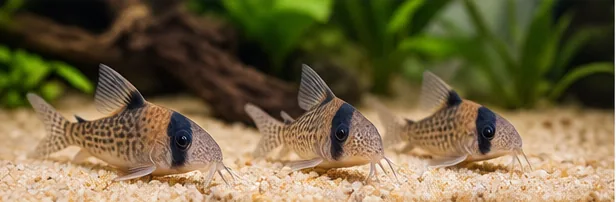
- Heating, often optional. Guppies, platies, danios, rosy barbs and corydoras live from 18 °C (64 °F): in a heated room, a heater is not always needed. A thermometer in the aquarium settles it.
- pH, a compromise. The FAO aims for 6 to 7, Oklahoma State University for 6.8 to 7.2: plants absorb some elements better in slightly acidic conditions, bacteria work better a little above 7. With guppies or platies, which prefer 7 to 8, stay around 7.
- Compatible species. No tiger barbs with guppies; no large fish that eat the small ones or nibble the roots.
- Never released. An aquarium fish never goes into a pond or a stream.
4. Which plants?
Yes
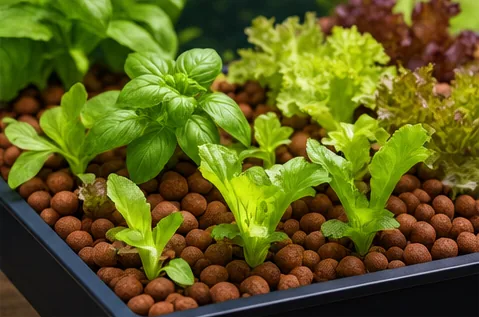
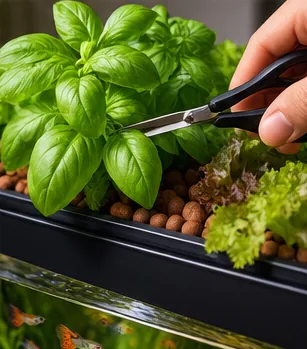
- Herbs: basil, mint, parsley, chives (see herbs).
- Cut-and-come-again lettuces, arugula, watercress.
- Indoor green plants whose roots like water.
No
- Tomatoes, peppers, strawberries: 50 to 80 g of feed per m² per day (FAO), out of reach for small fish.
- Plants that are toxic if their leaves fall into the water.
Oklahoma State University advises starting with leafy greens, which are less demanding. Basil, which likes warmth, goes well with tropical fish water.
5. Calculator: how many plants for your fish?
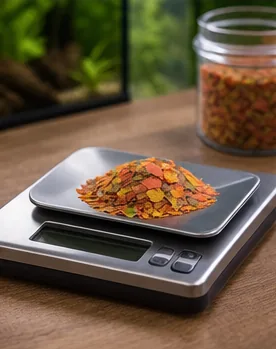
Weigh a week’s worth of food on an accurate kitchen scale and divide by 7. The calculator applies the FAO rules.
FAO rules (2014): 40 to 50 g of feed per m² per day for leafy crops, 50 to 80 g for fruiting crops, 20 kg of fish at most per 1,000 liters (264 gal). These are sizing guidelines; the plants and the water quality have the final word.
6. Tutorial: an aquaponic aquarium
Time: an afternoon, then 3 to 5 weeks of startup. Level: intermediate.
- Set the grow bed on the aquarium: an opaque tub, filled with rinsed clay pebbles, with an overflow that lets the water flow back down (see reservoirs and tubs and growing media).
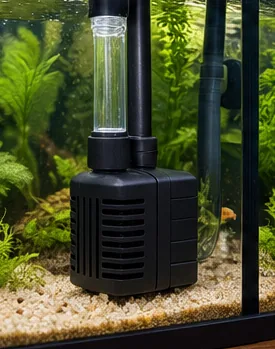
- Install a small aquarium pump, protected by an intake strainer so it doesn’t suck up fry, that lifts the water to the grow bed (see choosing a pump).
- Fill with tap water that has been left to stand, switch on and check that not a single drop escapes.
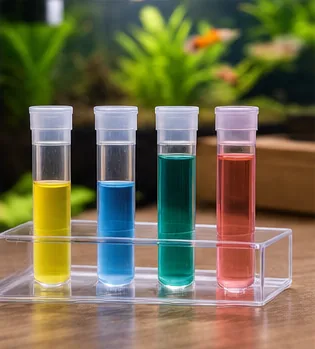
- Start the cycle without fish or with very few: 3 to 5 weeks according to the FAO, with an ammonia and nitrite test twice a week.
- Add the fish gradually once ammonia and nitrites have dropped close to zero and nitrates appear.
- Plant already rooted seedlings (see sowing and transplanting), then adjust the planted area with the calculator.
- Record feed, pH, temperature and tests in the grow log.

7. What you never add
- No complete hydroponic nutrients. Oklahoma State University specifies that only iron, potassium and calcium may run short and need adding, for example chelated iron; the FAO mentions 2 mg/L of iron in case of deficiency.
- No chemical pesticides: they are incompatible with aquaponics (Oklahoma State). Use mechanical and biological control instead (see diseases and pests).
- No fish medication in the loop without removing the plants: treat a sick fish in a separate tank.
8. Common mistakes
| Mistake | Consequence | The fix |
|---|---|---|
| Adding the fish on day one | Toxic ammonia and nitrites | 3 to 5 week startup, tests |
| Overfeeding “for the plants” | Rotting leftovers, polluted water | Feed for the fish, adapt the planted area |
| Planting tomatoes | Deficiencies, flowers without fruit | Leafy greens and herbs |
| Adding hydroponic nutrients | Fish in danger | Only fish-safe iron, potassium, calcium |
| Tiger barbs with guppies | Damaged fins | Compatible species |
| Guppies or platies with no eye on breeding | Overcrowded aquarium | A single sex, or a new home for the young |
| Letting the pH drop below 6.5 | Slowed bacteria, stressed guppies | Aim for 7, measure every week |
| Transparent grow bed | Algae | Opaque tub |
9. Key takeaways
Have you set up an aquaponic aquarium? Show it on the forum, with your fish, your plants and your water tests.
Frequently asked questions
Can you do aquaponics with guppies?
Yes, in an indoor aquarium topped with a small grow bed. Guppies are hardy and live from 18 to 28 °C (64 to 82 °F) according to FishBase, with a pH of 7 to 8. But they eat very little: their food grows a few herbs or cut-and-come-again lettuces, not a vegetable garden. The FAO counts 40 to 50 g of feed per day for one square meter of leafy greens.
Does an aquaponic aquarium need a heater?
Not always. According to FishBase, the guppy, platy, zebra danio, rosy barb and peppered cory live from 18 °C (64 °F): in a heated room, a heater is often unnecessary. The tiger barb needs at least 20 °C (68 °F). Plants such as basil also like warmth.
How many plants can a 60-liter aquarium feed?
It all depends on the feed given, not on the volume. With the FAO rule (40 to 50 g per m² per day for leafy greens), 1 g of feed per day feeds about 200 to 250 cm² (31 to 39 sq in), a small tub. The calculator in the article does the math with your numbers.
Can you add fertilizer to an aquaponic system?
No complete hydroponic nutrients: their salts and concentrations are not made for fish. Oklahoma State University states that only iron, potassium and calcium may need to be added, for example chelated iron; the FAO mentions 2 mg/L of iron in case of deficiency. Chemical pesticides are ruled out.
How long does it take to start an aquaponic aquarium?
Allow 3 to 5 weeks according to the FAO, the time it takes for bacteria to settle in the clay pebbles and the filter. Track ammonia and nitrites with test kits; when they drop to almost zero and nitrates appear, add the fish gradually.
- C. Somerville, M. Cohen, E. Pantanella, A. Stankus and A. Lovatelli, FAO, Small-scale aquaponic food production, Fisheries and Aquaculture Technical Paper 589, 2014
- C. Mullins, B. Nerrie, T. D. Sink and M. Beem, Oklahoma State University Extension, Principles of Small-Scale Aquaponics, 2017
- R. Froese and D. Pauly (eds.), FishBase, species pages for Poecilia reticulata, Xiphophorus maculatus, Danio rerio, Pethia conchonius, Puntigrus tetrazona, Corydoras paleatus