Part II · Design
Aquaponics: Growing with Fish, from Setup to Maintenance
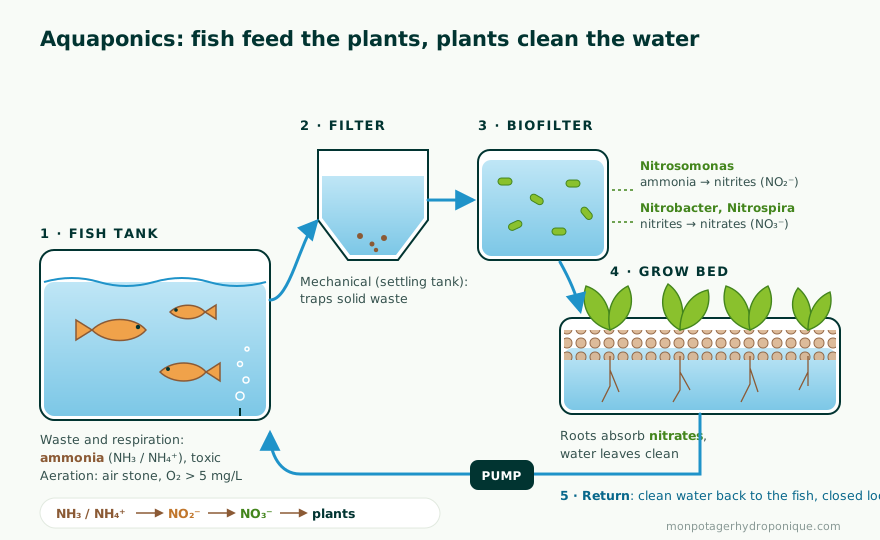
Functional diagram, not to scale.
Fish supply the nitrogen, bacteria convert it, plants clean the water. Method, sizing, species suited to Belgium, feeding, water quality and maintenance routine.
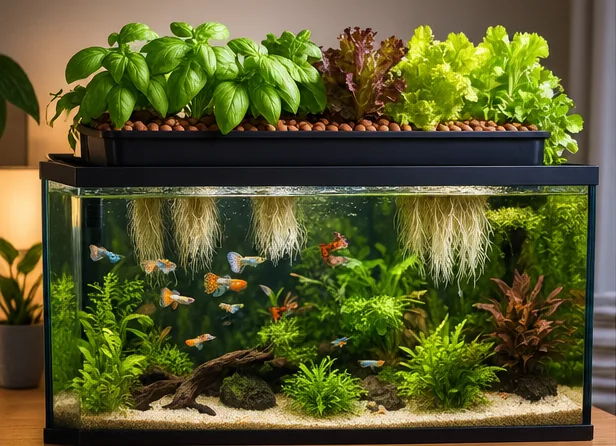
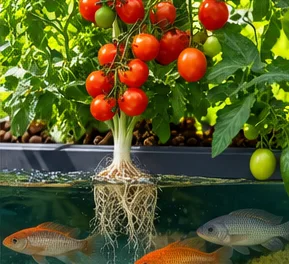
Aquaponics combines raising fish and hydroponic growing in a single water loop. The fish produce nitrogen, bacteria make it available, the plants feed on it and send clean water back to the fish. A miniature ecosystem, slower to get going than a hydroponic reservoir, but one that needs almost no fertilizer.
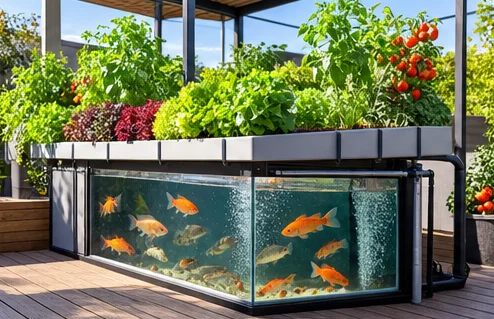
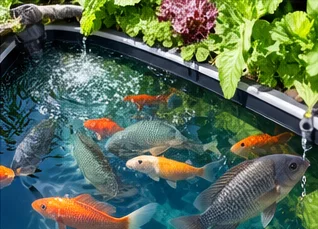
The principle: a closed-loop nitrogen cycle
Everything starts with fish food. Fish waste and respiration release ammonia, which is toxic to them. In the biofilter, two groups of bacteria do the work: Nitrosomonas convert ammonia into nitrites, still toxic, then Nitrobacter and Nitrospira convert those into nitrates, which are low in toxicity for fish and directly usable by plants. The roots take up these nitrates and the water returns, cleaned, to the tank.
The practical consequence: in aquaponics, you are not managing a nutrient solution, you are managing livestock. The amount of feed given each day sets the amount of fertilizer available to the plants. If you are new to hydroponics, start with the basics and monitoring pH and EC: the measuring habits are the same.
Three ways to build the grow bed
| Method | How it works | Best for | Watch out for |
|---|---|---|---|
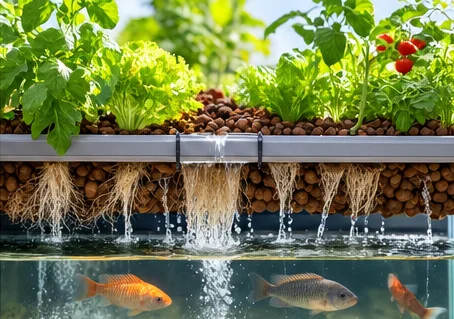
| Media bed (clay pebbles, gravel) | The bed fills and drains, often with a bell siphon; the media serves as both mechanical filter and biofilter. | Beginners, small systems, fruiting crops | Heavy media; clogs if the tank is overstocked with fish. |
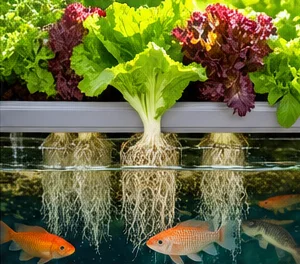
| Floating rafts (DWC) | Plants float on aerated water, roots submerged. | Lettuce and herbs in quantity | Separate mechanical filter and biofilter required; continuous aeration. |
| Channels (NFT) | A film of water flows through channels, as in standard NFT. | Lightweight, wall-mounted setups | Very thorough filtration: particles clog the channels and smother the roots. |
Sizing: start from the feed
The FAO offers a simple rule for small systems, the feeding rate ratio: the amount of feed given to the fish each day, relative to the growing area.
- Leafy greens and herbs: 40 to 50 g of feed per m² of growing area per day.
- Fruiting crops (tomatoes, peppers, cucumbers): 50 to 80 g per m² per day.
- Stocking density: 10 to 20 kg of fish per 1,000 liters (264 gal) at most; a hobbyist is better off staying at the low end of the range.
- Ration: adult fish eat about 1 to 2% of their body weight per day.
Which fish species?
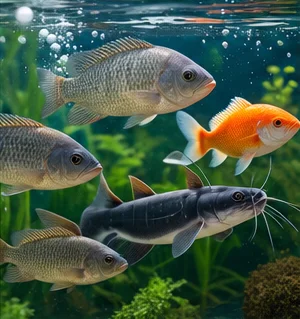
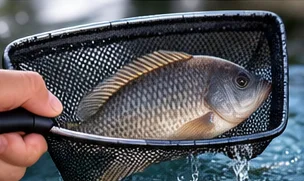
Each species has its own detailed profile: temperature, pH, oxygen, feed and tips for Belgium.
The right fish is first and foremost the one that handles your water temperature without ruinous heating costs. In Belgium and northern France, a tank in a garage or unheated greenhouse easily drops below 10 °C (50 °F) in winter, while a tank in a heated room stays mild all year.
| Fish | Water temperature | Strengths | Limits |
|---|---|---|---|
| Goldfish | Temperate water, comfortable around 18 to 29 °C (64 to 84 °F), tolerates cold | Very hardy, cheap, ideal for learning | Ornamental fish, not eaten; breeds easily |
| Koi | Temperate water, tolerates cold | Hardy, long-lived, eye-catching | Grows large: plan for a big tank; not eaten |
| Tilapia | 27 to 29 °C (81 to 84 °F) for good growth; dies below 10 °C (50 °F) | The most widely used species in aquaponics, fast-growing, edible | Heating essential in our climate; check the rules on keeping and slaughter |
| Rainbow trout | Cold water, 13 to 18 °C (55 to 64 °F) | Edible, suited to a cool room | Very demanding in oxygen; suffers as soon as the water warms up in summer |
| Common carp | Temperate water | Rugged, tolerant, edible | Stirs up the bottom and clouds the water; slow growth without warmth |
Water quality to monitor
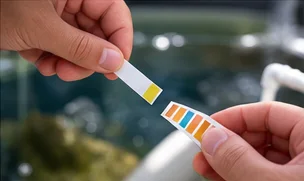
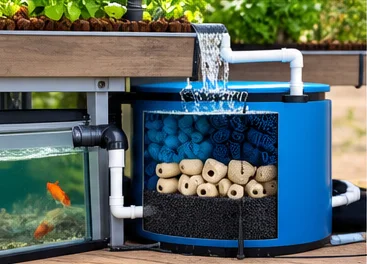
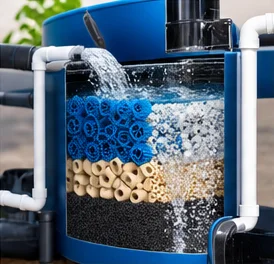
Aquaponics is a compromise: nitrifying bacteria prefer a fairly high pH, plants a slightly acidic one. You settle around neutral.
| Parameter | Target | Why |
|---|---|---|
| pH | 6 to 7 (6.5 to 7 with tilapia) | Compromise between fish, bacteria and plants |
| Dissolved oxygen | Above 5 mg/L | Fish, bacteria and roots all consume oxygen |
| Total ammonia | Below 1 mg/L | Toxic to fish |
| Nitrites | Below 1 mg/L | Toxic to fish |
| Nitrates | 5 to 150 mg/L | The plants’ fertilizer; above that, replace part of the water |
| Alkalinity (KH) | 100 mg/L as CaCO₃ or more | pH buffer, needed by the bacteria |
| Temperature | That of the chosen species | See the fish table |
Nitrification acidifies the water: pH drops naturally over time. Raise it gently with bases that also supply elements useful to plants, for example calcium carbonate or potassium hydroxide, never all at once. Alkalinity acts as a reserve: as long as it stays high enough, the pH doesn’t crash.
Feeding the fish (and therefore the plants)
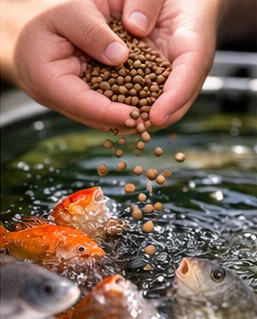
- A complete feed suited to the species and to mouth size: floating pellets so you can see what gets eaten.
- Two or three small meals a day rather than one big one, at set times.
- What gets eaten in a few minutes, no more. Remove leftovers: feed that rots on the bottom turns into ammonia and uses up oxygen.
- Less food when the water is cold: fish slow down, and so does their appetite.
- Stop immediately if ammonia or nitrites go above 1 mg/L, or if the pump or aeration fails.
- Homegrown supplements are possible, as extras only: duckweed grown separately, insect larvae, worms. They don’t replace a balanced feed.
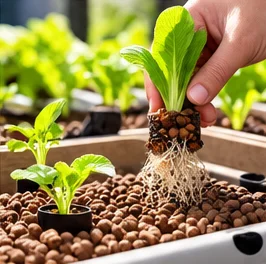
On the plant side, nitrogen comes from the fish, but iron is almost always lacking: add a chelated iron such as Fe-DTPA, stable around pH 7 (SRAC gives a target concentration of 2 mg/L). Potassium and calcium come from the bases used to correct the pH, alternating between them. Never put standard hydroponic nutrients, pesticides or garden treatments in the loop: anything that touches the plants also touches the fish.
Building a small clay pebble media bed system
- The fish tankAn opaque food-grade tank of about 300 liters (80 gal), out of direct sun to limit algae, with a lid or a net: fish jump.
- The grow bedA bed with the surface area planned in the sizing step, about 30 cm (12 in) deep, placed above the tank so water returns by gravity.
- The mediaRinsed clay pebbles (never limestone, which would push the pH up). They act as a filter and as a home for the bacteria.
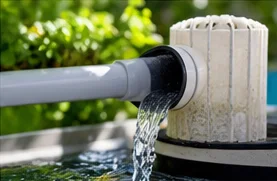
- CirculationA submersible pump lifts the water to the bed; a bell siphon drains the bed in cycles to oxygenate the roots. Add an air pump and air stone in the tank. See how to choose a pump.
- Cycling, without fishAdd a small source of ammonia and measure ammonia, nitrites and nitrates every day. The system is ready when ammonia and nitrites stay below 1 mg/L and nitrates are rising. Allow several weeks.
- Adding the fishIntroduce them gradually, after acclimating them to the water temperature, and feed lightly the first week while watching the readings.
- The first plantsStart with lettuce and herbs, which are more tolerant. Tomatoes and strawberries can come once the system is stable.
Maintenance: the routine
| When | What |
|---|---|
| Every day | Feed and watch the fish (appetite, swimming, gasping at the surface); check pump, aeration and water level; remove leftovers and dead fish; record the temperature. |
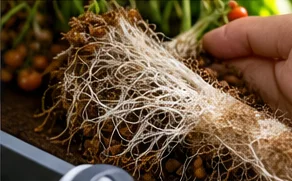
| Every week | Measure pH, ammonia, nitrites, nitrates (every day during startup); top up evaporated water with dechlorinated water; clean the pump prefilter; inspect leaves and roots. |
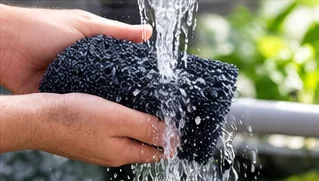
| Every month | Check KH; remove sludge from the mechanical filter; rinse filter media in system water, never under chlorinated tap water; check tubing and siphon. |
| Every season | Adjust the ration to the temperature; plan heating or shading; test the backup plan for power outages. |
In a closed loop, water losses stay low, mostly evaporation and what the plants drink. If nitrates go above 150 mg/L, replace part of the water or add plants. Keep a log: date, readings, ration, observations. That is what will help you understand your system, just as in standard hydroponics.
Hygiene and common sense
Aquaponic vegetables grow in water that has been around fish. A few simple rules, as US extension services point out: wash your hands after touching the water or the fish, avoid splashing tank water on the leaves, wash harvests well, and cook any fish meant for eating. If a fish is sick, isolate it and get advice rather than treating the whole loop: aquarium medications can destroy the biofilter and are not intended for vegetables that will be eaten.
A question, a setup to show off? The Aquaponics category of the forum is made for that, and the diagnostics category helps track down the cause of a problem from your readings.
Frequently asked questions
Which fish should a beginner choose for aquaponics in Belgium?
Goldfish or koi: hardy, tolerant of temperature swings and easy to feed. Tilapia grow fast but need water heated to about 27 to 29 °C (81 to 84 °F); rainbow trout need cool water (13 to 18 °C, 55 to 64 °F) that is highly oxygenated.
How many fish for 1 m² of lettuce?
The FAO recommends 40 to 50 g of feed per m² per day for leafy greens. Since fish eat 1 to 2% of their body weight per day, that works out to about 2 to 5 kg of fish, in a tank of at least 300 liters (80 gal) to stay under 10 to 20 kg per 1,000 liters.
How long does it take to start an aquaponic system?
First you need to establish the nitrifying bacteria: this is called cycling. It usually takes several weeks, often a month or more. The system is ready when ammonia and nitrites stay below 1 mg/L and nitrates start to show up.
Can I use hydroponic nutrients in aquaponics?
No. The water flows through the fish tank: standard mineral fertilizers and pesticides put the fish at risk. The only common supplements are chelated iron (Fe-DTPA) and bases that supply potassium and calcium to correct the pH.
What should I do during a power outage?
Oxygen becomes the emergency: without aeration, fish can suffer within a few hours, especially in warm water. Keep an air pump on a battery or a UPS, and stop feeding until circulation is restored.
- FAO, Small-scale aquaponic food production (Somerville et al., 2014)
- SRAC 454, Aquaponics: Integrating Fish and Plant Culture (Rakocy, Masser, Losordo)
- NMSU CR-680, Important Water Quality Parameters in Aquaponics Systems
- Regulation (EU) 1143/2014, invasive alien species
- Vermont / NECAFS, food safety in aquaponics