Part V · Care
Going on vacation without losing your hydroponic garden: water reserve, preparation, neighbor
A weekend, a week, three weeks: how to calculate the water reserve your plants need, prepare the system the week before, install a float-valve top-off reservoir, secure the power supply, brief a neighbor and get everything back on track when you return. System by system, with a calculator.
A week in the sun, and when you get back, lettuces collapsed over an empty reservoir. It is the fear of everyone who grows without soil. Good news: a well-prepared hydroponic system handles your absence better than a container garden, because the water is already there. You just need to know how much it takes, and to prepare the week before.
1. What can really go wrong
| Risk | Mostly for | The fix |
|---|---|---|
| Running out of water | Small reservoirs, large plants, summer, full sun | Measure water use, enlarge the reserve, float-valve top-off |
| Pump or air pump failure | NFT, towers, drip, DWC | Maintenance and testing the week before, monitored outlet, battery-powered air pump |
| Power outage | All active systems, lights | Timer that resets to the right time, pump that restarts on its own, neighbor in the loop |
| Leak | Fittings, gutters, towers | Drip tray, checked fittings, no raised system above a wood floor |
| Heat | Sunroom, patio, windowsill in summer | Shade, volume, insulation; see summer in DWC |
| Pests | Herbs, tomatoes, peppers | Inspection and treatment a week before; see diseases and pests |
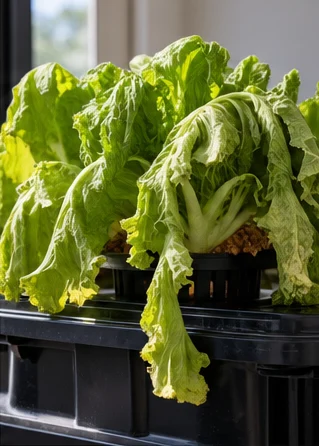
The first risk, by far, is water. A thirsty plant in hydroponics does not dry out slowly as it would in the ground: once the level drops below the roots, it wilts within hours.
2. How much water should you plan for?
Needs vary enormously from one crop to another and from one season to another. A few published benchmarks:
| Crop | Water use | Source |
|---|---|---|
| Lettuce | 4 to 6 liters per plant over the entire crop, from sowing to harvest (1 to 1.5 gallons) | University of Florida |
| Mature tomato | 1 to 3 liters per plant per day, depending on stage and size (1 to 3 quarts) | Oregon State |
| Tomato, average | About 2 liters (2 quarts) per plant per day, more in hot, sunny weather | Alabama Extension |
| Herbs, peppers, strawberries | N/A: measure it | No published figure suited to home growers |
The difference is huge: four tomato plants can drink in ten summer days what a tub of lettuce uses in two months. The only reliable number is the one for your setup, in your room, in this season.
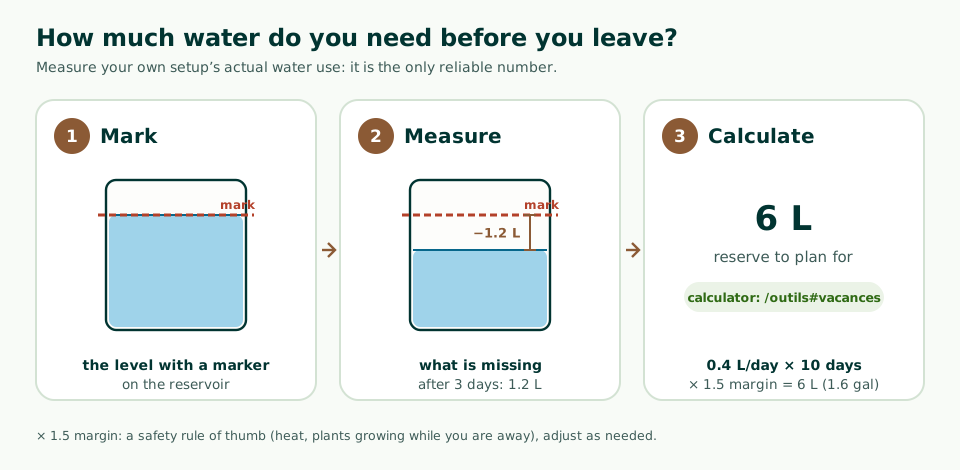
Measuring water use before you leave
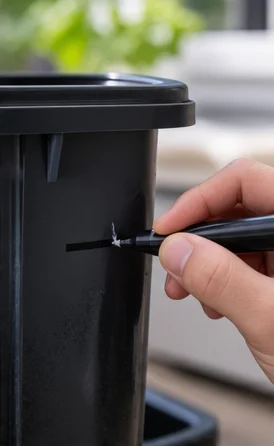
- Make a markTop off the reservoir, then mark the level with a marker or a piece of tape.
- Wait three daysWithout adding anything, lights and pumps running as usual.
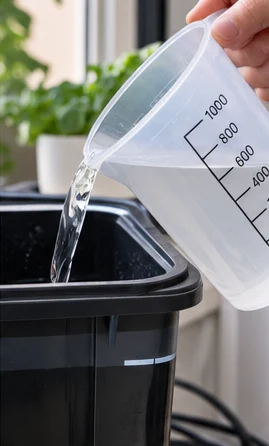
- Measure what is missingBring the level back to the mark with a measuring cup: that is your three-day water use.
- CalculateDaily use × days away × 1.5. The margin covers a heat wave and plants growing while you are gone; it is a safety rule of thumb, not a standard.
- Compare with the reservoirThe volume actually available is what remains above the point where the roots stop reaching the water, or where the pump would start sucking air.
3. Depending on how long you are away
| Time away | In general | What to plan |
|---|---|---|
| A weekend | No problem if the reservoir is full | Top off, check the pump, lights on a timer. Watch out for small kits and tomatoes in summer. |
| One week | Doable on your own in most cases | Water-use measurement, fresh solution three days before, large reservoir or top-off |
| Two weeks | Top-off almost always needed | Float-valve top-off reservoir, or a neighbor visiting halfway through |
| Three weeks or more | Risky without help | A trusted person, or a pause between two crops: harvest, drain, clean, restart when you get back |
4. System by system
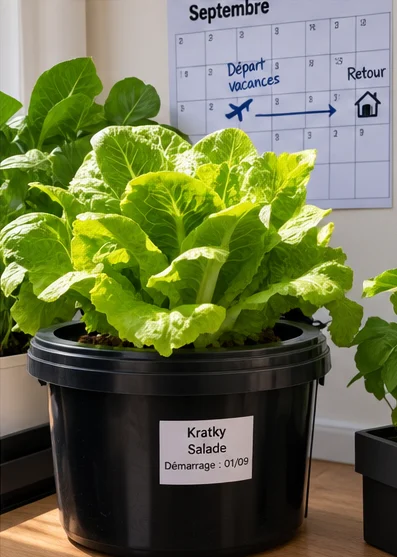
- Kratky: the vacation champion. The whole idea is to fill once for the entire crop; the University of Florida describes a bucket of lettuce you “forget” until harvest. Leave with the reservoir full and a sufficient air gap, without raising the level up to the net pots. See the Kratky method.
- DWC: the air pump must run day and night. Fresh solution, clean air stone, level topped off, and if possible a small battery-powered air pump. See DWC and air pumps.
- NFT, towers, gutters: the most vulnerable, because the roots have almost no reserve when the pump stops. Clean the filter and intake strainer, test the pump, check every fitting, and enlarge the reservoir.
- Growing medium and drip: the medium holds a little water, which gives you some margin during a short stoppage. Make sure no emitter is clogged.
- Indoor kits: small reservoirs, often just a few liters. Follow the manual, fill to the max, and harvest the biggest plants: they are the ones that drink the most.
- Microgreens: harvested in 7 to 21 days, they will not hold during an absence. Harvest before you leave, sow when you get back. See microgreens.
- Aquaponics: fish cannot be put on a timer. A trusted person is essential, with written instructions. See aquaponics.
5. The week before, day by day
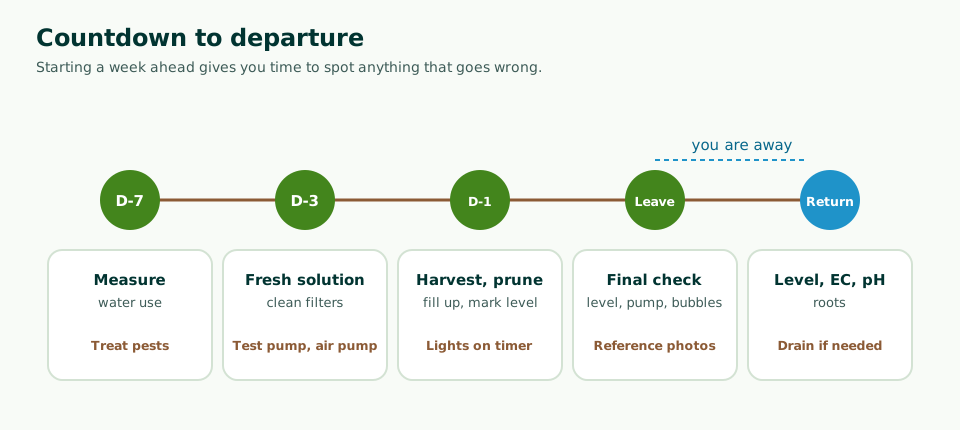
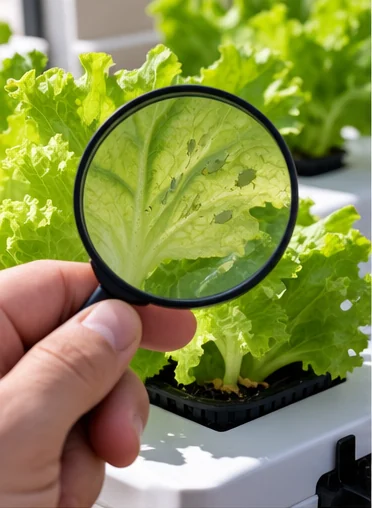
- D-7: water-use measurement (section 2). Inspect the leaves, top and underside: an aphid or spider mite outbreak explodes in two weeks without supervision.
- D-3: fresh solution, pH and EC adjusted. Not on departure day: three days let you check that everything is stable. Filters, strainers and air stones cleaned, pump and air pump tested.
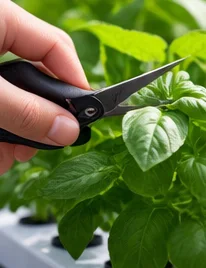
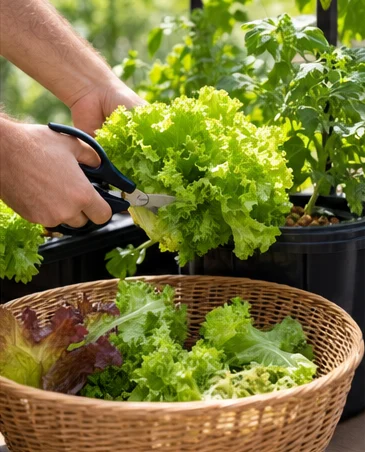
- The day before: harvest everything that is ready, prune the bushiest plants, remove damaged leaves. Less foliage also means less water drunk. Fill up, mark the level.
- The lights: on a timer, same light duration as before. Choose a timer that keeps the time after a power outage.
- Departure day: a last look at the level, the pump, the bubbles. Take photos: when you get back, you will know what has changed.
6. The float-valve top-off reservoir
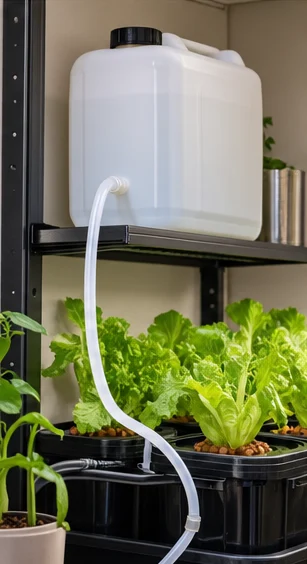
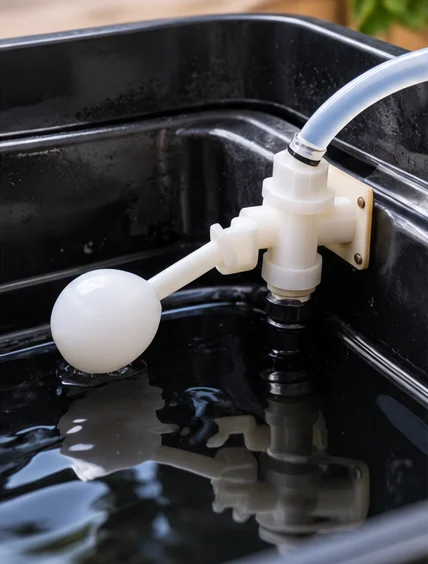
For one to three weeks, the most reliable solution is a top-off reservoir: a jug set higher than the tub, connected to a float valve (the same principle as a toilet tank). When the plants drink, the level drops, the float goes down and lets water in; once the level is back, it closes.
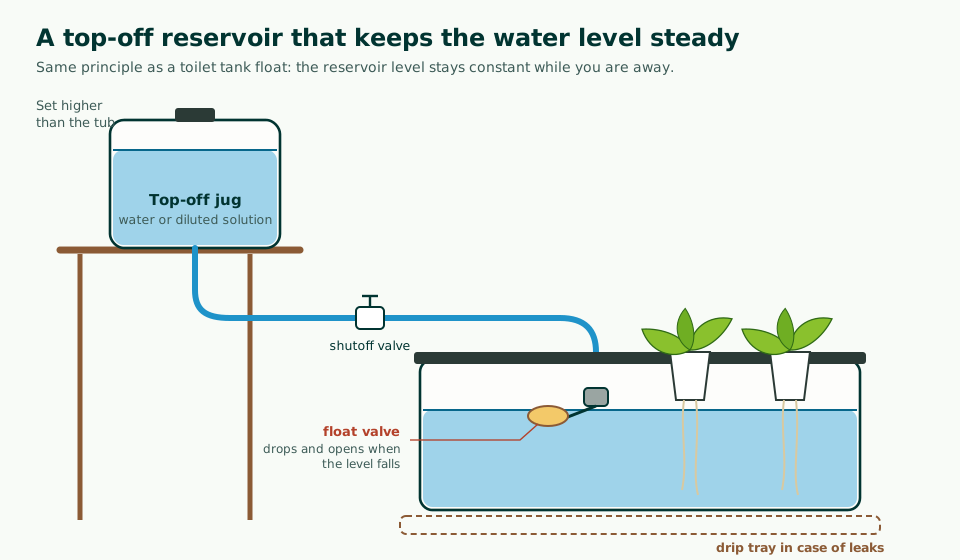
Installing a float-valve top-off
- Choose the valveA plastic mini float valve for aquariums or livestock waterers, with a fitting for 6 to 8 mm (1/4 to 5/16 in) tubing.
- Drill and mountA hole in the side or lid of the tub, at the height of the level you want; gasket and nut hand-tightened.
- Connect the jugA clean, opaque jug set higher than the tub, outlet tubing at the bottom of the jug, a small shutoff valve to cut the flow.
- Fill the top-offPlain water or a half-strength solution: plants often drink more water than nutrients, and EC tends to rise. This is common grower practice, to be adjusted based on your measurements.
- Test for three daysRemove a little water from the tub: the valve should open, then close at the right level, without a constant drip.
- Set everything in a drip trayA valve stuck open will empty the whole jug: it must be able to drain without flooding the room.
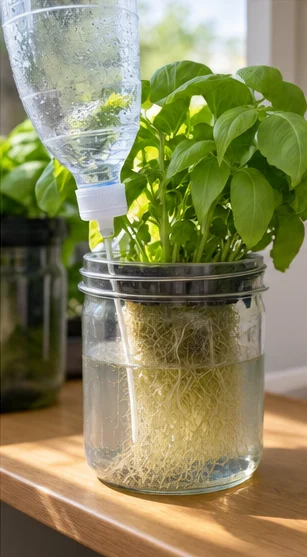
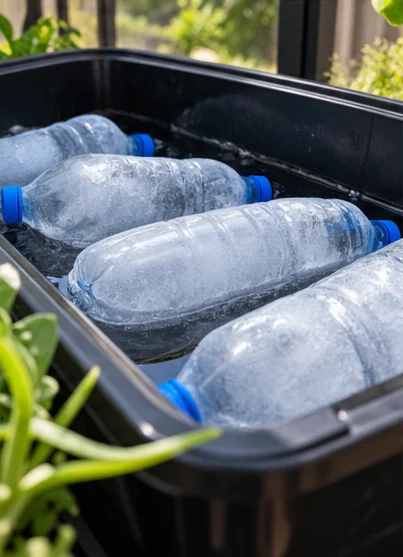
For a jar or a small tub, an upside-down bottle with its neck in the water works as a basic top-off: it empties when the level drops below the neck. Less precise, but no drilling.
7. Power and leaks
- A pump that restarts on its own after an outage (most do) and a light timer that keeps the time.
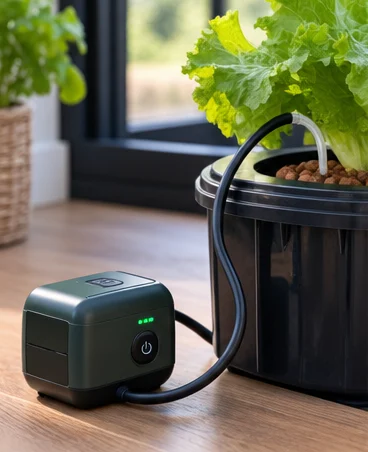
- A battery-powered air pump for DWC and aquaponics: it takes over during an outage.
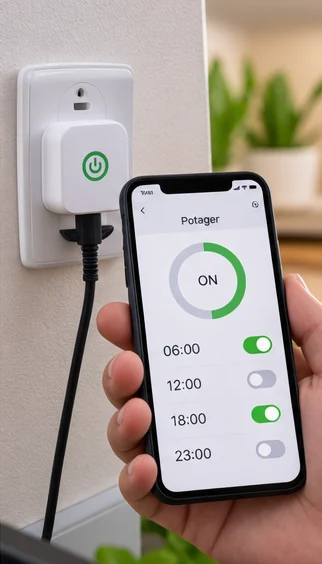
- A smart plug that measures power use: from your phone, you can see whether the pump is running (a few watts) or not (zero).
- No running the pump dry: if the reservoir might empty, a pump with a low-level cutoff or a float-valve top-off protects it.
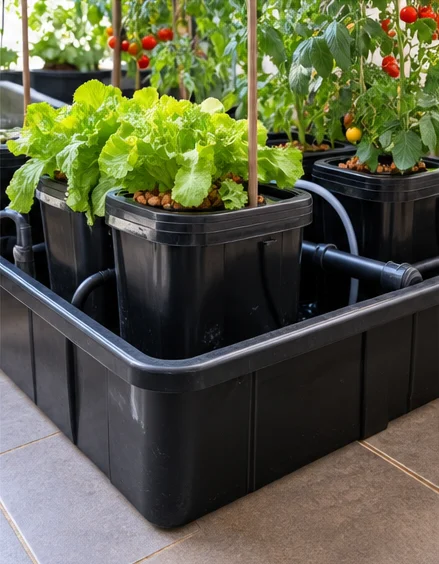
- A drip tray under the system, and nothing electrical on the floor where water could run. Outlets and power strips higher than the reservoir.
8. Briefing a neighbor
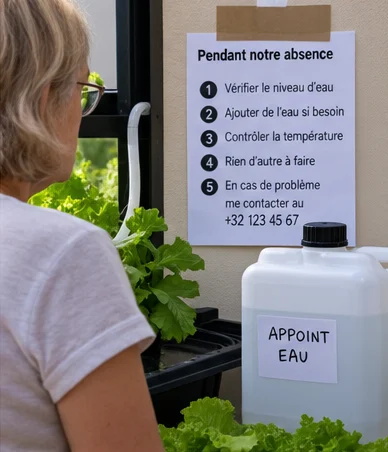
A visit halfway through your absence changes everything, as long as the person knows what to look at. Leave them a short sheet taped near the system:
A prepared, labeled top-off jug prevents mistakes: no nutrients to measure, no pH to check.
9. When you get back
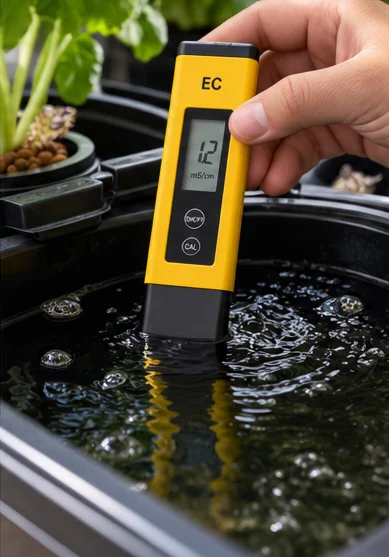
- The level: how much was used? Write it down: it is the most valuable measurement for your next vacation.
- EC and pH: if EC has risen a lot or pH has left its range, drain and mix a fresh solution. See pH and EC.
- The roots: white and firm, all is well; brown and slimy, see diseases and pests.
- The leaves: harvest, prune, remove anything that suffered. A lettuce that has bolted should be harvested right away or replaced.
- The logbook: duration, water use, weather, what worked. See maintenance routines.
10. Common mistakes
| Mistake | Consequence | The fix |
|---|---|---|
| Estimating instead of measuring | Empty reservoir on day 5 | Three days of measurement before leaving |
| Solution changed on departure day | pH drifting with no one noticing | Fresh solution three days before |
| Kratky filled to the brim | Drowned roots, no more air gap | Keep the usual level, plan a bigger tub |
| Untested pump | Stops on day two | Cleaning and testing at D-3 |
| Tomatoes in midsummer without a top-off | Several liters per plant per day to supply | Float-valve top-off or a neighbor |
| Neighbor without instructions | Nutrients poured by guesswork, pH thrown off | A short sheet and a prepared top-off jug |
| No drip tray | Water damage when you get back | Tray under the system, outlets up high |
To go further: calculate your reserve with the “Vacation” calculator, and share your successful (or failed) getaways on the forum.
Frequently asked questions
How long can a hydroponic garden last without me?
It all depends on the ratio between the reservoir volume and how thirsty the plants are. A Kratky tub of lettuce filled at the start can last the whole crop; that is actually the whole idea (University of Florida). A small indoor kit full of mature basil, or tomatoes in summer, can empty their reservoir in a few days. Measure water use three days before you leave to find out.
Should you leave the lights on during vacation?
Yes, on a timer, with the same light duration as before: plants need light to live. Just check that the timer has a battery backup or resets itself to the right time after a power outage.
What should go in the top-off reservoir: water or nutrient solution?
Plants often drink more water than they use nutrients, and EC tends to rise. Many growers therefore fill the top-off with plain water or a half-strength solution. When you get back, measure EC and pH, and drain if the solution has drifted too far.
Can you sow right before leaving?
For seedlings in cubes, yes if someone can keep them moist; otherwise, it is better to sow when you get back. Microgreens, harvested in 7 to 21 days, are best sown on the day you return rather than the day before you leave.
What about the fish in aquaponics?
Fish cannot be put on a timer like a lamp: arrange for a trusted person to check aeration and circulation, with written instructions, and a battery-powered air pump in case of a power outage. See the aquaponics article.
- University of Florida IFAS Extension, “Set It and Forget It” Hydroponic Lettuce (HS1488)
- B. A. Kratky, University of Hawaiʻi CTAHR, non-circulating hydroponic methods
- Oregon State University, Tomato, Greenhouse (Oregon Vegetables)
- Alabama Cooperative Extension System, Greenhouse Tomato Production
- Penn State Extension, Pythium