Part II · Design
DWC and air pumps: growing in oxygenated deep water, from bucket to tub
An opaque bucket, a lid, a net pot, an air pump and an air stone: DWC (deep water culture) is the simplest active system in hydroponics. The principle, oxygen and water temperature, choosing the right air pump, the step-by-step tutorial, settings, summer, the RDWC and raft variants, cost and the mistakes to avoid.
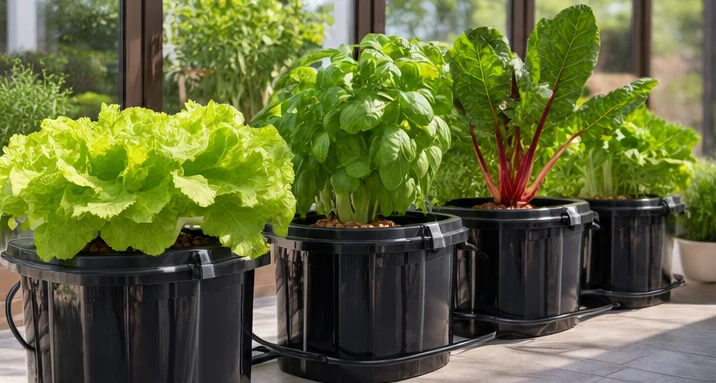
DWC, short for Deep Water Culture, is the aerated version of the Kratky method: the roots hang in a nutrient solution, and a small aquarium air pump oxygenates it day and night. A bucket, a lid, a net pot, an air pump: it is the simplest active system to build, and one of the most productive for lettuce and herbs.
1. The principle

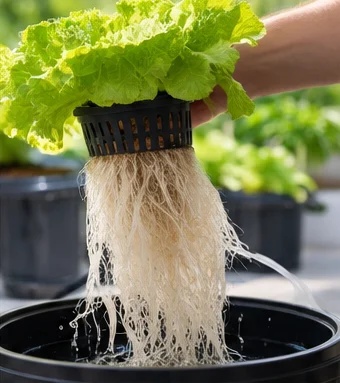
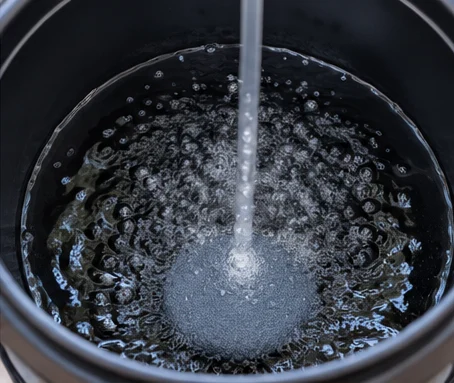
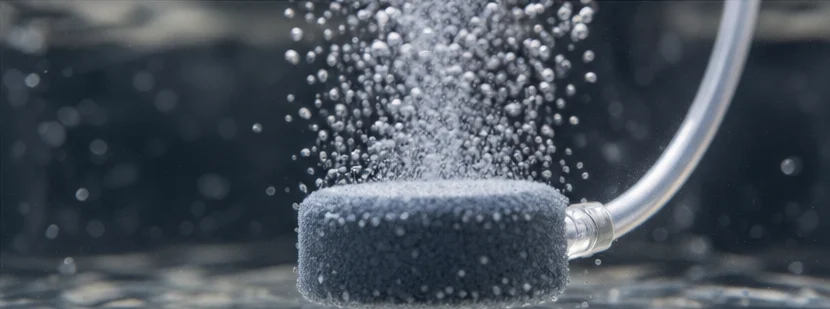
The plant is held by a net pot filled with clay pebbles, set in an opaque lid. Under the lid, a reservoir filled with nutrient solution. At the bottom, a diffuser (air stone, disc or microporous tube) connected to an air pump releases a stream of fine bubbles. The bubbles bring oxygen and stir the water: the roots grow fast, white and bushy.
| System | Aeration | Best for |
|---|---|---|
| Kratky | None: the level drops and leaves air for the roots | First try, jar or small reservoir, no electricity |
| DWC | Air pump and air stone running continuously | Bucket or tub, bigger plants, ongoing harvests |
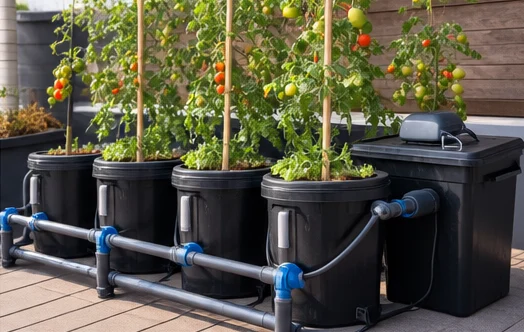
| RDWC | DWC where several buckets share the same solution, circulated by a water pump | Several large plants, a single reservoir to adjust |
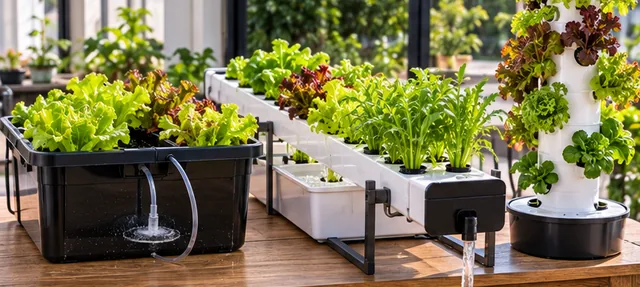
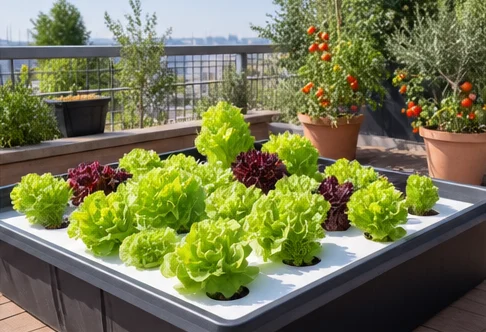
| Floating raft | Large shallow tub, drilled polystyrene board, often aerated | Lettuce in succession, patio, school |
To compare with towers, NFT and growing media, see which system to choose.
2. Why oxygen matters so much
A root breathes: it uses oxygen to take up water and nutrients. In soil, air circulates between the particles. In water, the plant only has dissolved oxygen, measured in milligrams per liter (mg/L).
- At least 4 mg/L for optimal lettuce growth, and severe plant stress below 2 mg/L: that is what ten years of pond lettuce trials at Cornell University measured (A. J. Both, 2003).
- More than 6 mg/L, ideally saturation (8 to 9 mg/L): Cornell's target (N. Mattson) to limit root rot caused by Pythium, which a lack of oxygen encourages.
- About 5 mg/L: the benchmark given by the University of Florida for a small lettuce system.

3. Which crops for DWC?
| Crop | Recommended container | Note |
|---|---|---|
| Lettuce, arugula, mizuna, mustard greens | 20 to 60 L (5 to 16 gal) tub, several net pots | The go-to crops: fast, undemanding |
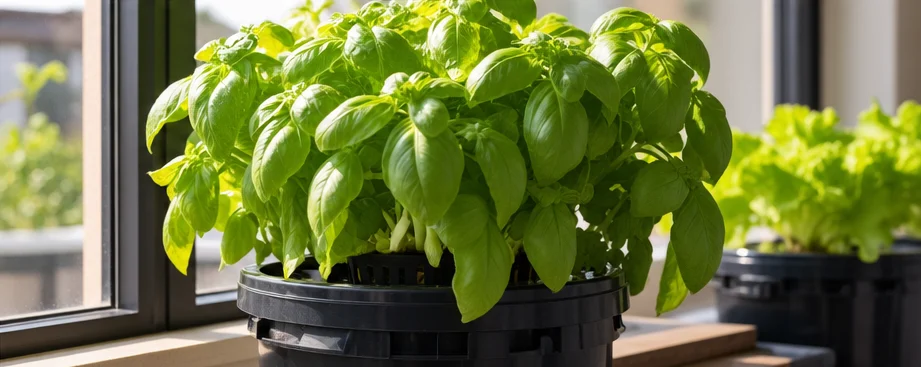
| Basil, mint, chives | Bucket or shared tub | Basil loves DWC, but is vulnerable to Pythium in warm water |
| Swiss chard, kale, bok choy | Tub, 20 to 30 cm (8 to 12 in) between plants | Leaves harvested as you go |
| Tomato, pepper, cucumber | One 15 to 20 L (4 to 5 gal) bucket per plant | Sturdy stake, generous air pump, higher EC |
| Radishes, carrots, potatoes | Avoid | Root vegetables do not like sitting in water |
Crops listed by the University of Florida for the floating raft: lettuce, mustard greens, mizuna, mint, chives, kale, basil, Swiss chard, cucumber, watercress. Volumes: common practice among hobby growers.
4. The equipment
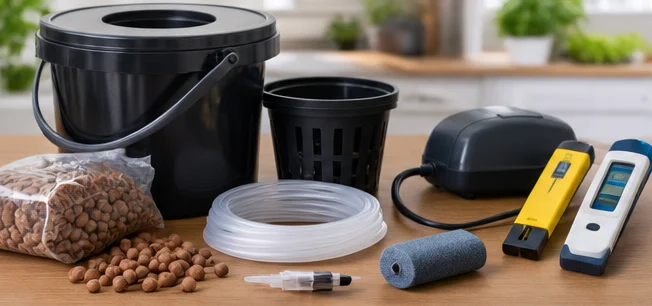
- An opaque, food-grade bucket or tub with a lid: 10 to 20 L (3 to 5 gal) for a bucket, more for a lettuce tub. Light on the water grows algae: paint or wrap a translucent tub.
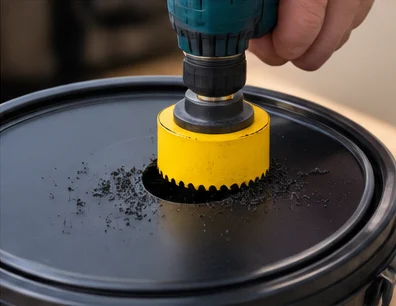
- Net pots of 5 to 7.5 cm (2 to 3 in), and a hole saw just under the diameter of the net pot rim. The University of Florida drills its holes 15 cm (6 in) from the edges and 30 cm (12 in) apart for lettuce.
- An inert growing medium: rinsed clay pebbles, or a rockwool cube to start seedlings.
- An aquarium air pump, 4 mm silicone tubing, a check valve and one air stone per reservoir.
- Measuring tools: pH tester, EC tester, thermometer. See pH and EC of the solution.
- Hydroponic nutrients: see nutrients.
Choosing the right air pump
| Solution volume | Approximate airflow | Air stone |
|---|---|---|
| 10 to 20 L (3 to 5 gal) bucket | 2 to 5 L/min | One round stone or a 5 to 10 cm (2 to 4 in) disc |
| 40 to 60 L (10 to 16 gal) tub | 5 to 10 L/min | Two stones or a microporous tube |
| Tub of 100 L (26 gal) or more | 10 L/min or more | Several air stones spread out, sturdier diaphragm pump |
No university source sets an airflow per liter for hobby growers: these benchmarks come from growers' practice (around 1 L/min of air per 4 to 5 liters of solution). Too much air does no harm; too little does.
5. Tutorial: a DWC bucket in 30 minutes
Build a DWC bucket
- Drill the lidOne hole in the center with the hole saw: the net pot must sit in it without falling through. A second small hole (6 mm, about 1/4 in) near the edge for the air tubing.
- Make the bucket opaqueA black or thick white bucket; otherwise a coat of paint or tape. No light must reach the water.
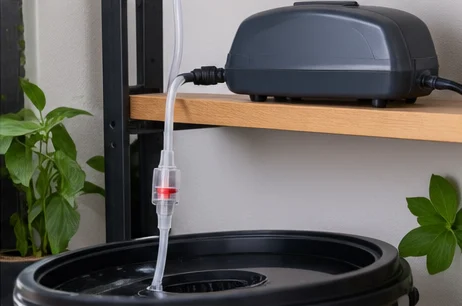
- Install the aerationAir stone at the bottom, tubing through the small hole, check valve on the tubing with the arrow pointing toward the bucket. The pump goes higher than the water, on a shelf.
- Mix the solutionRoom-temperature water, nutrients per the label, pH adjusted between 5.6 and 6.0 and EC around 1.2 mS/cm for lettuce (Cornell benchmarks). Fill until the water touches the bottom of the net pot.
- TransplantA seedling started in a rockwool cube, roots visible. Set the cube in the net pot and wedge it in with rinsed clay pebbles.
- Plug in and checkThe air pump runs 24 hours a day. Water surface shimmering, even bubbles: you're up and running.
- Lower the level afterwardOnce the roots reach well into the solution, leave an air gap of a few centimeters (an inch or two) under the net pot (diagram below).
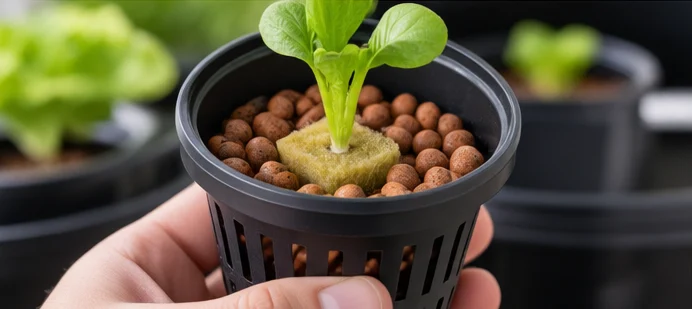

Setting the air gap is a hobby growers' practice, not a university figure: what matters is that the growing medium stays moist at first, and then that the plant's crown is not constantly sitting in water.
6. The right settings
| Parameter | Benchmark | Source |
|---|---|---|
| Dissolved oxygen | At least 4 mg/L (lettuce), more than 6 mg/L against Pythium, ideally 8 to 9 | Cornell (A. J. Both; N. Mattson) |
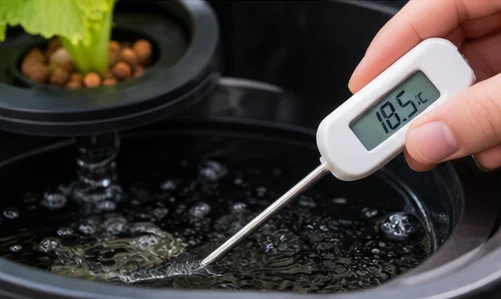
| Solution temperature | 20 to 24 °C (68 to 75 °F) against Pythium; below 20 °C (68 °F) for lettuce in a warm greenhouse; 18 to 27 °C (64 to 81 °F) tolerated for a small lettuce tub | Cornell (N. Mattson; A. J. Both); University of Florida |
| pH | 5.6 to 6.0 (lettuce, Cornell); 6.0 to 7.0 accepted by the University of Florida | Cornell; University of Florida |
| EC | 1.15 to 1.25 mS/cm (lettuce, Cornell); 1.2 to 1.8 mS/cm (University of Florida) | Cornell; University of Florida |
| Water depth | At least 13 cm (5 in) for a lettuce raft; about 30 cm (12 in) in Cornell's ponds | University of Florida; Cornell |
For other crops, EC and pH values are in the crop guides when a source publishes them.
The routine
- Every day: air pump running, even bubbles, water level, a quick look at the roots by lifting the edge of the lid.
- Twice a week: pH and EC, solution temperature. Top up with water if the EC rises, with solution if it drops.
- Every two to three weeks: full drain, rinse the bucket and the air stone (common hobby practice). For a small passive lettuce tub, the University of Florida keeps the same solution for two crops.
See also maintenance routines.
7. Summer, heat and Pythium
Pythium is a water-borne organism that rots roots. Cornell (N. Mattson) lists among the conditions that favor it excessive fertilization, low dissolved oxygen and extreme temperatures. In a DWC, the last two risks add up in summer: the water warms up and holds less oxygen.
- In the shade and on the ground: a bucket in full sun on a patio heats up fast. Place the reservoirs in the shade, on tiles rather than on a scorching slab.
- Insulate and reflect: a white tub, or one wrapped in reflective insulation, stays cooler than an exposed black tub.
- More volume: a big tub warms up more slowly than a small bucket.
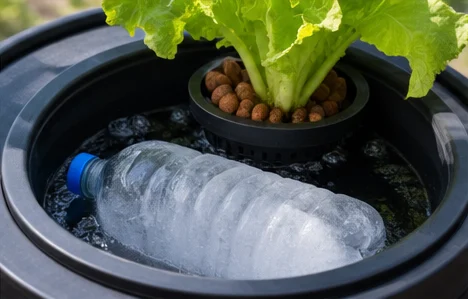
- Frozen water bottles: a clean, closed bottle placed in the reservoir lowers the temperature during heat waves. Swap it morning and evening.
- Chiller: for a large system, an aquarium chiller; Cornell uses one to keep its spinach ponds around 20 °C (68 °F) against Pythium.
- Hygiene: clean water, equipment disinfected between crops, no fungus gnats; according to Penn State, these are entry routes for Pythium.
| Roots | What it means | What to do |
|---|---|---|
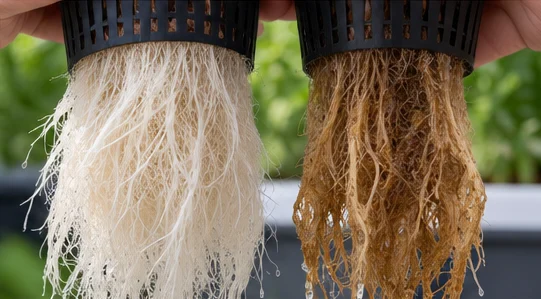
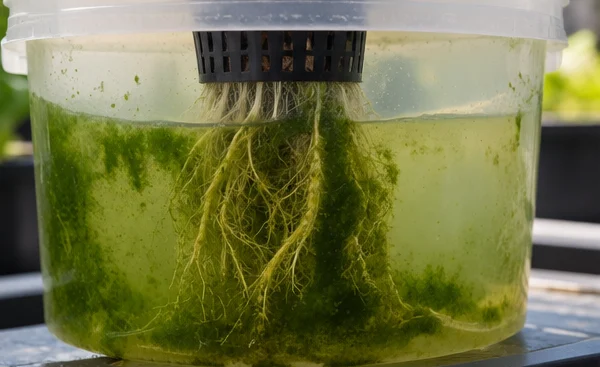
| White or cream, firm, odorless | All is well | Nothing |
| Slightly tinted, but firm | Often the color of the growing medium or nutrients | Watch, smell |
| Brown, mushy, slimy, swampy smell | Root rot, often Pythium | See diseases and pests: isolate, drain, disinfect, cool down |
8. Variants: RDWC, raft, top feed
- RDWC (recirculating DWC): several buckets connected by tubing to a shared reservoir, with a water pump circulating the solution. A single pH and a single EC to adjust for all the plants, handy for 4 to 8 tomato or pepper plants. See choosing a pump.
- Floating raft: a wide, shallow tub, with a drilled polystyrene insulation board floating on the solution. The University of Florida describes one measuring 1.2 × 2.4 m (4 × 8 ft), with 32 holes, which can produce two lettuce crops with the same solution.
- Top feed: a small pump waters the net pot during the first weeks, until the roots reach the water. Useful for seedlings transplanted young.
9. How much does it cost?
An air pump for one or two buckets usually draws 2 to 5 W. Using the formula power (kW) × 24 h × 30 days × price per kWh and about €0.45 per kWh in Wallonia, Belgium (Selectra, September 2026): a 3 W pump runs for about €1 per month. The biggest expense remains indoor lighting: see grow lights.
10. Common mistakes
| Mistake | Consequence | The fix |
|---|---|---|
| Translucent reservoir | Green algae, slimy roots | Opaque reservoir, closed lid, unused holes plugged |
| Pump on the floor, no check valve | Water flows back into the pump when it stops | Pump higher than the water, check valve |
| Air pump on a timer | Roots suffocate at night | Aeration 24 hours a day |
| Crown constantly sitting in water | Rot at the base of the plant | Lower the level once the roots have reached down |
| Warm solution in summer | Less oxygen, Pythium, brown roots | Shade, volume, insulation, frozen bottles |
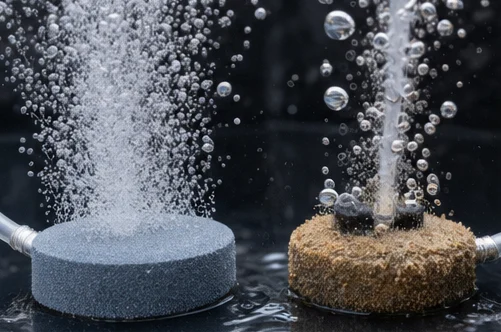
| Clogged air stone | Large irregular bubbles, less oxygen | Clean or replace at every drain |
| Never looking at the roots | Problem discovered too late | Lift the lid once a week |
To go further: start without a pump with the Kratky method, calculate your reservoir volume, and show off your bucket on the forum.
Frequently asked questions
What is the difference between DWC and the Kratky method?
In both, the roots bathe in a solution. In Kratky, nothing is aerated: the level drops and opens up an air zone that the roots use. In DWC, an air pump oxygenates the solution continuously, which allows bigger reservoirs, bigger plants and a stable water level.
Should the air pump stay on at night?
Yes, continuously, 24 hours a day. Roots breathe day and night, and night is when you forget to check. Putting the air pump on a timer is a false economy: it only uses a few watts.
What temperature should a DWC solution be?
Cool. Cornell (N. Mattson) aims for 20 to 24 °C (68 to 75 °F) to limit root rot; for lettuce in a warm greenhouse, A. J. Both (Cornell) kept the solution below 20 °C (68 °F). The University of Florida accepts 18 to 27 °C (64 to 81 °F) for a small lettuce tub. Above 25 °C (77 °F), keep a close eye on the roots.
How often should you change the solution in a DWC?
Top up every day or every other day with water or solution, based on the EC. For a small passive lettuce system, the University of Florida keeps the same solution for two crops. In hobby DWC, many growers drain every two to three weeks, or as soon as the EC and pH drift for no reason.
Can you grow tomatoes in DWC?
Yes, in a 15 to 20 L (4 to 5 gal) bucket per plant, with a sturdy stake and a generous air pump. Lettuce, herbs, Swiss chard and bok choy remain the easiest crops; root vegetables are not suitable.
- A. J. Both, Ten Years of Hydroponic Lettuce Research, Cornell University CEA, 2003
- Cornell University (N. Mattson, e-GRO), Pythium root rot on hydroponically grown basil and spinach
- University of Florida IFAS Extension, Growing Lettuce in Small Hydroponic Systems (HS1422)
- University of Florida IFAS Extension, Building a Floating Hydroponic Garden (HS943)
- FAO, Site selection for aquaculture: chemical features of water
- Penn State Extension, Pythium