Part II · Design
DWC, NFT, towers, aeroponics, growing media: what side-by-side trials show
Which hydroponic system grows best? Six university trials grew the same plant in several systems at once. Their results, why the winner changes with the crop, the nutrients and the criterion (yield, water, energy, space), and a calculator to compare the electricity use of your setup.
“What is the best system?” It is the question that comes up most often on forums, and everyone defends their own. To answer it honestly, you need trials where several systems grow the same plant, at the same time, in the same greenhouse. We gathered six of them, run by American and Brazilian universities. Their shared conclusion is surprising: the winner changes with the plant, the nutrients and what is being measured.
To discover each system, see choosing your system; for the details, DWC, NFT, ebb and flow, drip, wick systems and aeroponics.
1. Six trials, six winners

University of Georgia and Purdue, 2025
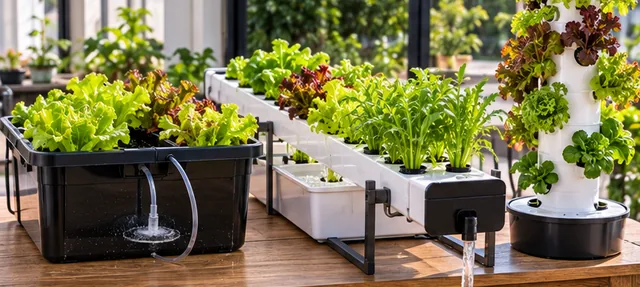
- Hutchinson, Rubio Ames, Nemali and Ferrarezi grew lettuce and arugula in a greenhouse in four systems: DWC, NFT, vertical tower and aeroponics.
- Lettuce: best in DWC and NFT; the tower yielded 30% less than DWC.
- Arugula: 48% more in NFT, towers and aeroponics than in DWC.
- The authors’ conclusion: arugula in aeroponics, lettuce in DWC or NFT.
University of Arkansas, 2020
- Doty, Dickson and Evans compared basil in DWC, in NFT and in shallow gravel ebb-and-flood.
- 102.6 g per plant in DWC, 90.4 g in ebb-and-flood, 75.8 g in NFT.
- In a second trial, plant size at transplanting mattered just as much: 72.8 g with the smallest plugs, 148.5 g with the largest.
Ohio State and USDA, 2024
- Chowdhury, Samarakoon and Altland grew lettuce with a liquid organic fertilizer in NFT, DWC, Dutch buckets and pots of growing medium.
- The media-based systems produced clearly bigger and heavier lettuce than NFT and DWC.
- The exact figures differ between the abstract and the results section of the paper; the trend, however, is clear.
Texas Tech, Brazil, Campinas
- Texas Tech: 211 g lettuce in aeroponics versus 67 g in hydroponics at week five, with twice as much water.
- Brazil (Oliveira et al., 2024): bok choy up to 398 g in semi-hydroponics on coco coir and sand, versus 278 g at best in NFT.
- Campinas (Ferrarezi and Testezlaf, 2016): lettuce on a wick system with coco coir heavier than in NFT.
2. The winner depends on the criterion
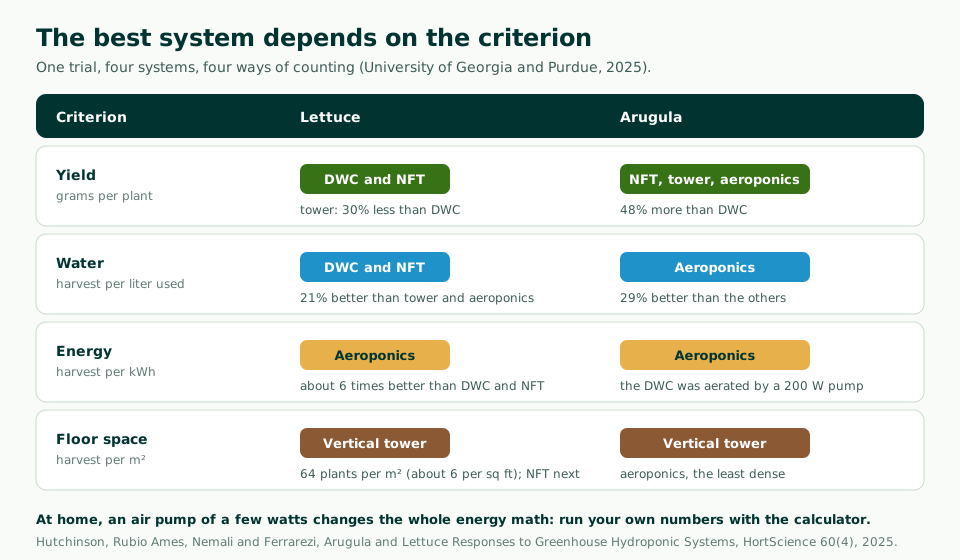
- Yield per plant: DWC and NFT for lettuce; NFT, towers and aeroponics for arugula.
- Water: for lettuce, DWC and NFT harvested 21% more per liter than the tower and aeroponics; for arugula, aeroponics did 29% better than the others.
- Energy: aeroponics, about six times more efficient than DWC and NFT. But the DWC in the trial was aerated by a 200 W air pump: at home, an air pump of a few watts changes the whole calculation.
- Space: the vertical tower, with 64 plants per square meter (about 6 per sq ft), won by a wide margin; NFT came next.
3. Calculator: the electricity use of my setup
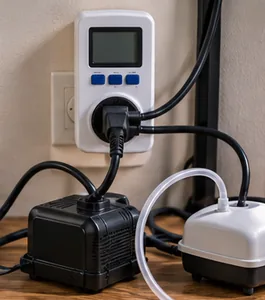
Enter the wattage of your air pump (which runs nonstop), your water pump and your light, with their running hours: the calculator gives the kWh and the cost per year, each device’s share, and the cost per plant and per crop.
Enter 0 for anything you don’t have: no air pump in NFT, no water pump in DWC, no light on a balcony. Default price per kWh: about $0.19 in the US (EIA, March 2026); adjust it to your bill.
4. The method: choosing your system in five questions
- Which plants? Lettuce and herbs: DWC, NFT, Kratky. Arugula and small greens: NFT, towers, aeroponics. Fruiting plants: drip on a growing medium (see Dutch buckets).
- Which nutrients? Mineral: any system. Organic: preferably a media-based system (see hydroponics and organic growing).
- How much space? A wall or a corner: a tower. A table: a DWC tub or an NFT bench.
- How much tolerance for breakdowns? Often away: Kratky or wick. Home every day: NFT or aeroponics are possible.
- What electricity budget? Run the numbers above: it is often the light, not the system, that drives the bill.
5. Tips
- Test two systems at home with the same plant, the same seedlings and the same solution: it is the only ranking that counts for your room.
- Big plants at transplanting: at the University of Arkansas, basil transplanted with a large plug yielded twice as much as basil transplanted with a small one.
- Record the weights at harvest in your grow log: you will quickly learn which system works for you.
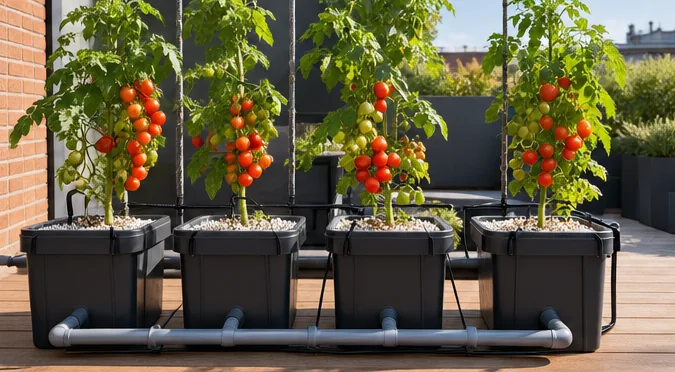
- Combine: a tower for salad greens, a Dutch bucket for tomatoes, a Kratky jar for basil.
6. Common mistakes
| Mistake | Why | The fix |
|---|---|---|
| Believing one system is the best everywhere | The winner changes with the plant | Choose based on your crops |
| Comparing on a single criterion | The most productive per plant is not the most productive per m² | Yield, water, energy, space |
| Organic fertilizer in NFT or DWC | Weaker growth than in a growing medium | A media-based system |
| Leaving the light out of the budget | It often uses more than the pumps | Calculator above |
| Transplanting tiny plants | Smaller harvest, whatever the system | Plants with a good plug |
7. Key takeaways
Have you compared two systems? Share your harvest weights on the forum.
Frequently asked questions
What is the most productive hydroponic system?
There is no single one. In the University of Georgia trial (2025), lettuce grew best in DWC and NFT, but arugula yielded 48% more in NFT, towers or aeroponics than in DWC. At the University of Arkansas, basil was heavier in DWC than in NFT. Choose first based on your plants, your space and your time.
Is NFT less productive than DWC?
For the University of Arkansas basil, yes: 75.8 g per plant in NFT versus 102.6 g in DWC. For the University of Georgia lettuce, no: DWC and NFT were tied. NFT does, however, need a pump that never stops, and it is less forgiving of a breakdown.
Which system for organic fertilizer?
Preferably a media-based system. At Ohio State (2024), with a liquid organic fertilizer, lettuce in buckets and pots of growing medium grew clearly better than in NFT or DWC: the growing medium hosts the microorganisms that release the nutrients. See our article on hydroponics and organic growing.
Does a vertical tower produce more?
Per square meter of floor space, yes: in the Georgia trial, the tower held 64 plants per square meter and had the best space efficiency. But per plant, lettuce yielded 30% less there than in DWC. A tower is a good choice when space is tight, not when you want the biggest heads of lettuce.
Which system uses the least electricity?
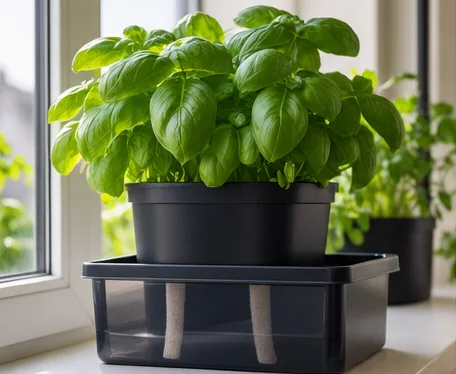
Passive systems (Kratky, wick) use none. Among active systems, it all depends on your pumps: in the Georgia trial, DWC was the most power-hungry because of a 200 W air pump, but at home an air pump of a few watts is enough. And the light is often the biggest consumer: run the numbers with the calculator in this article.
- G. K. Hutchinson, Z. Rubio Ames, K. Nemali and R. S. Ferrarezi, Arugula and Lettuce Responses to Greenhouse Hydroponic Systems: An Analysis of Yield and Resource Use Efficiencies, HortScience 60(4), 2025 (University of Georgia, Purdue)
- S. Doty, R. W. Dickson and M. Evans, Evaluation of a Novel Shallow Aggregate Ebb-and-flood Culture System and Transplant Size Effects on Hydroponic Basil Yield, HortTechnology 30(5), 2020 (University of Arkansas)
- M. Chowdhury, U. C. Samarakoon and J. E. Altland, Evaluation of hydroponic systems for organic lettuce production in controlled environment, Frontiers in Plant Science 15, 2024 (Ohio State, USDA)
- P. Newberry, C. Simpson and V. Baliga, Texas Tech University, comparison of lettuce in aeroponics and hydroponics (poster)
- F. A. de Oliveira et al., Production and quality of pak choi grown in different hydroponic systems and electrical conductivities, Revista Caatinga 37, 2024
- R. S. Ferrarezi and R. Testezlaf, Performance of wick irrigation system using self-compensating troughs with substrates for lettuce production, Journal of Plant Nutrition 39, 2016