Part II · Design
Wick systems: the simplest passive hydroponics, its limits and how to set one up right
A wick, a pot of growing medium, a reservoir: the solution rises on its own by capillary action, with no pump and no electricity. What the research says, the plants that thrive and the ones that are too thirsty, choosing the wick and the medium, the salt buildup trap, a step-by-step how-to and a reservoir autonomy calculator.
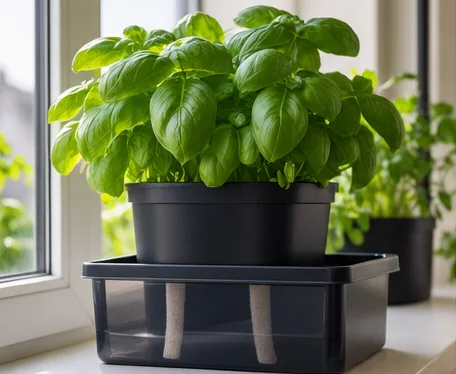
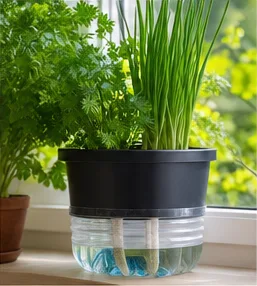
It is often the first hydroponic system people put together: a pot of growing medium sitting on a reservoir, a strip of fabric connecting the two, and the solution climbs up to the roots on its own. No pump, no noise, no electricity. But the wick has its limits: a modest flow and salts that build up. Here is how it works, what the research says about it, which plants it suits, and how to build one that actually works.
For the other passive systems, see the Kratky method; to compare all systems, see choosing your system.
1. The principle: capillary action

A wick is a porous material: water climbs up it on its own, like a sugar cube dipped in coffee. In a wick system, one or more strips connect the reservoir of nutrient solution to the growing medium in the pot. As the plant drinks and the medium dries, the wick draws up more. It is a form of subirrigation: the water comes in from the bottom, not from the top (Semananda et al., 2018).
- Passive: no pump, no timer, no air pump and air stone. Nothing breaks down while you are on vacation.
- Roots in a moist growing medium, not in water: they breathe the air held in the medium, which sets it apart from Kratky and DWC.
- Water-efficient: in a study cited by the 2018 review, wick irrigation of potted plants used on average 86% less water than overhead watering (Yeager and Henley, cited by Semananda et al.).

2. What the research says
What works
- At the University of Campinas (Brazil), lettuce grown on wicks in coco coir produced the best plants, ahead of pine bark and ahead of NFT. In NFT, leaf fresh weight was 58% lower (Ferrarezi and Testezlaf, 2016).
- At Isabela State University (Philippines), 5 mm cotton strips were enough to grow lettuce; a single wick per plant gave the best water efficiency (Felipe and Bareng, 2022).
- The University of Illinois tested it as a demonstration with rockwool, for lettuce, tomato and basil (Anderson, 2014).
The limits
- Flow: a wick only delivers a limited amount of water and nutrients. These systems mainly suit small pots and non-fruiting crops; the wick may not keep up with the transpiration of a large vegetable plant (Semananda et al., 2018).
- Salts: the water rises, evaporates and leaves through the leaves, while the salts stay in the top of the growing medium.
- Still solution: with no mixing, nutrients can settle at the bottom of the reservoir (Semananda et al., 2018).
3. Which plants?
| Crop | On a wick | Why |
|---|---|---|
| Lettuce, cut-and-come-again greens, arugula | Very good | Small size, short cycle, successful university trials |
| Herbs (basil, parsley, chives, mint, thyme) | Very good | Light-feeding potted plants, continuous harvest |
| Strawberries, dwarf peppers | Possible | Keep an eye on them in summer: a plant in fruit drinks a lot |
| Tomatoes, cucumbers, zucchini | Avoid | The wick cannot keep up with a full-grown plant’s thirst (Semananda et al., 2018) |
| Houseplants, seedlings | Very good | Wick irrigation trials mostly involve potted plants (Semananda et al., 2018) |


To pick your first herbs, see which herbs to choose; for salad greens, the lettuce guide.
4. The wick and the growing medium
The wick
- Cotton, nylon and polyester are the most commonly used materials; the rise varies a lot with the material, the width and the weave (Semananda et al., 2018).
- Choose a synthetic material that does not rot in water: felt, or acrylic or nylon cord or fabric. In a small Indonesian trial, acrylic flannel carried the solution better than polyester flannel (Rachman, 2025).
- The wider the wick, the more water it delivers; the longer it is, the less it delivers: keep the reservoir just below the pot.
- Wash a new wick before use, and replace it when it turns stiff or greenish.
The growing medium
- A fine medium that holds water and spreads it: coco coir, a coco and perlite mix, vermiculite. At Campinas, coco coir gave better results and half the salinity of pine bark.
- Clay pebbles alone are a poor fit: they are large and leave little contact between the wick and the roots.
- Rinse coco coir before use (see growing media).


5. Salts: the wick system’s trap
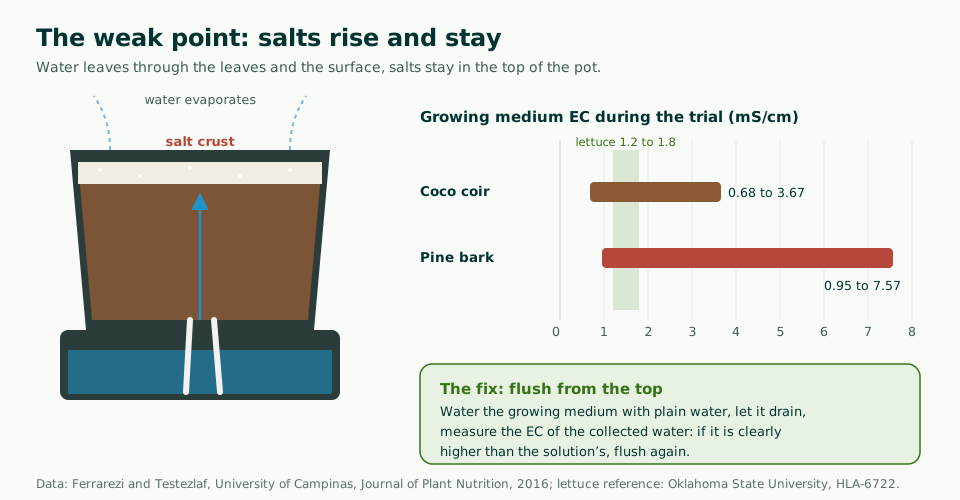
With bottom watering, the water that evaporates from the surface leaves its salts in the top of the growing medium: it is a known drawback of all subirrigation (Semananda et al., 2018). You can spot it by a white crust, leaf edges turning brown or growth slowing down for no apparent reason.
- Water from the top with plain water, slowly, over a sink or a basin, with the pot lifted off the reservoir.
- Collect the water that drains out of the bottom.
- Measure its EC: if it is clearly higher than your solution’s, flush again.
- Put the pot back on a reservoir filled with fresh solution.


6. Calculator: how long will my reservoir last?
Measure how much the reservoir level drops over a few days, enter its dimensions and the height of water left above the ends of the wicks: the calculator gives the daily consumption and the number of days before the wicks come out of the water.
For a round reservoir, enter the diameter as both length and width, then take off about one fifth of the result. Consumption goes up with heat and plant size: measure again in summer.
7. How-to: a wick system in one hour
Time: one hour. Level: beginner. Budget: a few euros if you reuse a tub and a pot.
- Choose the reservoir: an opaque tub, or a tub painted or wrapped in tape, that the pot can sit on securely (see reservoirs and tubs).
- Drill the bottom of the pot: two holes as wide as the wicks, plus a few small drainage holes.
- Test the wicks: dip one end in a glass of colored water for 24 hours and see how high the water climbs. Keep the material that wicks the highest.
- Thread the wicks through the holes, spreading them in a spiral in the bottom of the growing medium, and let 5 to 10 cm (2 to 4 in) hang below the pot so they reach the bottom of the reservoir.
- Fill the pot with rinsed coco coir, or a coco and perlite mix, moistened with the solution. Plant or transplant.
- Fill the reservoir with nutrient solution, EC at the low end of the crop’s range, pH checked, and set the pot on top. Write down the date in your grow log.


8. Common mistakes
| Mistake | Result | The fix |
|---|---|---|
| Putting a full-grown tomato on a wick | Wilting on hot days | Small plants, or a different system |
| Wick too long, reservoir too low | Growing medium dry on the surface | Reservoir just below the pot, short wick |
| Natural wick that breaks down | Odor, dropping flow | Synthetic wick, replaced when needed |
| Letting the level fall below the wicks | No more water for the roots, plant wilts | Top up before, autonomy calculator |
| Never flushing the growing medium | Salts on the surface, brown leaf edges | Flushing from the top and measuring EC |
| Clay pebbles alone | Not enough wick-to-root contact | Coco coir, perlite, vermiculite |
| Clear reservoir | Algae in the solution | Opaque or covered tub |
9. Key takeaways
Built a wick system? Show it off on the forum, with your wick material and your EC readings.
Frequently asked questions
What is the difference between a wick system and the Kratky method?
In Kratky, the roots hang directly in the solution, then in the air gap that opens up as the level drops. In a wick system, the roots stay in a moist growing medium above the reservoir: the wick carries the solution up to them. Both are passive, with no pump.
What material should I use for the wick?
A synthetic material that wicks water well and does not rot: a strip of synthetic felt, or acrylic or nylon cord or fabric. The review by Semananda and colleagues (2018) notes that the rise depends a lot on the material, the width and the weave: run a 24-hour test before planting.
Can I grow tomatoes in a wick system?
A dwarf plant or a young plant, yes, but a full-grown plant in midsummer drinks more than a wick can deliver. The 2018 review concludes that these systems mainly suit small pots and non-fruiting crops. For tomatoes, go with a drip bucket or a DWC.
How many wicks per pot?
There is no universal number: the amount of water delivered increases with the width of the wick. Start with two wicks for a pot of lettuce or herbs and watch the growing medium: if the surface dries out between checks, add a wick or shorten the distance to the reservoir.
Do I need to change the solution in the reservoir?
Yes. The solution stays still and salts build up in the growing medium. Top up the reservoir with solution, replace it completely at regular intervals and flush the growing medium with plain water from the top, measuring the EC of the water that drains out.
- S. Semananda, J. D. Ward and B. R. Myers, A Semi-Systematic Review of Capillary Irrigation: The Benefits, Limitations, and Opportunities, Horticulturae 4(3), 23, 2018
- R. S. Ferrarezi and R. Testezlaf, Performance of wick irrigation system using self-compensating troughs with substrates for lettuce production, Journal of Plant Nutrition 39, 2016
- F. N. Rachman, Daya Kapilaritas Berbagai Jenis Sumbu pada Sistem Wick, 2025
- A. J. B. Felipe and J. L. R. Bareng, Growth and yield assessment of lettuce: an economic feasibility and performance evaluation of capillary wick irrigation system, Plant Science Today 9(1), 2022
- C. Anderson, University of Illinois Extension, Home hydroponic systems, 2014
- H. Singh and B. Dunn, Oklahoma State University Extension, Electrical Conductivity and pH Guide for Hydroponics, HLA-6722, 2016