Part III · Water and nutrients
Hydroponic nutrients: understand, choose, dose and diagnose
The elements a plant needs and what they do, two reference recipes, A and B nutrients and why you never mix them undiluted, step-by-step mixing, doses by crop, solution maintenance, reading deficiencies, safe storage and the real cost.
In hydroponics, there is no soil to feed the plant: everything it eats is in the water you mix. The good news is that this is also what makes it grow so fast. Here is everything you need to know to choose a nutrient, dose it, maintain the solution and spot a deficiency at a glance.
1. What a plant needs
Carbon, hydrogen and oxygen come from the air and water. Everything else, the mineral nutrients, has to be in the solution. Penn State sorts them into two groups: macronutrients, needed in large amounts, and micronutrients, essential but in very small doses.
| Element | Group | Main role |
|---|---|---|
| Nitrogen (N) | Macro | Leaf and stem growth, proteins, chlorophyll |
| Phosphorus (P) | Macro | Plant energy, roots, flowering |
| Potassium (K) | Macro | Water management, fruit quality and flavor |
| Calcium (Ca) | Macro | Strong cell walls, new shoots, healthy fruit |
| Magnesium (Mg) | Macro | Core of the chlorophyll molecule |
| Sulfur (S) | Macro | Proteins, aromas (herbs, cabbages) |
| Iron (Fe) | Micro | Chlorophyll production: without it, young leaves turn yellow |
| Manganese, zinc, copper | Micro | Enzymes, photosynthesis, tip growth |
| Boron (B) | Micro | Bud growth, flowering, fruit set |
| Molybdenum (Mo) | Micro | Helps the plant use nitrogen |
Classification: Penn State. Chlorine and nickel are sometimes added to the list; they are needed in tiny amounts and are almost always present in water or nutrients (Montana State).
2. Two reference recipes
You do not need to weigh out chemical salts to succeed: a store-bought nutrient does the job very well. But knowing the reference recipes helps you understand what is in the bottle. Figures are in ppm, that is, milligrams per liter of solution.
| Element | Hoagland solution (1950) | Modified Sonneveld, for herbs |
|---|---|---|
| Nitrogen | 210 | 150 |
| Phosphorus | 31 | 31 |
| Potassium | 235 | 210 |
| Calcium | 160 to 200 | 90 |
| Magnesium | about 49 | 24 |
| Sulfur | 64 | n/a |
| Iron | 5 | 1 |
| Manganese | 0.5 | 0.25 |
| Zinc | 0.05 | 0.13 |
| Copper | 0.02 | 0.023 |
| Boron | 0.5 | 0.16 |
| Molybdenum | 0.011 | 0.024 |
Hoagland and Arnon, Circular 347 of the California Agricultural Experiment Station, 1950 (final solution values). Modified Sonneveld: Penn State. For lettuce, Penn State gives 100 to 150 ppm nitrogen with a complete nutrient.
3. Choosing your nutrient
| Type | Best for | Pros | Limits |
|---|---|---|---|
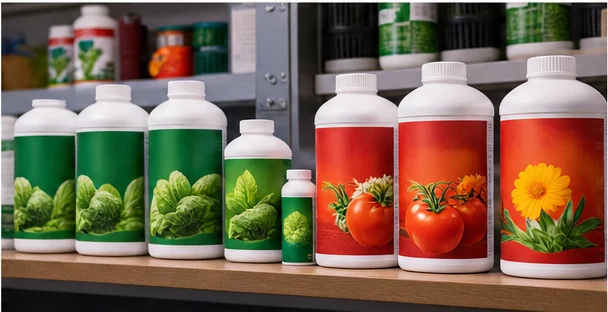
| Two-part liquid (A and B) | Everyone | Complete, easy to dose by syringe, stable over time | Two bottles you must never mix undiluted |
| Three-part liquid | Long crops (tomatoes, peppers) | You adjust growth and bloom by changing the ratios | More settings, more room for error |
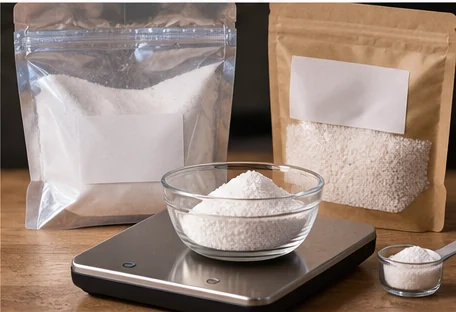
| Soluble powder + calcium nitrate | Large volumes, small budgets | Cheap per liter of solution | Two products to dissolve separately; Penn State gives an example with calcium nitrate in one stock tank, the complete fertilizer and magnesium sulfate in the other |
| “One-part” nutrient for Kratky and kits | Jar, small system with no pump | A single product, very simple | Less flexible, best kept for small crops |
| Liquid organic fertilizers | The curious, systems with a growing medium | Natural origin | Lower yields, biofilm, nitrites in systems without a growing medium (2024 study) |
- “Grow” or “bloom”: product lines often offer a version richer in nitrogen for leaves and one richer in potassium for fruit. Salad greens and herbs: grow formula all the way. Tomatoes, peppers, beans, strawberries: switch to the bloom formula at the first flowers.
- No garden fertilizer: granules and vegetable garden fertilizers are not designed to dissolve completely or to work in a recirculating solution.
- Read the label: the three N-P-K numbers give nitrogen, phosphorus (expressed as P₂O₅) and potassium (expressed as K₂O), as percentages. Also check that calcium, magnesium and micronutrients are listed.
4. A and B: why two bottles
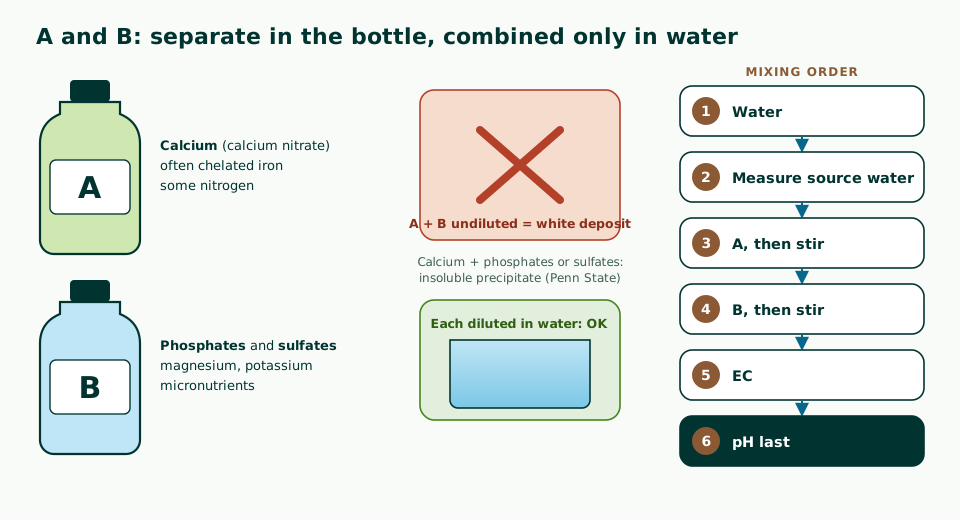
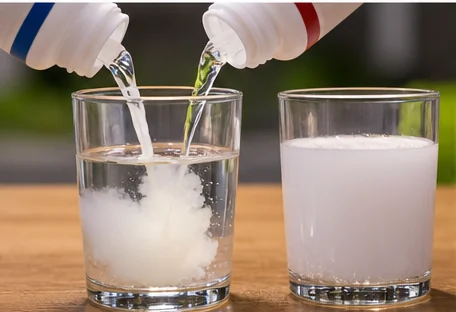
Penn State is clear: calcium must be in a different stock tank from phosphates and sulfates. Concentrated together, they form insoluble compounds that settle out, clog the tubing and deprive the plant of these nutrients. Diluted in the large volume of the reservoir, one after the other, they stay in solution.
5. Mixing the solution step by step
Mixing a nutrient solution
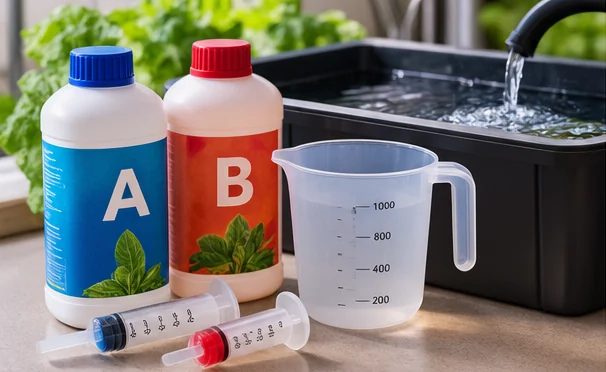
- Fill the reservoirWrite down the exact volume: every dose depends on it. Tap water left to stand, filtered rainwater or reverse osmosis water (see rainwater).
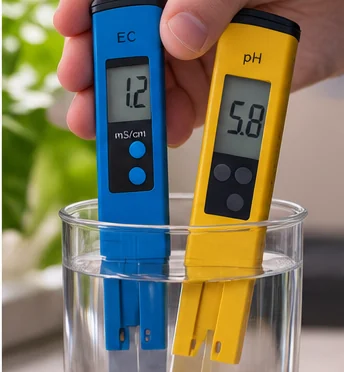
- Measure the source waterEC and pH before adding anything. Hard water already has an EC and pushes the pH up; rainwater or reverse osmosis water has almost no calcium or magnesium.
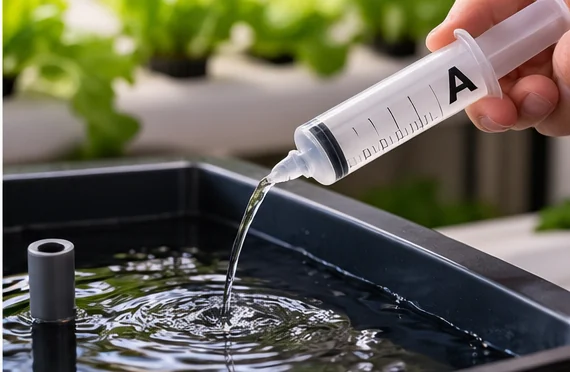
- Add part AThe manufacturer’s dose for the reservoir volume, by syringe. Stir or let the pump run for a few minutes.
- Add part BSame dose, with its own syringe. Stir again.
- Measure and adjust the ECAim for the crop’s range (table below). Too high: add water. Too low: a little A, then B, in equal parts.
- Correct the pH lastNutrients change the pH: adjust it once the dose is right, in small amounts of pH Down or pH Up, measuring between each addition.
- Take notesDate, volume, doses, EC, pH, temperature: your logbook becomes your best reference. Details in pH and EC: the two numbers to track.
6. How much to use?
You set the dose by EC, the conductivity of the solution, in mS/cm. Here are the ranges published by Oklahoma State for a few popular crops; each crop guide gives its own.
| Crop | EC (mS/cm) | pH |
|---|---|---|
| Lettuce | 1.2 to 1.8 | 6.0 to 7.0 |
| Basil | 1.0 to 1.6 | 5.5 to 6.0 |
| Parsley | 1.8 to 2.2 | 6.0 to 6.5 |
| Spinach | 1.8 to 2.3 | 6.0 to 7.0 |
| Strawberry | 1.8 to 2.2 | 6.0 |
| Cucumber | 1.7 to 2.0 | 5.0 to 5.5 |
| Tomato, bean | 2.0 to 4.0 | 6.0 to 6.5 |
- Lower for young plants: start below the range, then raise it gradually as they grow.
- ppm or EC? Some meters display ppm calculated from EC, using a conversion factor that varies by brand. Always compare EC values, or check your meter’s scale before following advice given in ppm.
- Heat: when it is hot, the plant drinks a lot; a slightly more diluted solution keeps the roots from burning.
7. Maintaining the solution
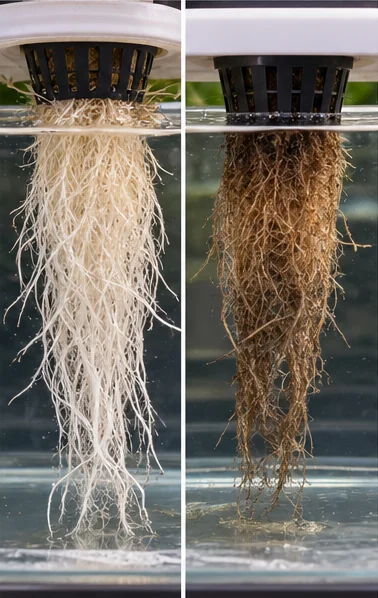
The best indicator of solution health is the roots. Lift a net pot every week:
- White or cream, firm: the solution is good, carry on.
- Brown, slimy or smelly: the solution is too warm, not oxygenated enough or too old. Mix a fresh solution, clean the reservoir, check the temperature and aeration.
- Short and sparse: the solution is often too concentrated; bring it back into the crop’s EC range.
| When | What |
|---|---|
| Every day | Measure pH and EC at the same time of day, check the level (Oklahoma State). |
| When the level drops | Top off: with plain water if the EC has risen (the plant drinks more than it eats), with nutrient solution at the normal dose if the EC has dropped. |
| About every two weeks | Empty and mix a fresh solution (Oklahoma State): nutrients are not taken up at the same rate and the balance drifts. |
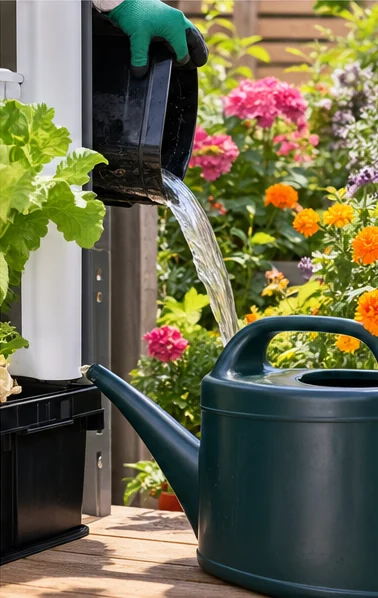
| At all times | Solution around 22 to 24 °C (72 to 75 °F), opaque and covered reservoir. The old solution is great for watering garden plants or houseplants. |
8. Spotting a deficiency
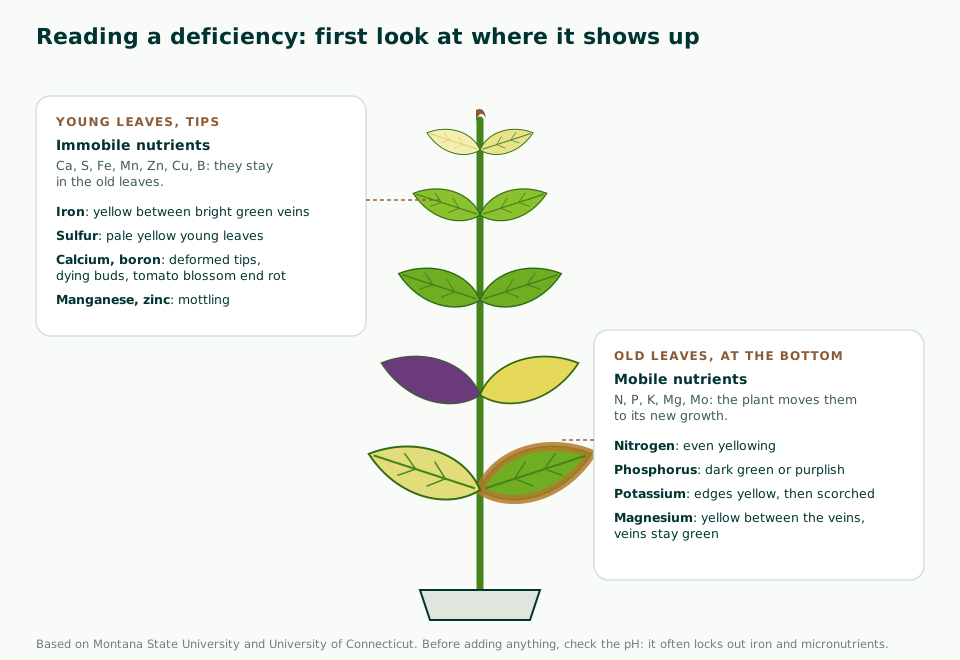
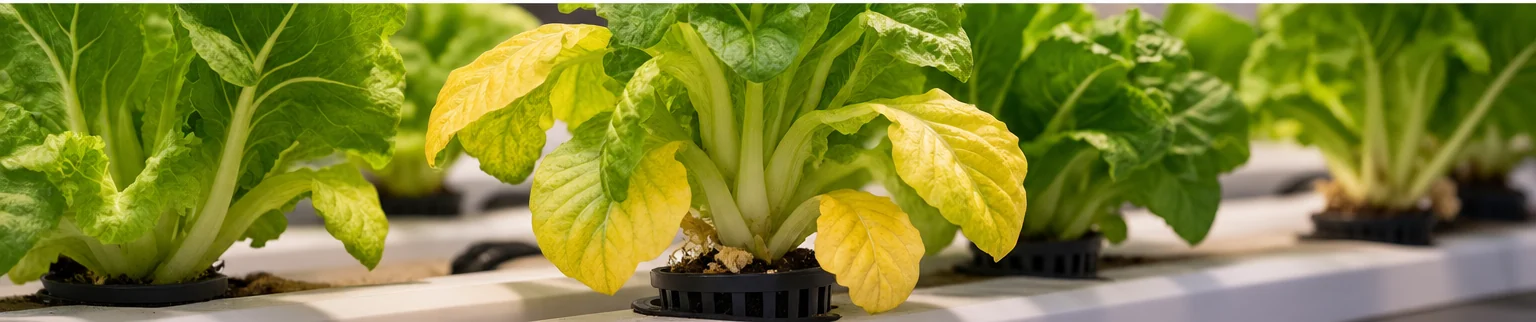
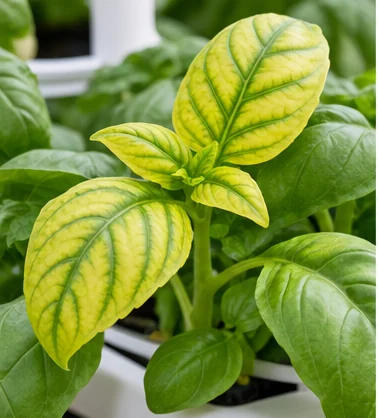
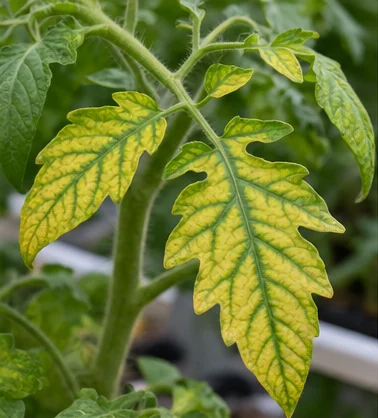
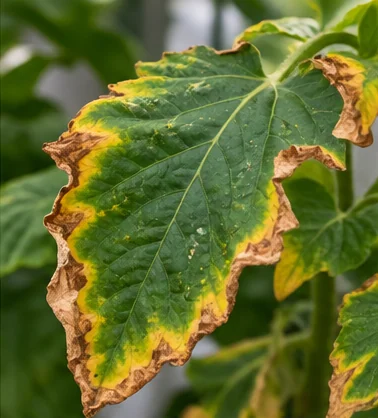
Some nutrients are mobile: when they run short, the plant pulls them from its old leaves to feed the young ones. Others are immobile and stay where they were laid down. Hence the rule: symptoms at the bottom, mobile nutrient; symptoms at the top, immobile nutrient (Montana State, University of Connecticut).
| Element | Where | What you see |
|---|---|---|
| Nitrogen | Old leaves | Fairly even yellowing, slow growth |
| Phosphorus | Old leaves | Stunted plant, dark green or purplish leaves |
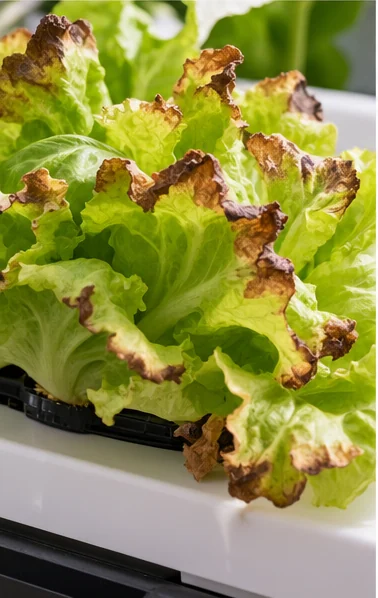
| Potassium | Old leaves | Edges turn yellow then scorched, midrib still green |
| Magnesium | Old leaves | Yellow between the veins, veins stay green |
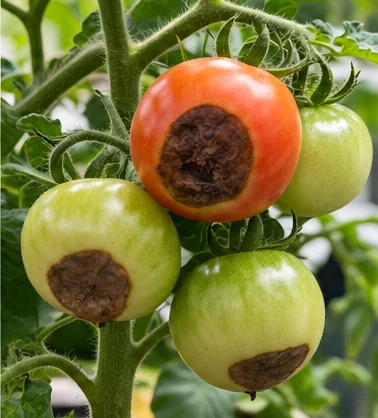
| Calcium | Young leaves, fruit | Hooked or burned tips, dying buds, blossom end rot on tomatoes and peppers |
| Sulfur | Young leaves | Yellow young leaves, thin stems |
| Iron | Young leaves | Yellow between the veins, sharp contrast with bright green veins |
| Manganese | Young leaves | Yellow mottling, no sharp edge along the veins |
| Zinc | Middle leaves | Yellow between the veins, sharp contrast |
| Boron | Tips | Thick, deformed young leaves, growing point dies |
9. Safe storage and handling
- Bottles closed, away from light and frost, in their original packaging with the label.
- Out of reach of children and pets, never in a food or drink bottle.
- Gloves and goggles for pH Down: it is an acid. Always add acid to water, never the other way around.
- One syringe per product, rinsed after use.
- Leftover solution: on garden plants, not in a ditch or a pond.

10. How much does it cost?
The math is simple: dose in ml per liter × reservoir volume × price per ml, for each part. A theoretical example: with a dose of 2 ml per liter of each part and a concentrate at €20 per liter (2 cents per ml), a 20 L (5 gal) reservoir takes 40 ml of A and 40 ml of B, or about €1.60 per batch of solution. Renew it every two weeks, plus top-offs. Plug in the dose and price of your own product: they vary a lot from brand to brand.
11. Common mistakes
| Mistake | Consequence | The fix |
|---|---|---|
| A and B mixed undiluted | White deposit, clogged tubing, deficiencies | Dilute each part in the reservoir, one after the other |
| pH adjusted before EC | pH to redo, wasted acid | EC first, pH last |
| “A little extra can’t hurt” | Burned leaf edges, damaged roots | Stay within the crop’s EC range |
| Always topping off with solution | EC creeping up day after day | Top off with plain water when the EC rises |
| Never emptying the reservoir | Unbalanced solution, mysterious deficiencies | Replace about every two weeks |
| Garden or organic fertilizer in a recirculating system | Deposits, biofilm, odors, poor growth | Complete mineral nutrient made for hydroponics |
| Treating a deficiency without measuring the pH | The problem comes back | pH and EC first, then the deficiency table |
To go further: making your own A and B nutrient, pH and EC, nitrogen and legumes, and your questions in the pH, EC and nutrients forum.
Frequently asked questions
What nutrients should I use in hydroponics?
A complete nutrient formulated for hydroponics, containing the macronutrients and micronutrients in fully soluble form. The easiest way to start is a two-part liquid nutrient, A and B, dosed to the target EC for the crop. Granular garden fertilizers and organic fertilizers are not designed for a solution that recirculates.
Why are hydroponic nutrients sold in two bottles?
Because calcium forms an insoluble deposit with phosphates and sulfates when they are concentrated. Penn State recommends keeping calcium in a separate stock tank from phosphates and sulfates. Diluted in the reservoir water, they get along fine: pour A, stir, then B.
Can I use organic fertilizer in hydroponics?
It is possible but tricky. A study published in 2024 in Frontiers in Plant Science got much smaller lettuce than with mineral nutrients, found high nitrite levels in NFT and deep water systems, and concluded that systems with a growing medium are better suited. When starting out, stick with a complete mineral nutrient.
How often should I change the nutrient solution?
Oklahoma State recommends a complete change about every two weeks, with daily pH and EC checks. Between changes, top off the reservoir: with plain water if the EC rises, with nutrient solution if it drops.
- Penn State Extension, Hydroponics Systems: Nutrient Solution Programs and Recipes
- Hoagland and Arnon, The Water-Culture Method for Growing Plants without Soil, California Agricultural Experiment Station, Circular 347, 1950
- Oklahoma State University Extension, Electrical Conductivity and pH Guide for Hydroponics (HLA-6722)
- Montana State University Extension, Nutrient Deficiencies
- University of Connecticut Extension, Watch Out for These Nutrient Deficiency Symptoms
- Evaluation of hydroponic systems for organic lettuce production in controlled environment, Frontiers in Plant Science, 2024