Part III · Water and nutrients
Tap water for hydroponics in Belgium and France: hardness, limescale, chlorine, should you filter?
Hard in Veurne, softer in Koksijde, highly variable in France: tap water changes everything in hydroponics. Where to find the hardness and alkalinity of your water in Belgium and France, university benchmarks, when to acidify, blending with rainwater or reverse osmosis water, why to avoid softened water, and a blending calculator.
Two gardeners follow the same nutrient recipe, one in Koksijde, the other in Alveringem, a few miles apart: one has a stable pH, the other sees the pH climb every day. The difference comes from the tap. In Belgium as in France, water changes from one town to the next, and in hydroponics, it is part of the recipe. Here is where to find your water’s numbers, how to read them, the university benchmarks, and what to do if your water is too hard.
To go further: pH and EC, nutrients, rainwater.
1. Why tap water matters
- It already has an EC: calcium, magnesium and the other dissolved salts count toward conductivity. Hard water “fills up” part of the target EC before you even add nutrients.
- It pushes the pH up: bicarbonates neutralize acidity. The higher the alkalinity, the more acid you need, and the more the pH climbs between two corrections (University of Massachusetts).
- It can contain too much of some elements: sodium, chloride or boron to keep an eye on (NC State).
- It is disinfected: residual chlorine protects the network; part of it evaporates in open air.
2. Finding your water’s numbers
In Belgium
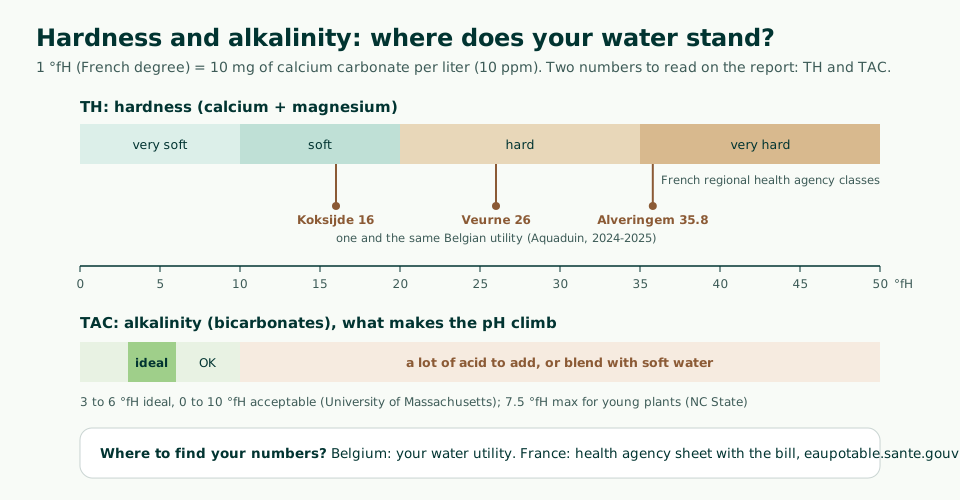
- Ask your water utility for the analysis: Vivaqua in Brussels; SWDE, CILE or inBW in Wallonia; De Watergroep, Farys, Water-link or Aquaduin in Flanders. Most publish results by town or by zone.
- The differences are large: at Aquaduin, from 16 °fH in Koksijde and Nieuwpoort to 35.8 °fH in Alveringem (2024-2025).
- In Brussels, the water comes mainly from groundwater, supplemented by the Meuse river; calcium there ranged from 69 to 132 mg/L depending on the reservoir (Bruxelles Environnement, 2019 data).
In France
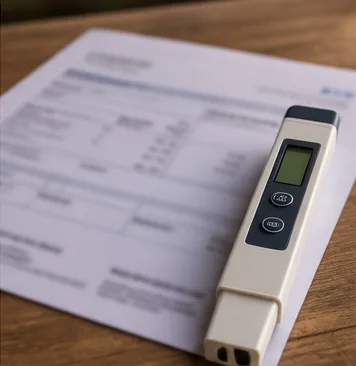
- Every year, the water bill comes with a summary from the ARS (Regional Health Agency) on the quality of the water in your distribution unit.
- The results of the health monitoring are online, town by town, at eaupotable.sante.gouv.fr.
- ARS classes: less than 10 °fH very soft, 10 to 20 soft, 20 to 35 hard, 35 and above very hard.
3. The university benchmarks
| Parameter | Benchmark | Source |
|---|---|---|
| Alkalinity (TAC) | 3 to 6 °fH ideal (30 to 60 mg/L CaCO₃), 0 to 10 °fH acceptable | University of Massachusetts |
| Alkalinity for young plants | 7.5 °fH max (1.5 meq/L) | NC State |
| Water pH | 5.8 ideal, 5.4 to 7.0 acceptable | NC State |
| Raw water EC | 0.75 mS/cm max for seedlings, 2.0 for production | NC State |
| Sodium / chloride / boron | 50 / 70 / 0.5 mg/L max | NC State |
Irrigation benchmarks for soilless greenhouse growing (NC State, 1994; University of Massachusetts). Drinking water can exceed them with no health risk at all: these are benchmarks for plants, not for drinking.
4. What to do depending on your water
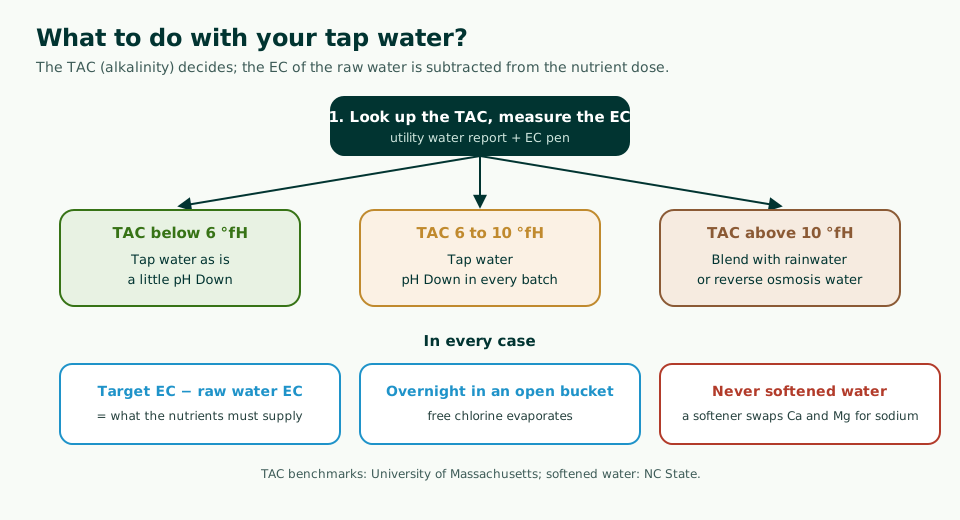
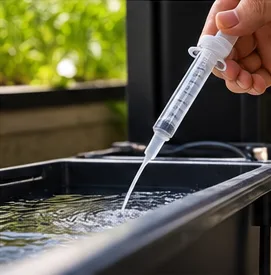
- Acidify: a pH Down made for hydroponics, added drop by drop after the nutrients (see pH and EC). The University of Massachusetts notes that acidifying is only really necessary if the pH and the alkalinity are high.
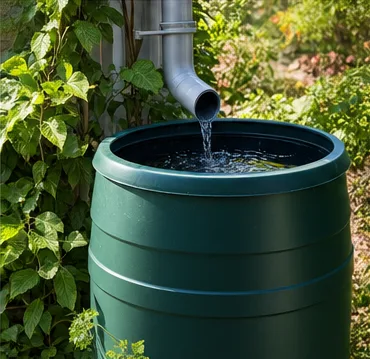
- Blend with rainwater: almost free of limescale, it dilutes the alkalinity (see rainwater and the water balance and the tank).
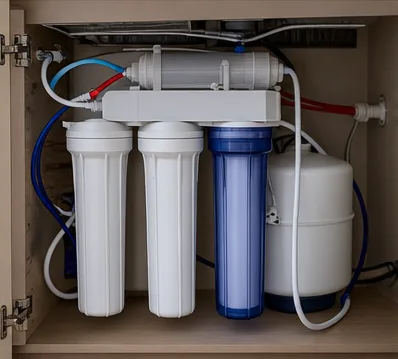
- Blend with reverse osmosis water: a home RO unit produces water with almost no salts. Used pure, it no longer contains calcium or magnesium: choose a fertilizer that supplies them, or keep a share of tap water.
- No softener: ion exchange replaces calcium and magnesium with sodium, which is bad for plants (NC State). Aquaduin itself only recommends softening for hot water. Draw water from an unsoftened tap.
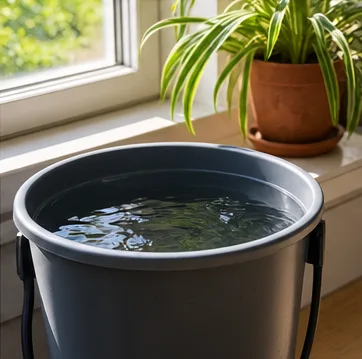
- Chlorine: a night in an open bucket, out of the light, lets the free chlorine evaporate and brings the water to temperature.


5. Calculator: my water and my blend
Enter your water’s TAC (from the analysis or a test), its measured EC, the target EC and the reservoir volume. The calculator compares them with the benchmarks and gives the blend with soft water (rain or reverse osmosis).
Benchmarks: TAC 3 to 6 °fH ideal, up to 10 °fH acceptable (University of Massachusetts). The calculation assumes soft water with no alkalinity or salts (rain or reverse osmosis): measure the EC of the blend to confirm.
6. Tutorial: analyze your water in fifteen minutes
- Get the analysis: the utility’s website in Belgium, the ARS summary sent with the bill or eaupotable.sante.gouv.fr in France. Note the TH, TAC, sodium, chloride.
- Fill a bucket at the kitchen tap (not at a softened-water tap) and let it stand overnight, uncovered.
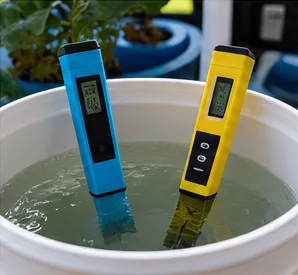
- Measure EC and pH with calibrated pens (see the testers).
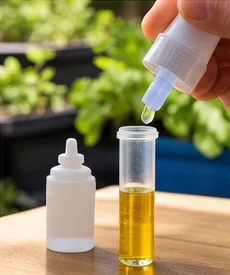
- Test the TAC if it is missing from the analysis, with an aquarium alkalinity test kit.
- Run the calculator and decide: tap water alone, pH Down, or a blend.
- Write it all down in the grow log, with the date: mains water can change with the seasons and the utility’s sources.
7. Common mistakes
| Mistake | Consequence | The fix |
|---|---|---|
| Following the nutrient dose without measuring the raw water | EC too high with hard water | Target EC minus water EC |
| Looking at TH and ignoring TAC | pH that climbs for no apparent reason | Look up or test the TAC |
| Using softener water | Sodium, deficiencies | Unsoftened tap, rain or RO water |
| Adjusting pH before adding nutrients | pH that shifts again | Nutrients first, pH second |
| Pure RO water with a calcium-free fertilizer | Calcium and magnesium deficiencies | Complete fertilizer, or a share of tap water |
| Assuming water is the same everywhere | A forum recipe that does not work at your place | Your own measurements |
| Cold water poured straight in | Shocked roots | One night at room temperature |
8. Key takeaways
Share your town’s TAC and EC on the forum: a shared map of the waters of Belgium and northern France will help everyone.
Frequently asked questions
Can you use tap water for hydroponics?
Yes, in most Belgian and French towns, as long as you know its alkalinity (TAC) and its EC. Up to 10 °fH of TAC, the water works with a little pH Down (University of Massachusetts). Above that, the pH climbs constantly: blend it with rainwater or reverse osmosis water. Also subtract the EC of the raw water from the target EC.
How do I find out the hardness of my water in Belgium?
On the website or from the customer service of your water utility (Vivaqua in Brussels, SWDE, CILE or inBW in Wallonia, De Watergroep, Farys, Water-link or Aquaduin in Flanders), which publish analyses by town or by zone. The differences are large: at Aquaduin, from 16 °fH in Koksijde to 35.8 °fH in Alveringem.
How do I find out the hardness of my water in France?
Every year, the water bill comes with a summary from the Regional Health Agency (ARS) on the quality of the water supplied. The results of the health monitoring can also be viewed town by town on eaupotable.sante.gouv.fr. The ARS classify water from very soft (less than 10 °fH) to very hard (35 °fH and above).
Should you let tap water stand before using it?
It is a good habit: a night in an open bucket lets the free chlorine evaporate and brings the water to room temperature. It changes neither the hardness nor the alkalinity.
Is softened water suitable for hydroponics?
No. An ion-exchange softener replaces calcium and magnesium with sodium; at high concentrations, sodium hinders the roots’ uptake of the other elements (NC State). Draw water from an unsoftened tap, or use rainwater or reverse osmosis water.
- D. Cox, University of Massachusetts Amherst, Water Quality: pH and Alkalinity
- P. V. Nelson and D. A. Bailey, NC State University, Water quality guidelines, N.C. Flower Growers’ Bulletin, 1994
- B. B. Messier, NC State University, Softened Water May Ruin Your Crop
- Aquaduin, Hardheid van het water, 2024-2025
- Bruxelles Environnement, L’eau à Bruxelles, Vivaqua data, 2020
- ARS Île-de-France, L’information sur la qualité de l’eau du robinet
- French Ministry of Health, eaupotable.sante.gouv.fr