Part III · Water and nutrients
Spent nutrient solution: when to change it, how to make it last, what to do with the drained water
Do you really need to empty your reservoir every two weeks? What trials at the University of Florida and São Carlos show, how to read EC drift, top up with water or with solution, drain part of the reservoir, and where to put the drained water without polluting. With a top-up and partial drain calculator.
“Drain and refill every two weeks”: that is the rule you read everywhere, and there are good reasons for it. But draining also throws away water and fertilizer that are still usable. University trials show that you can often make a solution last longer, provided you know how to read its EC and recognize the real warning signs. Here is when to top up, when to drain part of the reservoir, when to change everything, and what to do with the water that comes out of the reservoir.
For the basics, see pH and EC and nutrients.
1. What changes in a reservoir day after day
- The level drops: plants drink, the surface evaporates.
- EC drifts: it rises if water leaves faster than salts, it drops if plants take up more salts than water.
- The balance shifts: plants do not take up every element at the same rate. Elements they use little of, and those brought in by hard water, build up. EC cannot see this difference: it measures the total amount of salts, not which ones.
- pH drifts, and the solution can pick up root debris and microorganisms.
For all these reasons, Oklahoma State and University of Illinois Extension recommend a full solution change about every two weeks. It is simple and safe. But it is not the only method.
2. What the trials say
University of Florida, basil
- Solis-Toapanta, Fisher and Gómez (2020) grew basil for eight weeks in 7.6 L (2 gal) DWC tubs, in a greenhouse and indoors. Half of the tubs got a full solution change every two weeks; the other half never did, but received the same nutrient dose.
- Result: no difference in harvest, either in the greenhouse or indoors.
- But indoors, where plants drink little, the EC of the never-changed solution climbed as high as 5.5 mS/cm. The authors then recommend reducing the fertilizer, and point out that EC mostly reflects the buildup of ions the plants use little of.
Federal University of São Carlos, lettuce
- Macedo and colleagues (2022) compared, in NFT, a renewed solution and a reused solution, topped up only with what the lettuces had taken up according to analysis.
- Same harvest: 27.58 kg versus 27.51 kg.
- With 512 L (135 gal) of water instead of 1,400 L (370 gal), and 142 g of nitrogen instead of 240, 49 g of phosphorus instead of 216, 191 g of potassium instead of 315.
3. Top up, adjust or drain
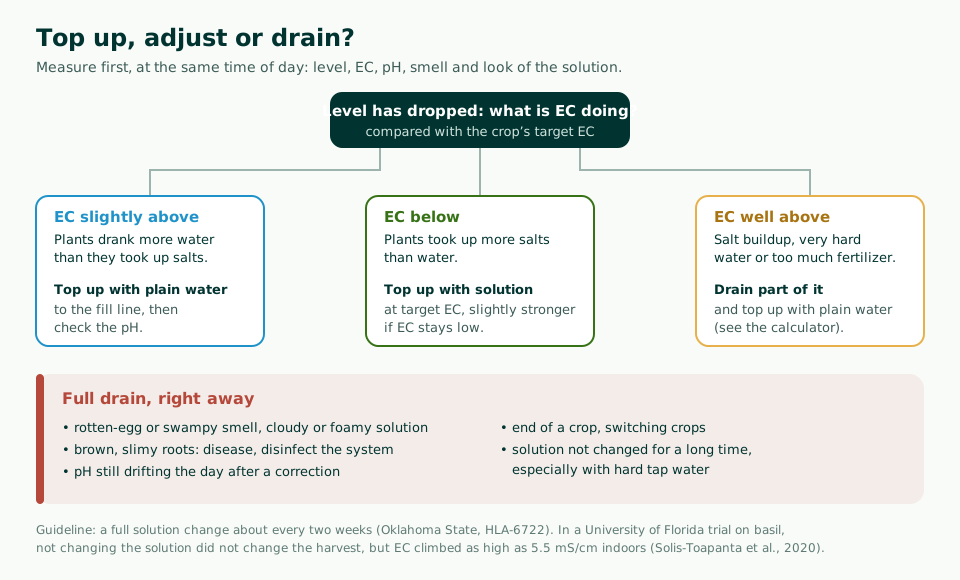
Always measure at the same time of day, after stirring the reservoir. Compare the EC with the range for your crop (see the crop guide), then:
- EC slightly above: top up with plain water to the fill line, then check the pH.
- EC below: top up with solution at the target EC, or slightly stronger. The nutrient calculator gives the doses.
- EC well above: drain part of the reservoir, then top up with plain water. The calculator below tells you how much to remove.
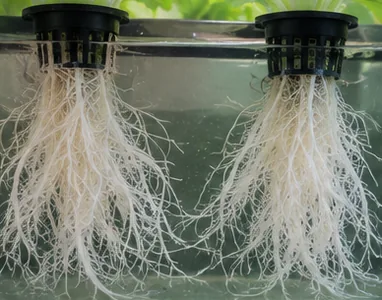
- Full drain right away if the solution smells bad, turns cloudy or foams, if the roots turn brown (see diseases and pests), if the pH is still drifting the day after a correction, and at the end of a crop.


4. Calculator: top up or drain part of the reservoir
Enter the volume of the reservoir when full, how much it holds now, the measured EC, the EC of your water and the target EC: the calculator tells you whether to top up with water, top up with solution, or how much to drain before topping up. Volumes are in liters (1 gal = 3.785 L).
The calculation assumes that EC values mix in proportion to volumes, which is a good approximation at these concentrations. Always check the EC after topping up.

5. What to do with the drained water
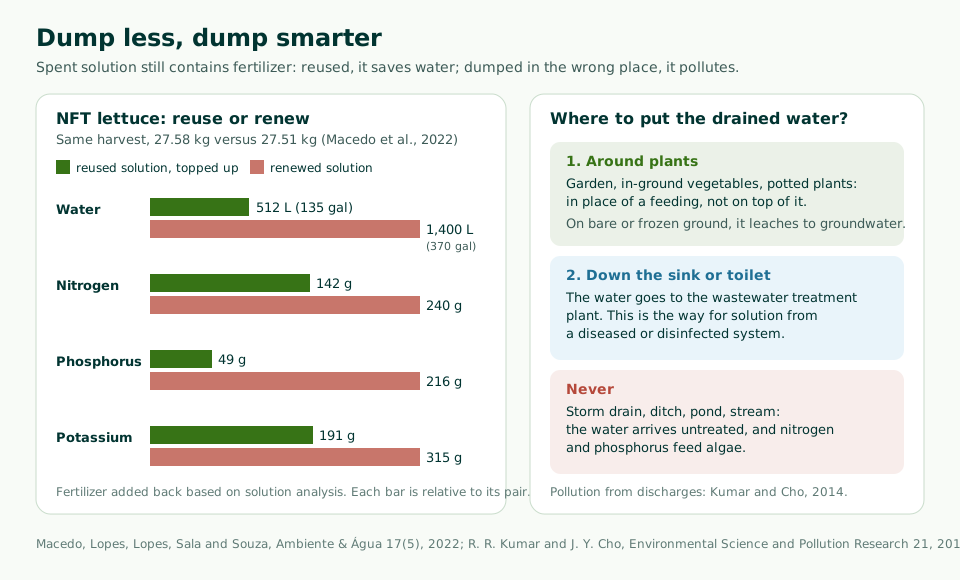
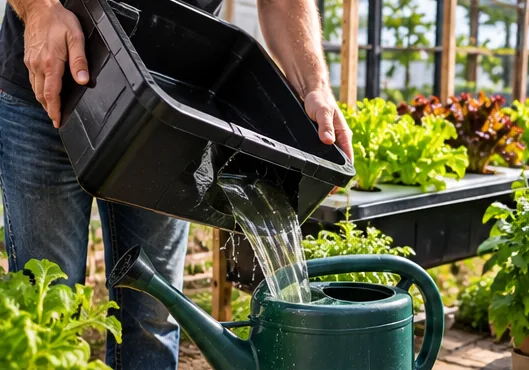
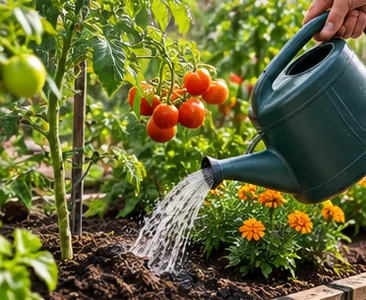
- Around plants: in-ground vegetable garden, flower beds, potted plants. In a Korean trial, spent solution (EC 2.4) replaced half of the nitrogen fertilizer for radishes: growth was best with at least 50% spent solution, and soil chemistry did not change (Hong et al., 2022). Count it as fertilizer: in place of a feeding, not on top of it.
- Not on bare, frozen or waterlogged ground: whatever the plants do not take up leaves with the water toward the groundwater.
- Down the sink or toilet (to the wastewater treatment plant) if you have no plants to water, and always for solution from a diseased system or one that has just been disinfected (see cleaning and disinfecting).
- Never into a storm drain, a ditch or a stream: the water arrives there untreated. A 2014 review points out that discharges of spent solution can pollute surface water and groundwater (Kumar and Cho).

6. The method: making a solution last safely

- Write down the starting EC and pH in your grow log, along with the reservoir volume.
- Measure every two or three days, at the same time of day: level, EC, pH, smell, root appearance.
- Top up according to EC: with water if it rises, with solution if it drops.
- Drain part of the reservoir when EC stays clearly above target despite water top-ups.
- Change everything at the slightest warning sign, between two crops, and regularly if your water is hard.
- Water the garden with what comes out of the reservoir, in place of a fertilizer.
7. Tips
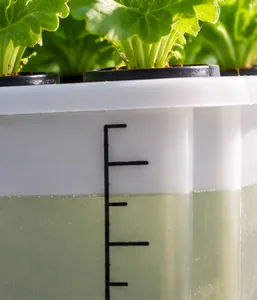
- A fill line drawn with a marker on the reservoir, and a mark every 5 L (1.3 gal): you know at a glance how much to top up.
- A dedicated watering can for draining: the solution goes straight to the garden plants.
- Indoors, where plants drink little, start with an EC at the low end of the range: it will rise on its own.
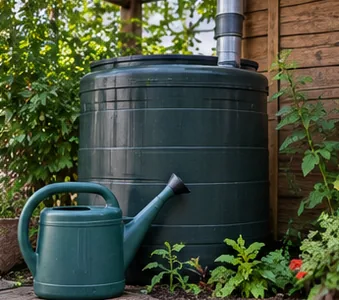
- Rainwater for topping up: it adds almost no salts, so EC drifts more slowly.
- Kratky works differently: the level has to drop to leave air for the roots, so you do not refill the jar to the line like a reservoir (see the Kratky method).
8. Common mistakes
| Mistake | Consequence | The fix |
|---|---|---|
| Always topping up with solution | EC climbs week after week | Top up with water when EC rises |
| Always topping up with water | Solution gets weaker and weaker | Solution when EC drops |
| Relying on EC alone for months | Invisible imbalance, useless salts build up | Regular full solution change |
| Keeping a solution that smells bad | Root disease | Drain, clean, disinfect |
| Emptying the reservoir into the storm drain | Fertilizer flows untreated into streams | Garden, potted plants, or sink |
| Watering the garden on top of the usual fertilizer | Too much nitrogen, losses to groundwater | The solution replaces a feeding |
9. Key takeaways
Making your solution last longer? Share your EC readings on the forum.
Frequently asked questions
Should I change the nutrient solution every two weeks?
It is the most common guideline (Oklahoma State, Illinois Extension) and it remains a safe choice for beginners. But a University of Florida trial on basil showed no difference in harvest between a full solution change every two weeks and a solution never changed, simply topped up with the same nutrient dose. The condition: watch the EC, which can climb indoors, and drain as soon as the solution smells, turns cloudy or the roots turn brown.
Why is the EC in my reservoir going up?
Because the plants and evaporation remove more water than salts: what is left becomes more concentrated. Top up with plain water to the fill line. If the EC stays well above target, drain part of the reservoir and top up with water. With hard water, the salts the plants do not use also build up: that is a reason to change the solution more often.
Why is the EC going down?
The plants are taking up more salts than water, which happens with fast-growing plants or a solution that is too dilute. Top up with solution at the target EC, or slightly stronger, rather than with water.
Can I water the garden with spent solution?
Yes, it is actually the best use: it still contains nitrogen, phosphorus and potassium. In a Korean trial, spent solution replaced half of the nitrogen fertilizer for radishes without changing soil chemistry (Hong et al., 2022). Pour it around the plants, in place of a fertilizer application and not on top of it, not on bare or frozen ground. Solution from a diseased or disinfected system should go down the sink instead.
Can I pour nutrient solution down the sink?
Yes: the water goes to the wastewater treatment plant. What to avoid is the storm drain, the ditch or the creek, where the water arrives untreated. A 2014 review points out that discharges of spent solution can pollute water bodies and groundwater (Kumar and Cho).
- E. Solis-Toapanta, P. Fisher and C. Gómez, Growth Rate and Nutrient Uptake of Basil in Small-scale Hydroponics, HortScience 55(4), 2020 (University of Florida)
- P. H. S. Macedo, E. M. C. Lopes, M. V. S. S. Lopes, F. C. Sala and C. F. Souza, Ciclagem de macronutrientes no cultivo de alface hidropônica, Ambiente & Água 17(5), 2022
- Y. S. Hong et al., Fertilizer Effect of Waste Nutrient Solution in Greenhouses for Young Radish Cultivation, Journal of Bio-Environment Control 31(4), 2022
- R. R. Kumar and J. Y. Cho, Reuse of hydroponic waste solution, Environmental Science and Pollution Research 21, 2014
- H. Singh and B. Dunn, Oklahoma State University Extension, Electrical Conductivity and pH Guide for Hydroponics, HLA-6722
- University of Illinois Extension, Home hydroponics, 2017