Part III · Water and nutrients
Make your own two-part (A and B) hydroponic nutrient: a step-by-step DIY recipe
Five mineral salts, a scale accurate to 0.1 g and two bottles: the recipe for a two-part A and B hydroponic nutrient, for a few cents per reservoir. Doses, what the final solution contains, step-by-step mixing, a calculator, mistakes to avoid and safety rules.
Store-bought hydroponic nutrients are convenient but add up quickly. With five mineral salts, an accurate kitchen scale and two bottles, you can mix your own two-part A and B solution for a few cents per reservoir. Here is the method, the doses, and above all the mistakes to avoid.
1. Why a two-part nutrient?
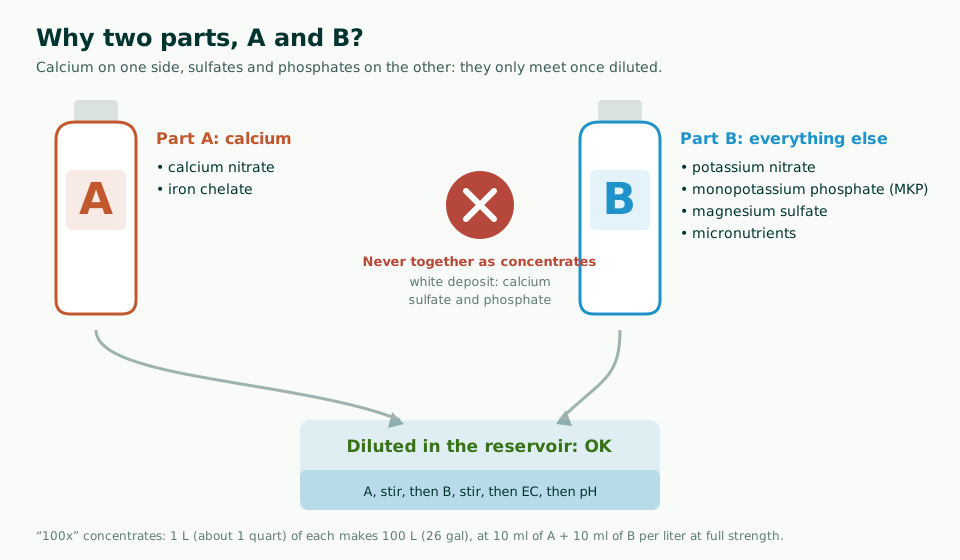
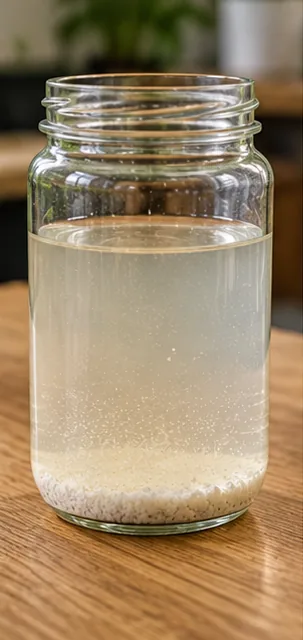
A complete nutrient solution contains calcium on one side, and sulfates and phosphates on the other. When mixed in concentrated form, these react with each other and form insoluble deposits (calcium sulfate, calcium phosphate): the bottom of the bottle turns white and the plants can no longer absorb anything.
The fix: split the ingredients into two concentrates.
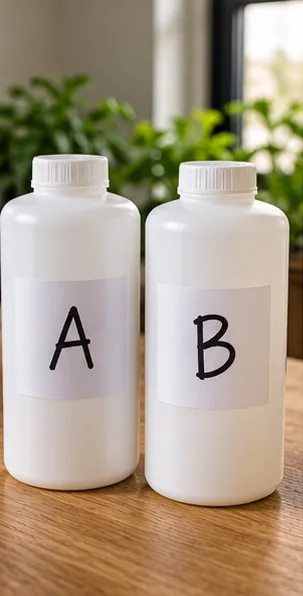
- Part A: calcium (calcium nitrate) and iron.
- Part B: potassium, phosphorus, magnesium, sulfur and micronutrients.
Once diluted in the reservoir, the two parts get along just fine.
2. Equipment
- A scale accurate to 0.1 g (jeweler’s or precision kitchen scale, around $15)
- Two opaque 1-liter bottles (about 1 quart), clearly labeled A and B
- A measuring cup or graduated syringe (10 ml)
- An EC meter and a pH meter (essential)
- Gloves and safety glasses
- Low-mineral water: reverse osmosis, filtered rainwater or distilled water
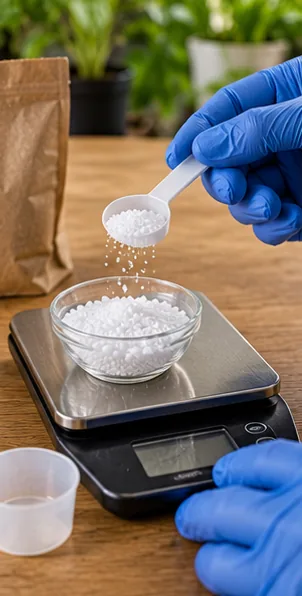
Use tools dedicated to this job, never your kitchen ones.
3. Ingredients
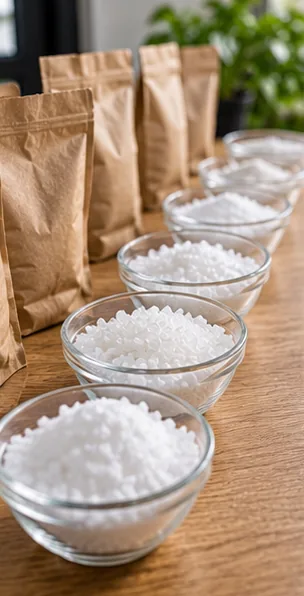
Buy them as water-soluble fertilizer grade, from a garden center, farm supply store or online retailer.
| Mineral salt | Analysis | What it provides |
|---|---|---|
| Calcium nitrate (fertilizer grade) | 15.5-0-0 + 19% Ca | Nitrogen, calcium |
| Potassium nitrate | 13-0-46 | Nitrogen, potassium |
| Monopotassium phosphate (MKP) | 0-52-34 | Phosphorus, potassium |
| Magnesium sulfate heptahydrate (Epsom salt) | 9.8% Mg, 13% S | Magnesium, sulfur |
| Iron chelate (DTPA 7% or EDDHA 6%) | 7% or 6% Fe | Iron |
| Chelated micronutrient mix | per product | Boron, manganese, zinc, copper, molybdenum |
For Epsom salt, use agricultural or pharmacy grade, never scented bath salts.
4. The recipe (“100x” concentrates)
Each liter of concentrate makes 100 liters of solution (about 26 gallons).
Part A (in 1 liter of water)
- 70 g calcium nitrate
- 3 g iron chelate (DTPA 7%)
Part B (in 1 liter of water)
- 40 g potassium nitrate
- 15 g monopotassium phosphate (MKP)
- 50 g magnesium sulfate heptahydrate
- 3 to 5 g micronutrient mix (follow the product label)
What the final solution contains
At full strength (10 ml of A + 10 ml of B per liter), you get roughly:
| Element | ppm (mg/L) | Where it comes from |
|---|---|---|
| Nitrogen (N) | 160 | Calcium nitrate (108) and potassium nitrate (52) |
| Phosphorus (P) | 34 | MKP |
| Potassium (K) | 195 | Potassium nitrate (153) and MKP (42) |
| Calcium (Ca) | 133 | Calcium nitrate |
| Magnesium (Mg) | 49 | Magnesium sulfate |
| Sulfur (S) | 65 | Magnesium sulfate |
| Iron (Fe) | 2 | Iron chelate |
This is an all-purpose profile, close to the reference solutions used in research (a lighter Hoagland-type solution). Values are calculated from the guaranteed analysis of the salts, so yours may vary slightly by brand.
5. Step by step: making the concentrates
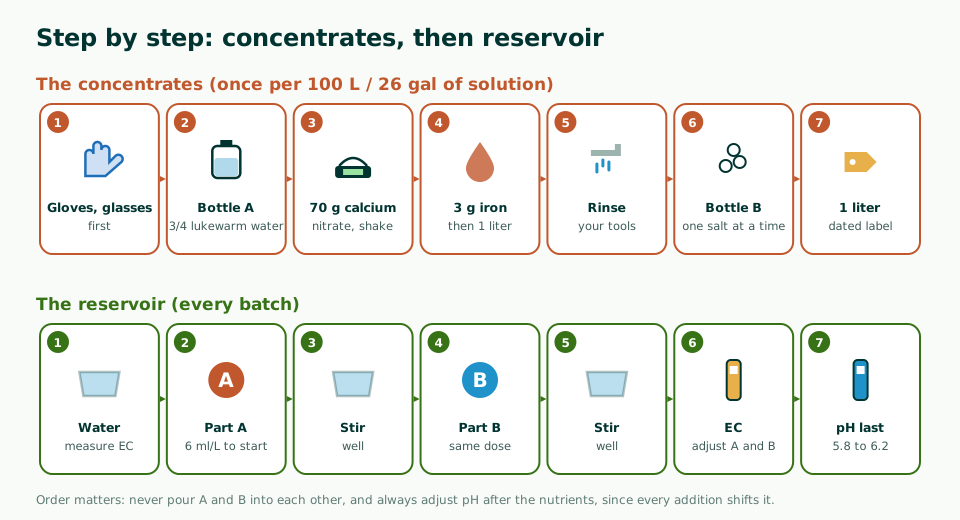
Making the two concentrates
- Put on gloves and glassesBefore opening the first bag.
- Fill bottle A three-quarters fullWith lukewarm (not hot), low-mineral water.
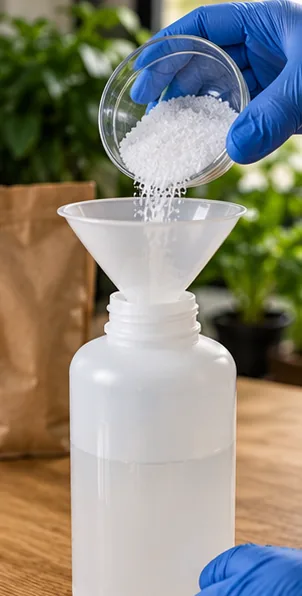
- Add the calcium nitrateWeigh 70 g, pour it through a funnel, shake until fully dissolved.
- Add the iron chelate3 g, shake, then top up to 1 liter.
- Rinse your toolsSo no calcium ends up in bottle B.
- Fill bottle B three-quarters fullAdd one salt at a time, shaking in between: potassium nitrate, then MKP, then magnesium sulfate, then micronutrients.
- Top up to 1 literLabel with the date and the contents.
6. Step by step: mixing the reservoir
The reservoir, in the right order
- Fill the reservoir and measure the water’s ECHard tap water can already read 0.5 to 0.8 mS/cm (see tap water).
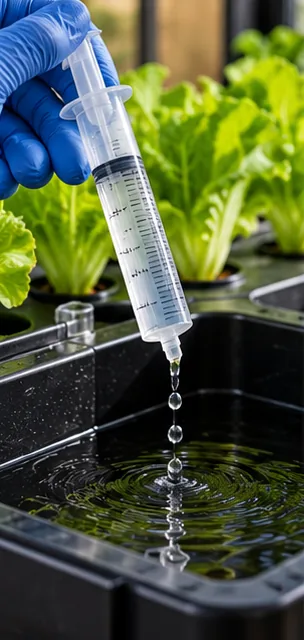
- Add part AWith the graduated syringe, then stir well.
- Add part BThe same dose, then stir well.
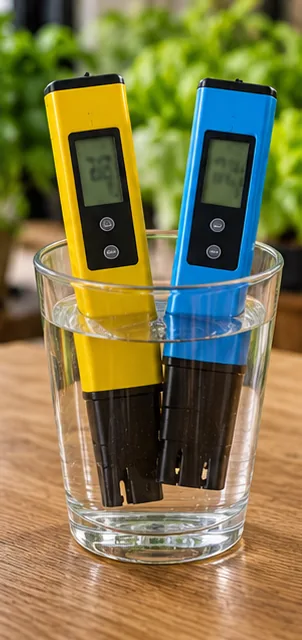
- Measure the ECAdjust with a little more A and B in equal amounts, or a little water.
- Adjust the pH lastTo 5.8 to 6.2: every nutrient addition shifts it.
How much for which crop?
Start at 6 ml of A and 6 ml of B per liter, measure the EC, then adjust in small steps until you reach your crop’s range. EC ranges published by Oklahoma State University (HLA-6722):
| Crop | Recommended EC (mS/cm) |
|---|---|
| Basil | 1.0 to 1.6 |
| Lettuce | 1.2 to 1.8 |
| Cucumber | 1.7 to 2.0 |
| Parsley | 1.8 to 2.2 |
| Strawberry | 1.8 to 2.2 |
| Tomato | 2.0 to 4.0 |
For other crops, check their crop sheet: when no source publishes a value, we say so. The measured EC is what counts, not the number of milliliters: depending on your water and salts, the same dose can give a slightly different EC.
7. Calculator: reservoir doses and salts to weigh
Enter your reservoir volume, the dose you chose (6 ml/L to start, 10 ml/L at full strength) and how much concentrate to make: the calculator gives the milliliters of A and B, the approximate nutrient levels, and the grams of each salt.
Levels scale with the dose and are calculated from the salts’ guaranteed analysis; your water’s EC adds to them. 1 US gallon = 3.785 L. Always check the EC with a meter.
8. Tips
- Write everything down in your grow log: date, dose, EC, pH. You will quickly learn what works in your setup.
- Start with small batches: 1 liter of each concentrate already makes 100 liters of solution.
- Store concentrates in the dark, somewhere cool: iron chelate breaks down in light. They keep for several months.
- Replace the reservoir solution every 2 to 3 weeks rather than endlessly topping up (see spent solution).
- Hard water? Blend it with rainwater or RO water, and account for its starting EC.
9. Mistakes to avoid
| Mistake | Consequence | The fix |
|---|---|---|
| Pouring A and B into each other before dilution | White precipitate, ruined solution | Always dilute A in the reservoir before B |
| Adjusting pH before adding nutrients | pH shifts with every addition | pH last |
| Using an inaccurate scale | A 1 to 2 g error skews iron and micronutrients | A scale accurate to 0.1 g |
| Mixing up hydrate forms | Anhydrous magnesium sulfate is more concentrated than the heptahydrate | Check the label |
| Forgetting iron | Young leaves turn yellow within weeks | 3 g of chelate in part A |
| Letting pH climb above 6.5 | Iron and manganese become unavailable, even when present | Check pH every two or three days |
| Keeping bottles in the light | Algae and degraded iron | Opaque bottles, cool cupboard |
10. Safety
Potassium nitrate is a regulated substance in some countries (explosive precursor rules in the EU under Regulation 2019/1148, with similar reporting rules elsewhere). Buy it as fertilizer grade from a horticultural supplier; you may be asked about its intended use.
11. Key takeaways
Frequently asked questions
Is it really cheaper than store-bought nutrients?
Yes, clearly over time. One kilo (about 2 lb) of each salt makes hundreds of liters of solution. The starting outlay (salts, scale, meters) pays for itself within a few months if you grow regularly.
Can I put everything in one bottle?
Not as a concentrate: the calcium would react with the sulfates and phosphates. You can, however, dissolve the salts directly in a large volume of water (the reservoir), one at a time, starting with calcium nitrate. It works, but is less convenient day to day.
Does this recipe work for tomatoes?
Yes, it is an all-purpose base. For fruiting crops, simply raise the dose (EC 2.0 to 4.0 for tomatoes according to Oklahoma State). More advanced growers bump potassium slightly towards the end of the crop.
Can I make an organic hydroponic nutrient?
It is much trickier: organic fertilizers clog systems and encourage bacteria, and they first have to be broken down by microbes. Beginners are better off starting with mineral salts.
How long do the concentrates keep?
Several months somewhere cool and dark. If a deposit forms or the smell changes, make a fresh batch.
Is my tap water good enough?
It depends on its hardness. Measure its EC: above 0.5 mS/cm, blend it with rainwater or reverse osmosis water, and account for its starting EC in your doses.
- D. R. Hoagland and D. I. Arnon, The water-culture method for growing plants without soil, California Agricultural Experiment Station, Circular 347, 1950
- H. M. Resh, Hydroponic Food Production, CRC Press
- M. Brechner and A. J. Both, Hydroponic Lettuce Handbook, Cornell Controlled Environment Agriculture
- Oklahoma State University Extension, Electrical Conductivity and pH Guide for Hydroponics (HLA-6722)
- Regulation (EU) 2019/1148 on the marketing and use of explosives precursors