Equipment
Grow lights: choosing, installing, adjusting and costing your lighting
LEDs, T5 tubes, discharge lamps or regular bulbs: what really lights a plant, how much light salad greens, herbs or tomatoes need, at what height and for how many hours, how to maintain it, and what it costs in electricity in Belgium. With a table to choose by room and by crop.
No sun, no harvest: indoors, in winter or at the back of a room, the light is what makes things grow. You still have to choose it based on what matters to the plant, hang it at the right height and know what it will add to your bill. Here is the method, with the numbers to back it up.
1. The four families of lights
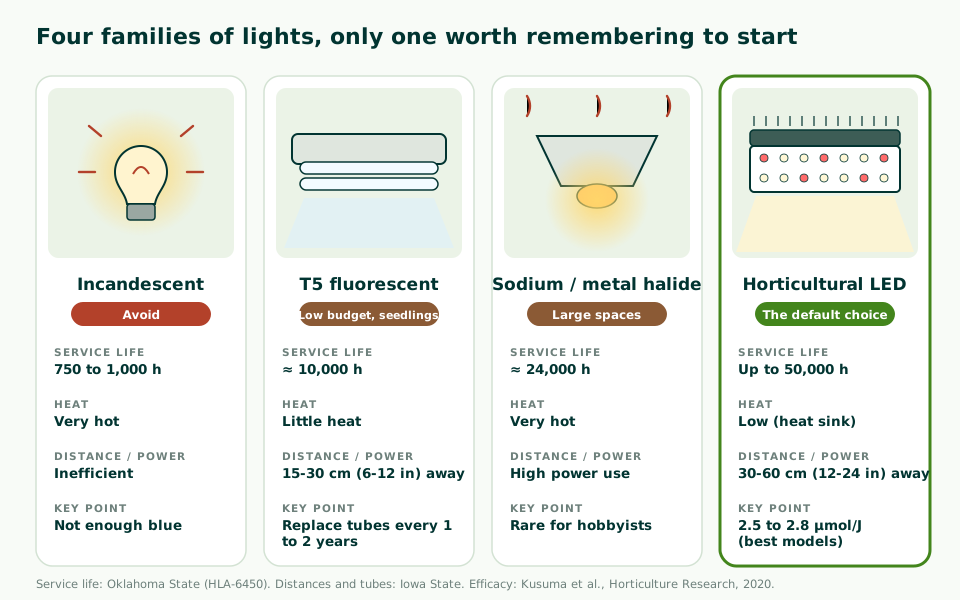
| Family | Service life | Heat | Who is it for? |
|---|---|---|---|
| Incandescent, halogen | 750 to 1,000 h | Very high | No one: inefficient, too hot, not enough blue (Iowa State) |
| Fluorescent (T5 tubes) | About 10,000 h; replace tubes every 1 to 2 years | Low | Seedlings and herbs on a small budget; little red for fruiting crops |
| Discharge lamps (high-pressure sodium, metal halide) | About 24,000 h | Very high | Large spaces; rare among hobbyists because of the heat and power use |
| Horticultural LED | Up to 50,000 h before dropping to 70% of its light output | Low on the leaves (removed by a heat sink) | Everyone: from the windowsill to the grow tent |
Service life: Oklahoma State (HLA-6450). Types and uses: Iowa State.
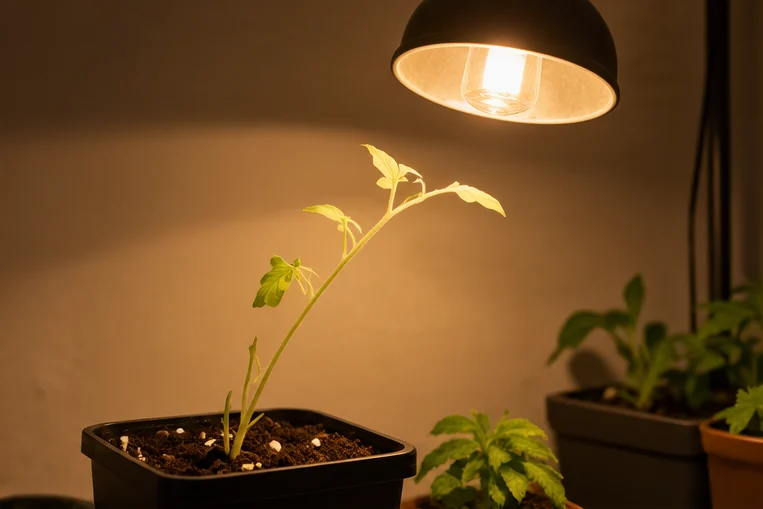
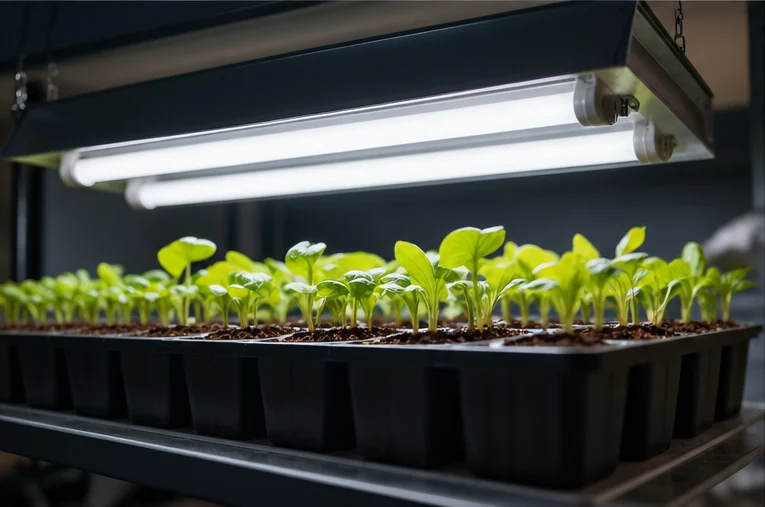
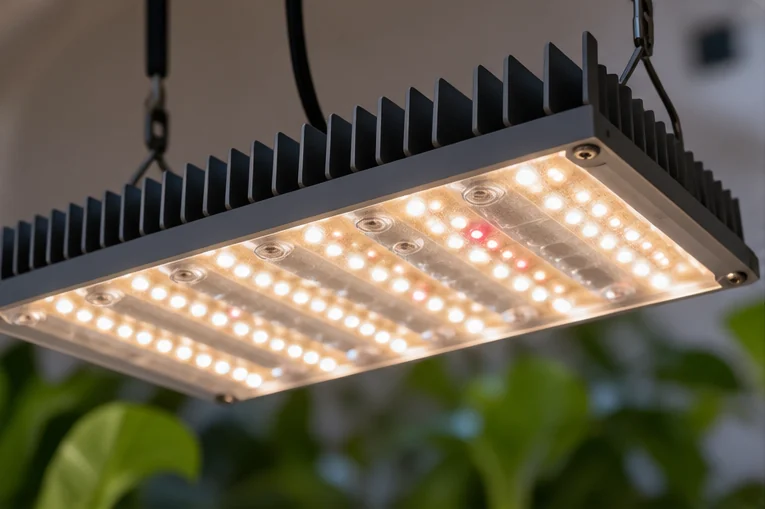
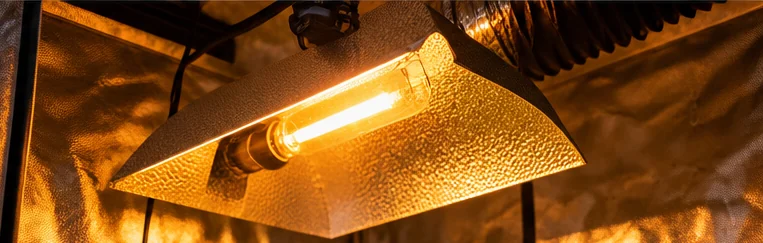
In terms of efficacy, the best white LEDs boosted with red now reach 2.5 to 2.8 µmol/J: each joule of electricity yields 2.5 to 2.8 micromoles of light useful to plants (Kusuma and colleagues, Horticulture Research, 2020). That number is what drives the bill.
2. The three numbers to understand
| Number | What it measures | What it’s for |
|---|---|---|
| PPFD (µmol/m²/s) | The useful light reaching the leaves, every second | Comparing lights and setting the height. Full sun is close to 2,000 (Virginia Tech). |
| DLI (mol/m²/day) | All the light received over the day | Knowing whether the crop has enough light: this is the target to aim for. |
| Efficacy (µmol/J) | The light produced per watt consumed | Comparing the running cost of two lights. |
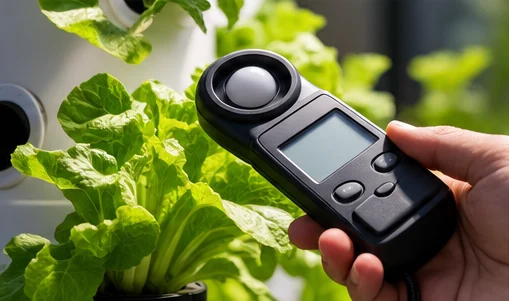
To know the light actually received, nothing beats a measurement. A PAR sensor (quantum meter) placed at leaf level gives you the PPFD directly. A lux meter, cheaper, measures in lux, a unit designed for the human eye: it is useful for comparing two spots under the same light, not for knowing the exact PPFD.
- In the center and at the edges of the tub: the difference shows whether the light covers the whole surface.
- At leaf height, and again once the plants have grown.
- Write down the value along with the light’s height: that is your reference setting.
3. How much light for which crop?
Virginia Tech classifies crops by the daily light (DLI) they need. We converted these targets into PPFD for 16 hours of light, then into the wattage of a recent LED for one square meter (about 11 sq ft).
| Crop | Target DLI (mol/m²/day) | PPFD over 16 h | LED for 1 m², approx. |
|---|---|---|---|
| Seedlings, cuttings | 5 to 10 | 90 to 175 | 45 to 90 W |
| Lettuce | 12 to 17 | 210 to 300 | 105 to 150 W |
| Spinach | 14 to 20 | 245 to 350 | 120 to 175 W |
| Basil | 15 to 25 | 260 to 435 | 130 to 220 W |
| Tomato, cucumber, zucchini | 20 to 30 | 350 to 520 | 175 to 260 W |
DLI: Virginia Tech (SPES-720). PPFD = DLI ÷ (16 × 0.0036). Wattage: our estimate for a 2.5 µmol/J LED with 80% of its light landing on the plants; the edges and the height change the result, hence the value of measuring. Oklahoma State gives a similar benchmark: roughly 16 to 25 W per square foot (about 930 cm²) depending on the plants’ needs.
Are your plants already getting light from a window? Measure what it provides and only ask the lamp for what is missing: see natural light or LED and the lighting calculator.
4. What to choose for each location
| Location | Situation | Our advice |
|---|---|---|
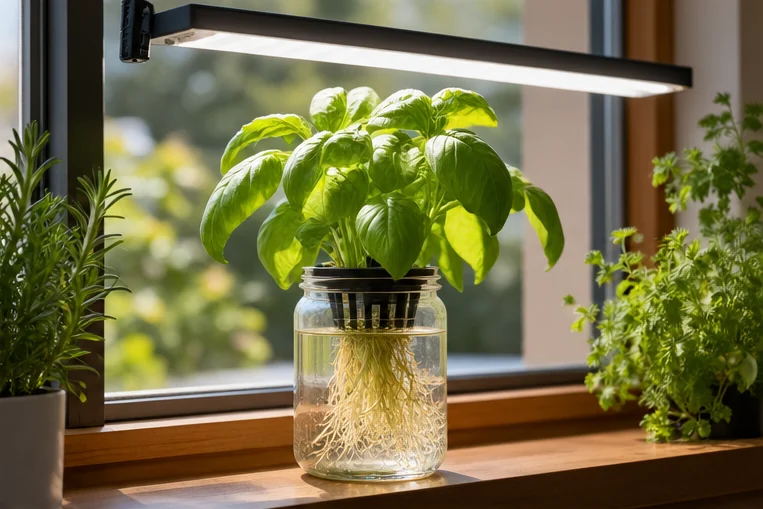
| South-facing windowsill | Good light in spring and summer, weak in winter | No light needed in summer; in winter, a 10 to 30 W LED bar above the jar or small tub, for herbs and salad greens. |
| North-facing window, dark room | Natural light is almost never enough | White LED covering the whole surface, 14 to 16 h a day. Ideal for salad greens and herbs. |
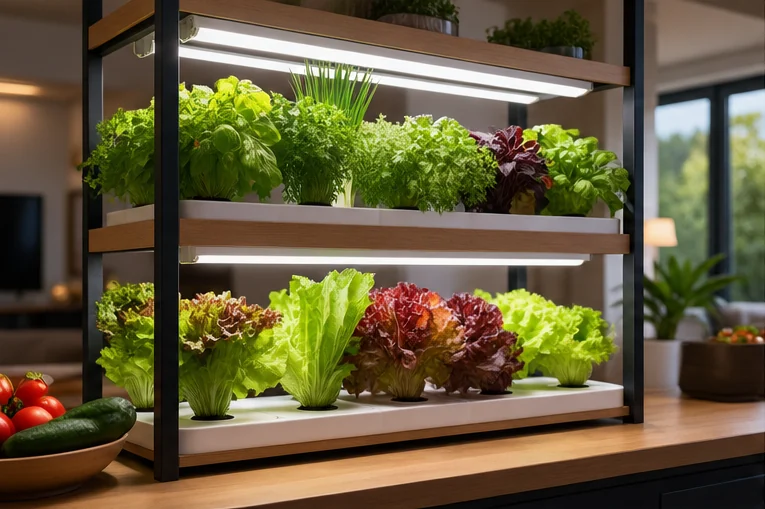
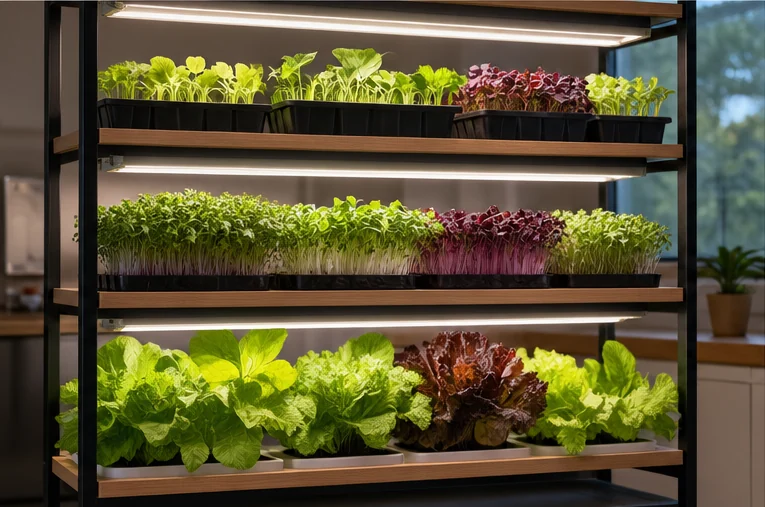
| Multi-tier shelf | Little height between two tiers | LED bars or T5 tubes under each tier, 15 to 30 cm (6 to 12 in) from the leaves: seedlings, microgreens, salad greens. |
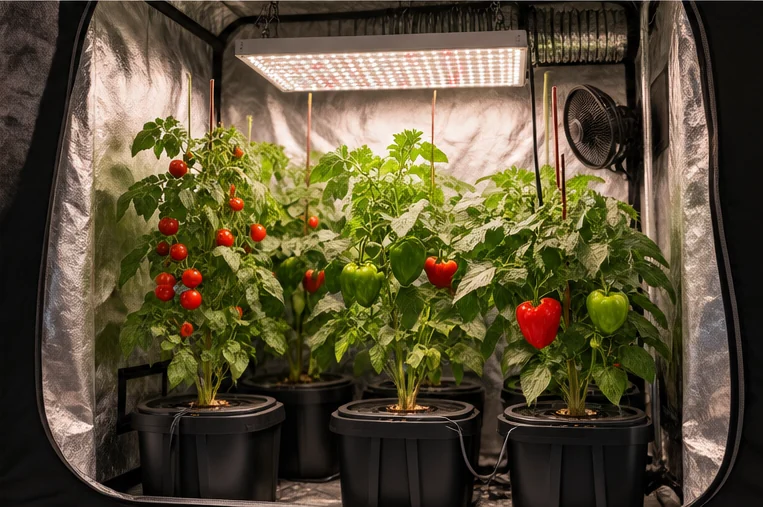
| Closet, grow tent | No light at all, enclosed space | LED panel with wattage suited to the area, ventilation, reflective walls. The only place where tomatoes and peppers are reasonable indoors. |
| Sunroom, greenhouse | Lots of light in summer, short days in winter | Supplemental winter LED on a timer, morning and evening. Light and outlet protected from humidity. |
| Balcony, patio | Outdoors | No light: sow indoors under LEDs, then move the plants outside when the season allows. |
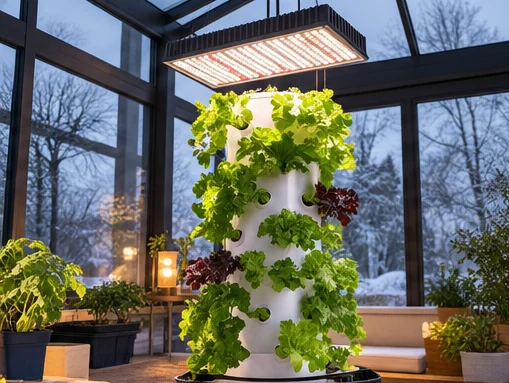
5. Installing your light
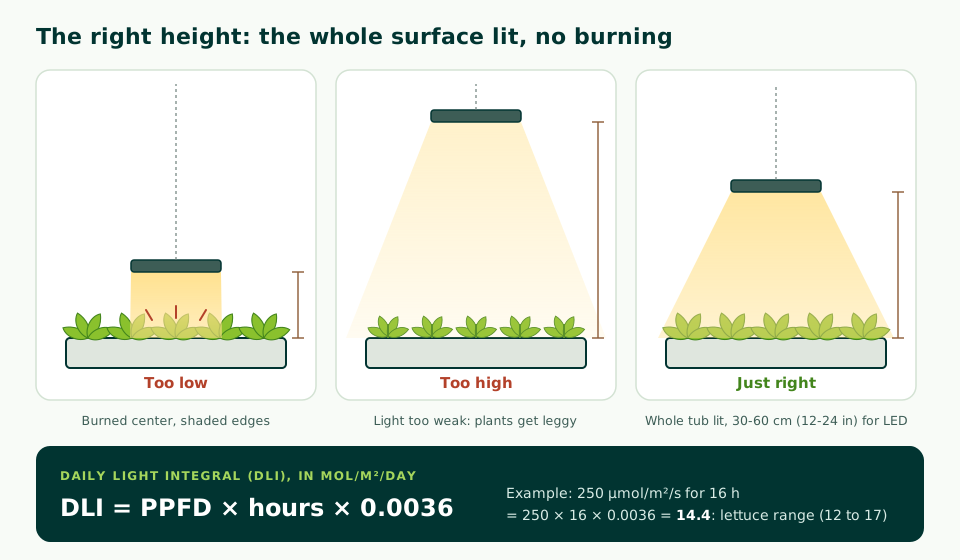
Hanging and adjusting an LED light
- Measure the areaLength × width of the tub or shelf: the light must cover this entire area, not just the center.
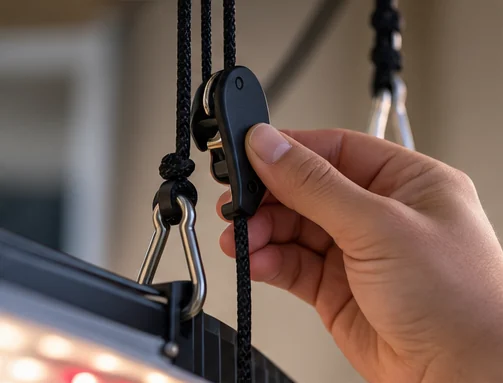
- Hang it adjustablyRatchet hangers, small chain or a stand: the height must be easy to change as plants grow. Two hanging points, never a single wire above the water.
- Set the starting heightThe one in the instructions, otherwise 30 to 60 cm (12 to 24 in) for an LED, 15 to 30 cm (6 to 12 in) for a T5 tube (Iowa State). Higher for seedlings, lower for tomatoes.
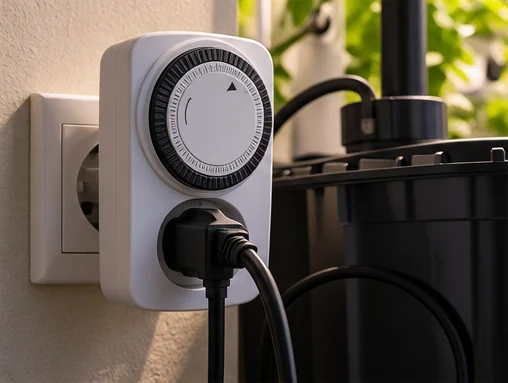
- Plug it into a timer14 to 18 hours a day (UNH), always at the same times, with a real night. Check that the timer can handle the light’s wattage.
- Protect the electricsOutlet protected by a 30 mA residual current device (the European equivalent of a GFCI), drip loops on the cables, the light’s power supply out of reach of splashes.
- Check after a weekStocky, green plants: perfect. Long, pale stems: move the light closer or lengthen the day. Bleached leaves at the top: move it away.
6. The golden rules
- Cover the whole surface: a light that is too small gives you gorgeous plants in the center and stunted ones at the edges.
- Raise the light as the plants grow, to keep the same distance to the leaves.
- Always a night: the timer sets regular days; UNH advises 14 to 18 h of light, not 24.
- Light-colored walls: a white wall or reflective film sends light lost to the sides back to the leaves.
- Seedlings farther away: they need only 5 to 10 mol/m²/day (Virginia Tech); too much light stresses them.
- Your eyes: don’t look at a powerful LED up close; turn it off or wear suitable glasses to work under it.
- Heat: even an LED gives off heat through its heat sink; let air circulate around it, especially in a closet.
- Spectrum: blue promotes chlorophyll, red and far-red promote growth and flowering (Oklahoma State). A “full spectrum” white suits everything; pink or purple light makes it hard to see the condition of the leaves.
7. Maintenance
| When | What |
|---|---|
| Every week | Check the height relative to the leaves, the timer’s clock and that there is no water on the light and cables. |
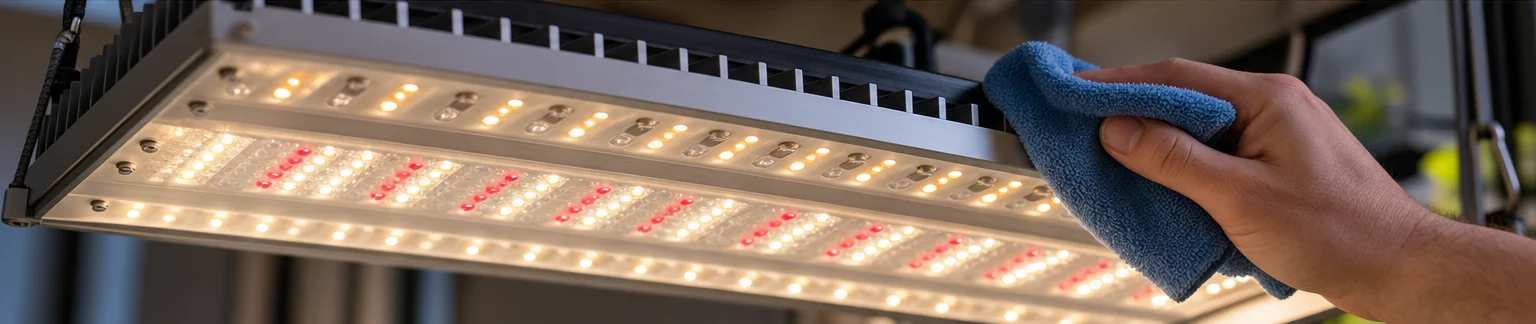
| Every month | Light off and unplugged: dust the emitting face and the heat sink with a dry cloth. Dust blocks light and hinders cooling. |
| Every crop | Check the fixings, the cords and the condition of the outlet; clean the reflective walls. |
| T5 tubes | Replace them every 1 to 2 years: their output drops significantly well before they burn out (Iowa State). |
| LEDs | Up to 50,000 hours before dropping to 70% (Oklahoma State), more than eight years at 16 hours a day. The weak point is often the power supply: a model where it can be replaced lasts longer. |
8. Estimating the cost
The formula is simple: actual power (kW) × hours per day × 30 days × price per kWh. According to Selectra, in September 2026 a kWh cost, all-in, about €0.40 in Flanders, €0.45 in Wallonia and €0.46 in Brussels for a household with a single-rate meter. Our examples are calculated at €0.45: use the price on your own bill.
| Setup | Consumption | Cost per month |
|---|---|---|
| 20 W LED bar, 14 h a day (herbs on a shelf) | 8.4 kWh | About €3.80 |
| Fixture with 2 × 24 W T5 tubes, 16 h a day (seedlings) | 23 kWh | About €10.40 |
| 100 W LED panel, 16 h a day (salad greens on 0.7 to 1 m², 7.5 to 11 sq ft) | 48 kWh | About €21.60 |
| 200 W LED panel, 16 h a day (tomatoes in a 1 m² tent, about 3 × 3 ft) | 96 kWh | About €43 |
| 250 W sodium lamp, 16 h a day | 120 kWh | About €54, plus ventilation |
9. Common mistakes
| Mistake | What you see | The fix |
|---|---|---|
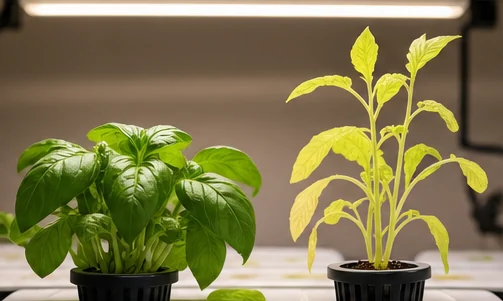
| Light too weak or too high | Stretched, pale, fragile plants (UNH) | Move it closer, lengthen the day, or use a more powerful light |
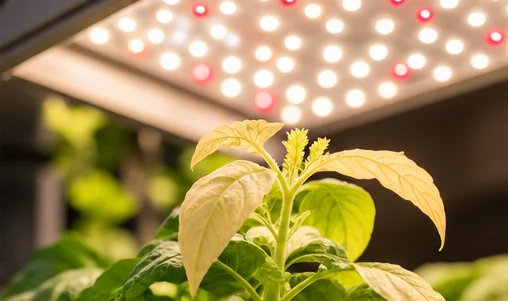
| Light too low | Bleached top leaves, dry edges | Raise it, especially above seedlings |
| Light smaller than the tub | Superb center, stunted edges | A wider light, or two lights |
| Buying on “equivalent watts” | Much less light than expected | Compare actual power draw and µmol/s |
| Lights on 24 hours a day | Higher bill with no matching gain | 14 to 18 h on a timer |
| A regular bulb “to make do” | Heat, leggy plants | A horticultural LED, even a small one |
| Cables above the reservoir | Electrical hazard | 30 mA RCD (GFCI), drip loop, double fixing |
Next up: the 5 essentials to get started, and your lighting questions on the Equipment reviews forum.
Frequently asked questions
Which light should you choose to grow salad greens indoors?
A white-spectrum horticultural LED that covers the entire surface of the tub. For lettuce, Virginia Tech gives 12 to 17 mol/m²/day of light: over 16 hours of light, that works out to about 210 to 300 µmol/m²/s at leaf level. For one square meter (about 11 sq ft), count on roughly 100 to 150 W of recent LED.
How many hours a day should you light your plants?
The University of New Hampshire advises planning for 14 to 18 hours a day, then adjusting. Always keep a night period and plug the light into a timer for regular days.
How far should a grow light be from the plants?
Iowa State gives 30 to 60 cm (12 to 24 in) for an LED and 15 to 30 cm (6 to 12 in) for a fluorescent tube. Follow your model’s instructions first, then observe: plants that stretch need more light, leaves that pale or burn at the top are getting too much.
How much does a grow light cost in electricity?
Multiply the actual power in kilowatts by the hours of light and by the price per kWh. At about €0.45 per kWh all-in in Wallonia in September 2026 (€0.46 in Brussels, €0.40 in Flanders, according to Selectra), a 100 W LED on 16 hours a day uses 48 kWh per month, about €22.
- Oklahoma State University Extension, LED Grow Lights for Plant Production (HLA-6450)
- Iowa State University Extension, Sources of Supplemental Light for Indoor Plants
- Virginia Cooperative Extension, Calculating and Using Daily Light Integral (SPES-720)
- University of New Hampshire Extension, Hydroponics at Home
- Kusuma, Pattison and Bugbee, From physics to fixtures to food: current and potential LED efficacy, Horticulture Research, 2020
- Selectra, price per kWh of electricity in Belgium (September 2026)