Part II · Design
Natural light or LED: how much sun your plants really get, and when to supplement
Belgian sunlight month by month, how much of it is left behind a window, how to measure the light at your spot with a simple phone, and when to add an LED grow light: how much light, what wattage, how many hours. With a calculator whose results you can save to your account.
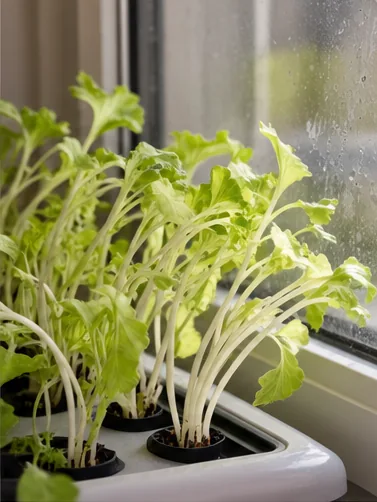
“I have a great window, no need for a lamp.” True… in June. In December, the same window gives ten times less light, and your salad greens stretch, turn pale and stall. This article takes stock of natural light in Belgium, how much of it is left behind a pane of glass, how to measure it with a phone, and when to supplement it with an LED, without oversizing. To choose and set up the lamp itself, see our guide to grow lights.
Calculate my lighting Sun, window and lamp, month by month. Results can be saved to your account.
1. Belgian sunlight, month by month
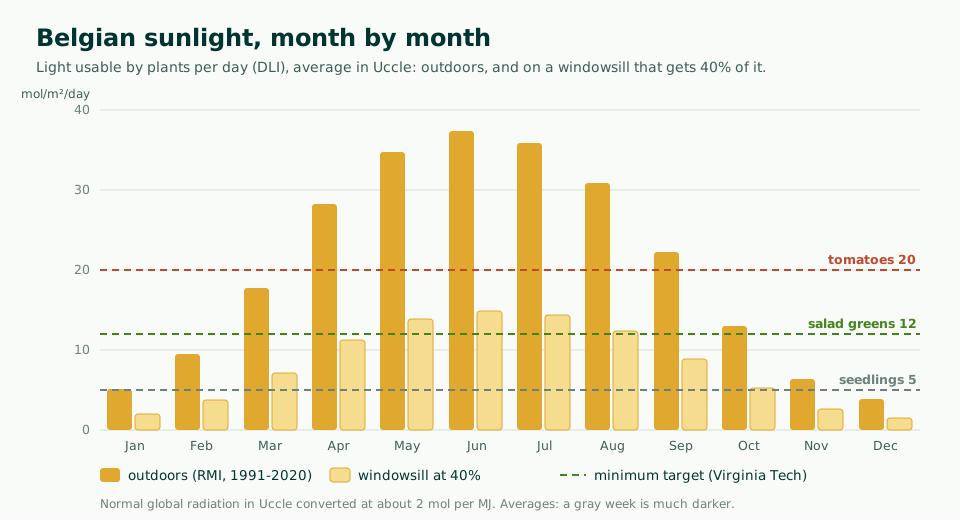
What matters for a plant is the amount of usable light received over a day: the DLI, in moles per m² per day. From the solar radiation measured in Uccle by the RMI, Belgium’s Royal Meteorological Institute (1991-2020 normals), it can be estimated month by month, at about 2 moles of usable light per megajoule of radiation (BioNumbers).
| Month | Sunshine (hours, RMI) | Usable light outdoors | Month | Sunshine (hours, RMI) | Usable light outdoors |
|---|---|---|---|---|---|
| January | 59 | 5.1 | July | 203 | 35.8 |
| February | 73 | 9.5 | August | 192 | 30.9 |
| March | 126 | 17.8 | September | 154 | 22.3 |
| April | 171 | 28.2 | October | 113 | 13.1 |
| May | 198 | 34.7 | November | 66 | 6.4 |
| June | 199 | 37.3 | December | 49 | 3.9 |
Usable light in mol/m²/day, monthly average. Sunshine duration: hours of sun per month.
Compare with crop needs (Virginia Cooperative Extension): 5 to 10 for seedlings and cuttings, 12 to 17 for lettuce, 20 to 30 for tomatoes, cucumbers and zucchini; our crop guides use 15 to 25 for basil. Outdoors, in the open air, Belgian sunlight covers salad greens from March to October. Behind glass, it is another story.
2. Behind glass, much less is left
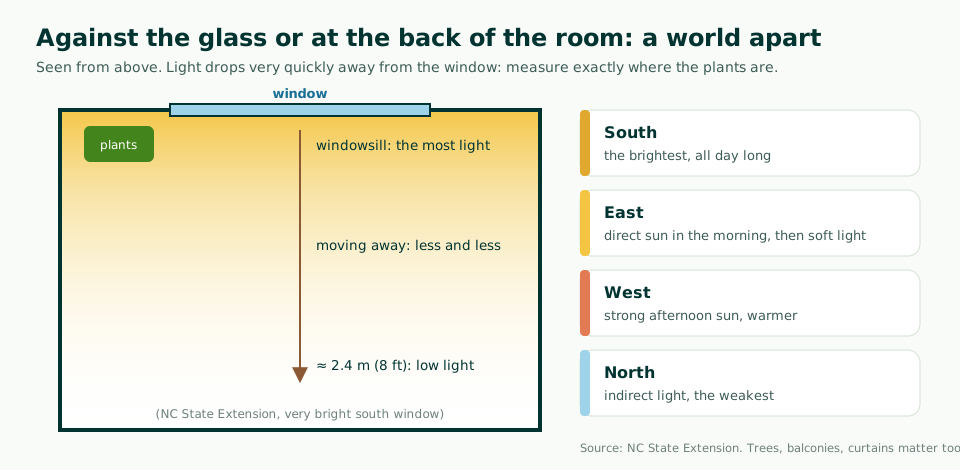
- Orientation. A south-facing window gives the strongest light all day; facing east, direct sun in the morning; facing west, strong sun in the afternoon, and more heat; facing north, indirect light, the weakest (NC State Extension).
- Distance. Light drops very quickly as you move away from the glass: a very bright south window becomes a low-light zone about 2.4 m (8 feet) back, according to NC State.
- Glazing and obstacles. Even a greenhouse, built to let the sun through, loses 30 to 50% of the outdoor light (Virginia Tech). A household window, a sheer curtain, a balcony above or a tree across the way take away even more.
- The season. In winter, the sun is low: it reaches farther into the room, but it is weak and the days are short.
3. Measuring your spot with a phone
No need to buy a sensor to get started. A free “lux meter” app is enough, as long as you use it for a comparison: phone sensors are not accurate in absolute terms, but the same phone, at the same moment, gives a reliable ratio between two places.
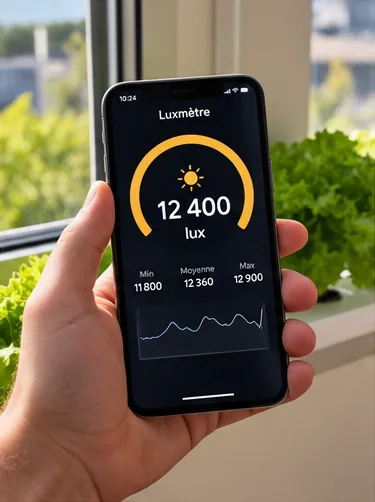
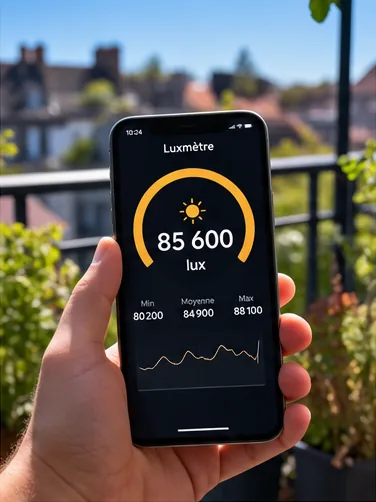
Find out the light at your spot in 2 minutes
- Pick the momentAround noon, on an evenly overcast day: the light changes more slowly than with passing clouds.
- Measure where the plants arePhone held at leaf height, sensor (at the top of the screen) facing up. Write down the lux.
- Measure outdoors, right afterSame gesture, out in the open: balcony, yard, street. Write down the lux.
- DivideLux indoors ÷ lux outdoors = the share of the outdoor light that reaches your plants. Enter both numbers in the calculator.
- Repeat every seasonAnd every time you move the plants: moving them a foot or so changes everything.
For daylight, you go from lux to plant units by multiplying by 0.0185 (Apogee Instruments): 20,000 lux of daylight is about 370 µmol/m²/s. This factor only applies to sunlight: under a lamp, it depends on the spectrum, and a lux meter under a pink-purple LED means almost nothing.
4. Lumens, lux, PPFD, DLI: what measures what
| Unit | What it measures | What it is for |
|---|---|---|
| Lumen (lm) | The light emitted by a lamp, weighted by the sensitivity of the human eye | Choosing a bulb to light a room, not to grow plants |
| Lux | The light received on a surface, as seen by the human eye | Comparing two places with the same lux meter |
| PPF (µmol/s) | The light usable by plants emitted by a lamp | Comparing two grow lights |
| PPFD (µmol/m²/s) | The usable light received at a given moment, at leaf level | Setting height and power |
| DLI (mol/m²/day) | The usable light received over a whole day | Knowing whether the plant gets enough light |
The formula that links the last two: DLI = PPFD × hours of lighting × 0.0036 (Virginia Tech). A lamp that only lists lumens? For a “daylight” type white light, 1,000 lumens is about 17 µmol/s of usable light (Wikipedia): a ballpark figure, not a spec sheet.
5. Supplementing: what is missing, no more
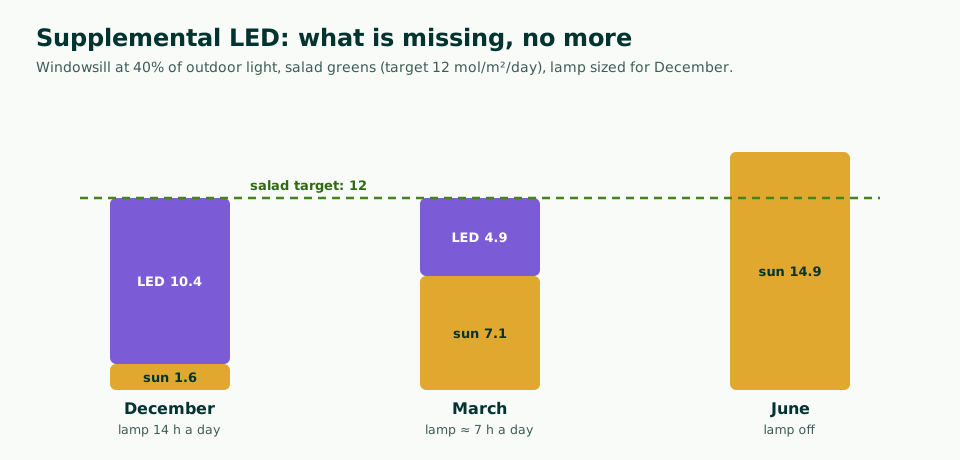
The principle is simple: crop target minus natural light = what the lamp has to supply. Size the lamp for the darkest month of its growing season, then cut its hours as the sun comes back. Three examples with the calculator, for an area of 60 × 30 cm (24 × 12 in) and an LED rated at 2.5 µmol/J:
| Location | Crop | Lamp needed | No lamp needed | Cost per year |
|---|---|---|---|---|
| Windowsill, 40% of the outdoor light | Salad greens year-round | ≈ 210 µmol/m²/s, at least 15 W | From May to August | ≈ €15 |
| Same windowsill | Basil year-round | ≈ 270 µmol/m²/s, at least 19 W | Never quite | ≈ €23 |
| Back of the room, 12% | Salad greens year-round | ≈ 230 µmol/m²/s, at least 17 W | Never | ≈ €32 |
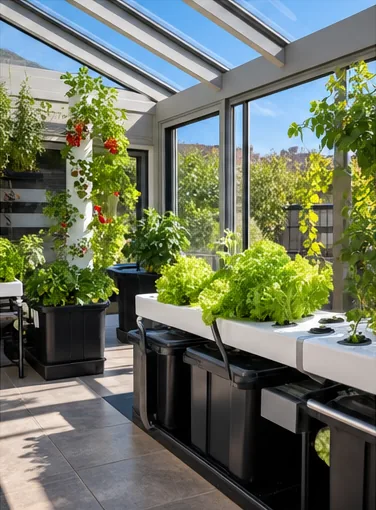
| Sunroom, ≈ 60% | Tomatoes from April to September | ≈ 130 µmol/m²/s, at least 10 W | From May to July | ≈ €3 |
Electricity at about €0.45 per kWh in Wallonia, Belgium (Selectra, September 2026). The wattages shown are a theoretical minimum: the edges and the lamp height lose part of the light.
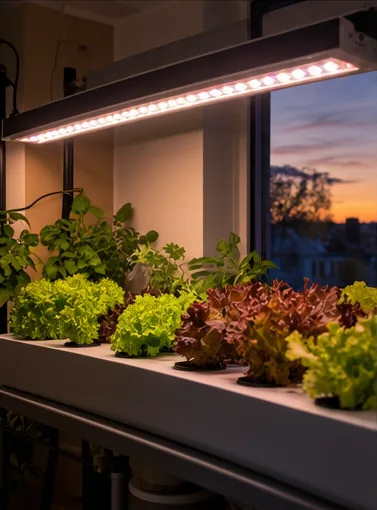
- Extend rather than double up. Program the lamp to lengthen the day, morning and evening, when the window no longer gives anything.
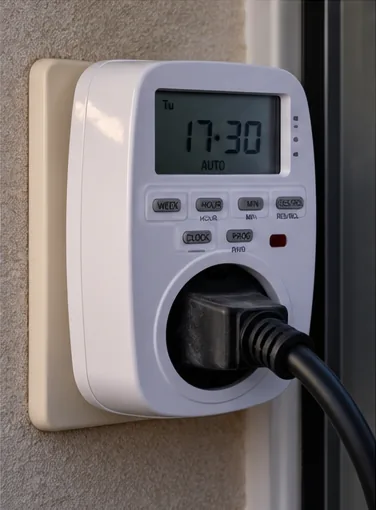
- Stay within 14 to 18 hours of light per day in total (University of New Hampshire), on a timer.
- Above the plants, not beside them. A lamp placed on the room side also corrects the “everything leans toward the glass” effect.
- Turn pots or reservoirs a quarter turn every week if they are lit from one side only.
- Switch off in summer, in the months when the calculator asks for nothing: that is where the savings are.
6. The calculator, and your results in your account
The lighting calculator puts this whole article into three steps: your location (your two lux readings, a sunroom, or no daylight at all), your plants and your season, then the lamp (area, maximum hours, efficacy, price per kWh). It shows the natural light and the LED supplement for each month, the light to aim for under the lamp, the minimum wattage, the hours of lighting month by month and the annual cost.
With a free account, the “Save to my account” button keeps the calculation, under a name of your choice (“Kitchen salad greens”, “Sunroom basil”…). You will find it in My account, My calculations tab, and you can reopen it with the same settings to edit it next season.
Open the calculator Two minutes, and you know which lamp to buy, or whether you need one at all.
7. Setting up the supplement
- The right lamp: an LED that lists its PPF or a PPFD map at different heights, and its efficacy in µmol/J. See grow lights.
- The height: 30 to 60 cm (12 to 24 in) above the leaves for an LED, 15 to 30 cm (6 to 12 in) for a T5 tube (Iowa State, as cited in our grow light guide), to be adjusted according to the lamp’s spec sheet.
- An adjustable hanger: small chain, hooks or a stand, to raise the lamp as the plants grow.
- A timer programmed with the calculator’s hours, to be reviewed every season. See automating your garden.
- Safety: water and electricity, an outlet protected by a 30 mA residual current device (similar to a GFCI), cables with a drip loop, a raised power strip.
8. Keeping the light up
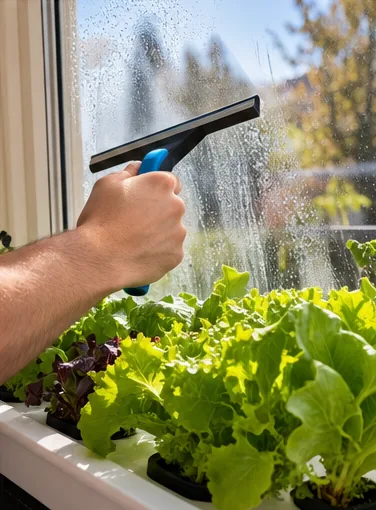
- Clean windows, especially in the fall: dust and rain streaks hold back light precisely when it is scarce.
- A dusted lamp, unplugged and cool, with a dry cloth.
- One measurement per season: same method, same spots. Write it down in your online journal, and update your saved calculation.
- Keep an eye on the plants: legginess, pale leaves, slow growth. If the calculation says “enough” and the plants say “not enough”, believe the plants, and measure again.
9. Common mistakes
| Mistake | Consequence | The fix |
|---|---|---|
| Judging your window in June | Leggy plants from November to February | Take stock month by month |
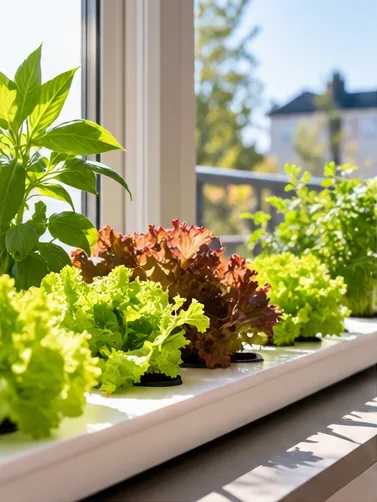
| Placing reservoirs in the middle of the room | Low light, even near a south window | Against the glass, or a lamp above |
| Buying a lamp on its lumens or watts | Useless or insufficient light | Look at the PPF, the PPFD and the µmol/J |
| Running the lamp 18 h a day all year | A needless bill in summer | Hours set month by month, according to the sun |
| Measuring a pink LED with a lux meter | Numbers unrelated to reality | Rely on the PPFD stated by the manufacturer |
10. Key takeaways
Other members are interested in your light readings: share them on the forum, along with the direction your window faces.
Frequently asked questions
Is a windowsill enough for hydroponic salad greens?
In Belgium, often only from May to August. On a windowsill that gets 40% of the outdoor light, salad greens receive on average 12 to 15 mol/m²/day in summer, but 2 to 4 in winter, far from the recommended 12. Measure your spot: the calculator will tell you in which months a lamp is useful.
How can I measure the light at my window without an expensive meter?
With a lux meter app: one reading where the plants are, another outdoors at the same moment, on an overcast day. The ratio between the two tells you what share of the outdoor light reaches your plants. A phone’s absolute values are approximate, the ratio is reliable.
Should I look at lumens when choosing a grow light?
No. Lumens measure light as the human eye sees it. For a plant, what matters is the lamp’s PPF (µmol/s) or the PPFD received at leaf level (µmol/m²/s). A lamp that only lists lumens leaves out the essential.
How many hours should the lamp run to supplement the window?
Just enough to reach the crop’s target: 14 hours in December in our example, 7 hours in March, none in June. In total, daylight included, stay within the 14 to 18 hours recommended by the University of New Hampshire.
Can I save my calculations?
Yes, with a free account: the calculator’s “Save to my account” button keeps your settings and results in My account, under the My calculations tab. You can reopen a calculation to edit it.
- RMI (Royal Meteorological Institute of Belgium), climate normals in Uccle 1991-2020: global radiation and sunshine duration
- BioNumbers (Harvard), ratio between light usable by plants and solar radiation, 2.1 mol per MJ (range 1.86 to 2.31)
- Virginia Cooperative Extension, Calculating and Using Daily Light Integral (SPES-720)
- NC State Extension, Light Considerations for Indoor Plants
- Apogee Instruments, PPFD to Lux Conversion
- University of New Hampshire Extension, Hydroponics at Home
- Kusuma, Pattison and Bugbee, From physics to fixtures to food: current and potential LED efficacy, Horticulture Research, 2020
- Wikipedia, Photosynthetically active radiation
- Selectra, price per kWh in Belgium (September 2026)