Equipment
Tubs, reservoirs, net pots and tubing: choosing the right hydroponic containers
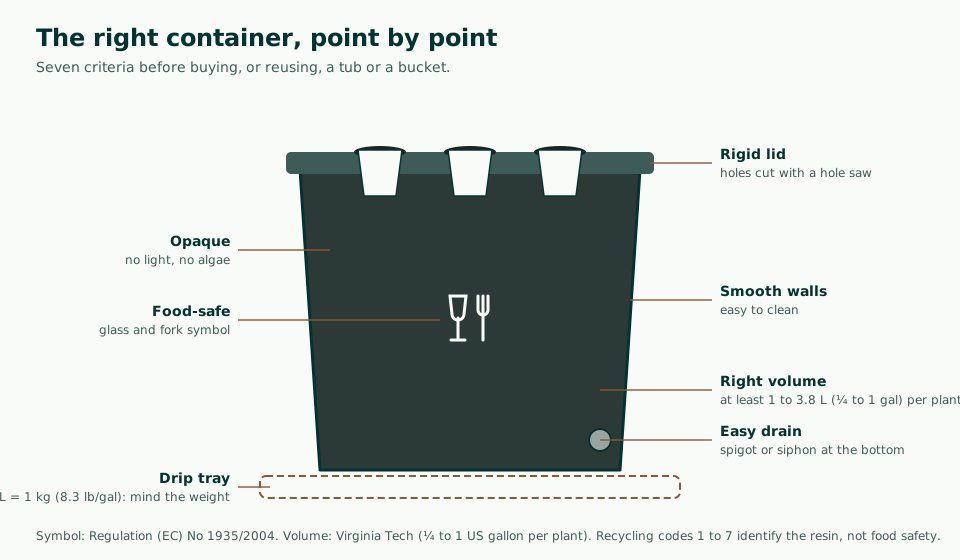
The right bucket or the right tub: food-safe material, opacity against algae, a volume suited to the crops, weight, lid and net pots, tubing and fittings, reusing old buckets, cleaning and a drip tray. Seven criteria to buy right.
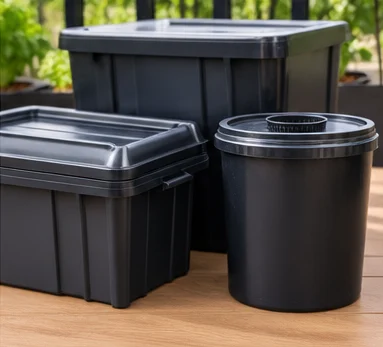
We rarely think about it, yet this is where everything happens: the tub, the bucket, the lid, the net pots and the tubing. A translucent container means algae everywhere a month later; an unsuitable bucket means a material you know nothing about touching the solution that feeds what you eat. Here are the criteria to choose right, new or reused.
1. A food-safe material
The roots bathe in the solution, and the solution touches the crown, sometimes the leaves, of what you harvest. It might as well sit in a plastic designed for food.
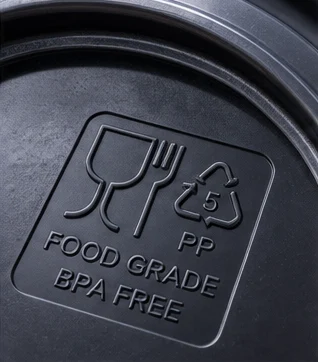
- The marking that counts: in Europe, a material intended for food contact bears the words “for food contact”, an indication of use, or the glass and fork symbol (Regulation 1935/2004, article 15, as restated by the DGCCRF, the French consumer protection agency).
- The recycling triangle is not enough: the number (2 for high-density polyethylene, 5 for polypropylene…) identifies the resin, not whether it is food-safe.
- Avoid: paint, plaster or cleaning product buckets, jugs that have held chemicals, even well rinsed.
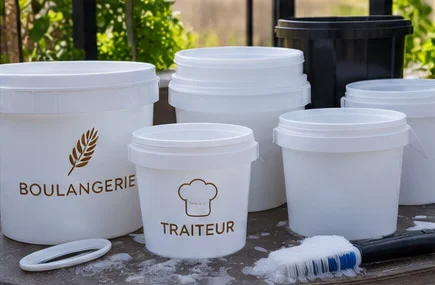
- Reuse: food buckets from bakeries, restaurants or delis (sauces, pickles, ice cream) make excellent grow containers, once well washed.
2. Opaque, always
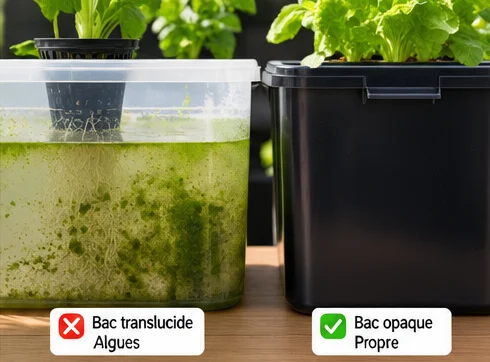
Light that reaches the solution feeds algae: green walls, slimy roots, clogged filters, oxygen used up at night. A hydroponic container must be opaque, lid included.
- Black or dark inside, or thick white that does not let light through (check with a flashlight).
- Translucent tub: exterior paint, opaque tape or an insulating cover.
- Plug unused holes: a simple upside-down net pot or a cap.
- In the sun: a light-colored or wrapped exterior heats up less than an exposed black tub. A warm solution holds less oxygen: see DWC and air pumps.
3. The right volume, and its weight
| Crop or system | Volume guideline | Source |
|---|---|---|
| Recirculating system reservoir | ¼ to 1 US gallon per plant (1 to 3.8 L) | Virginia Tech |
| Lettuce in Kratky | 4 to 6 L (1 to 1.5 gal) used over the whole crop | University of Florida |
| Mature tomato | Drinks 1 to 3 L a day: a 15 to 20 L (4 to 5 gal) bucket per plant at least | Oregon State; growers’ practice |
| Lettuce raft | At least 13 cm of water (5 inches) | University of Florida |
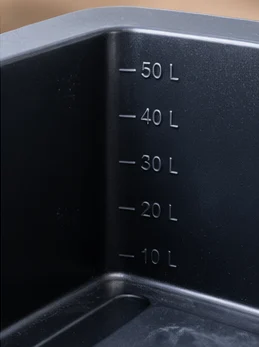
A bigger reservoir buffers better: pH, EC and temperature change more slowly. But 1 liter weighs 1 kilogram (a gallon weighs about 8.3 lb): four 60-liter (16 gal) tubs weigh a quarter of a metric ton (about 530 lb). Check the load capacity of a shelf, a balcony or a patio (see patio constraints), and the reservoir volume calculator.
4. Lid, net pots and drilling
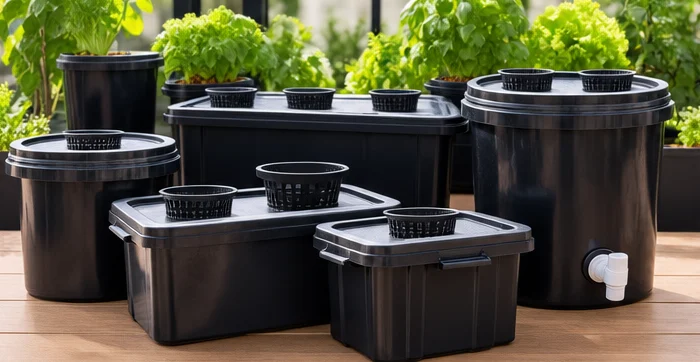
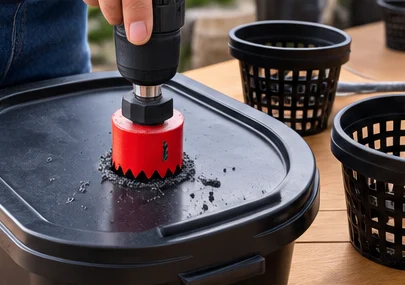
- A rigid lid that holds the weight of the plants without sagging into the water. A cut sheet of rigid foam insulation also works, as in the University of Florida raft.
- Net pots of 5 to 7.5 cm (2 to 3 in) for most lettuces and herbs; larger for fruiting vegetables.
- A hole saw at the diameter just below the net pot’s rim: the pot sits in the hole without falling through (University of Florida).
- A service hole in the lid, for the probe, the air line or refilling, without lifting the plants.
- Spacing: 15 cm (6 in) from the edges and 30 cm (12 in) between holes for full-size lettuces on a raft (University of Florida).
5. Tubing and fittings
| Use | Advice |
|---|---|
| Air (air pump) | 4 mm (about 3/16 in) flexible silicone tubing, check valve; see DWC |
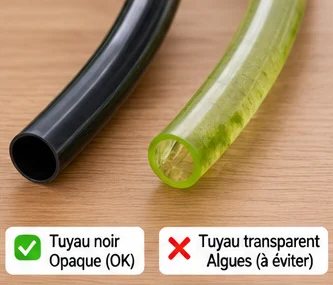
| Water (pump, return) | Opaque tubing, preferably black: clear tubing turns green within a few weeks |
| Rigid plumbing | Pipes and fittings rated for drinking water, easy to take apart for cleaning |
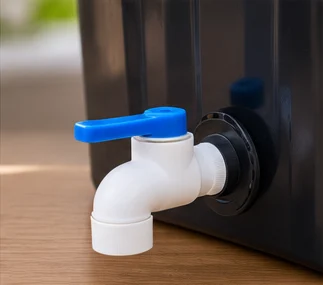
| Wall penetrations | Bulkhead fittings with gaskets, hand-tightened; test 24 to 48 hours with clean water before planting |
| Drain | A spigot or siphon at the bottom of the reservoir: emptying becomes a two-minute job |
For flow rate and head height, see choosing a pump.
6. Easy to clean
The University of Vermont points it out: in a hydroponic system, supports and growing media can become surfaces that touch the harvest. Everything that touches the solution must be easy to clean:
- Smooth walls, with no deep grooves or hard-to-reach corners where biofilm settles.
- Access for your hand and a brush: wide opening, removable lid.
- Dedicated tools for the system (brush, bucket, measuring cup); the University of Vermont even suggests color coding to avoid cross-contamination.
- Between two crops: empty, scrub, disinfect, rinse. See diseases and pests.
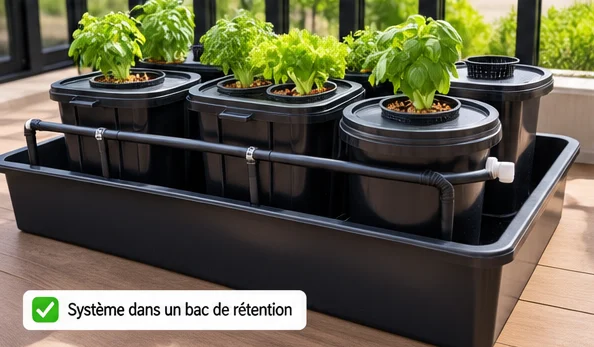
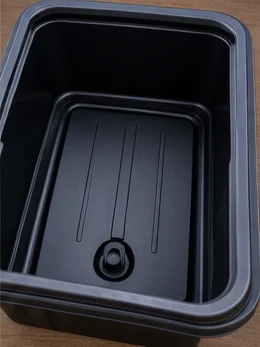
7. The drip tray
8. Common mistakes
| Mistake | Consequence | The fix |
|---|---|---|
| Translucent tub | Algae, slimy roots | Opaque container, or one made opaque |
| Reused hardware store bucket | Unknown material touching the solution | “For food contact” marking or glass and fork symbol |
| Relying on the recycling number | False reassurance | Look for the food-safe marking |
| Reservoir too small | pH and EC jumping around, running out of water in summer | At least 1 to 3.8 L (¼ to 1 gal) per plant, much more for tomatoes |
| Forgetting the weight | Sagging shelf, overloaded balcony | 1 L = 1 kg, check the load capacity |
| Clear tubing | Algae in the lines | Opaque tubing |
| No drain at the bottom | Postponed water changes, drifting solution | Spigot or siphon |
To go further: the 5 essentials to get started, growing media, and post photos of your reused tubs on the forum.
Frequently asked questions
Can I use a paint or hardware store bucket?
Better to avoid it: nothing guarantees it is food-safe, and it may have held chemicals. Choose a new bucket marked for food, or a well-cleaned reused food bucket (bakery, restaurant).
Are clear storage bins suitable?
Only once made opaque (exterior paint, tape, a cover) and if they are food-safe. Otherwise, algae take hold within a few weeks.
Black or white?
Black inside, or opaque, to block light; light-colored outside to limit heat in the sun. Indoors, a black tub works very well; on a patio, a light-colored or wrapped tub heats up less.
What net pot diameter should I choose?
Net pots of 5 to 7.5 cm (2 to 3 in) suit most lettuces and herbs. The University of Florida drills its raft with a hole saw at the diameter just below the net pot’s rim, so the pot sits in the hole without falling through.
- Regulation (EC) No 1935/2004 on materials intended to come into contact with food, article 15
- DGCCRF (French consumer protection agency), general fact sheet on the regulation of food contact materials
- University of Vermont Extension (NECAFS), Introduction to Produce Safety for Hydroponic and Aquaponic Growers
- Virginia Cooperative Extension, hydroponics series
- University of Florida IFAS Extension, Building a Floating Hydroponic Garden (HS943)
- Oregon State University, Tomato, Greenhouse (Oregon Vegetables)