Equipment
Plastics and Hydroponics: Which Ones to Choose for a Safe Harvest
Reservoirs, tubing, net pots, floating rafts, 3D-printed parts: in hydroponics, the nutrient solution sits in plastic for months. Resin codes and food-grade markings, what studies show about heat, bisphenol A, plasticizers and microplastics, a method to audit your system, and a container checker.
In hydroponics, the nutrient solution spends weeks in a reservoir, flows through tubing, and bathes the net pots and floating rafts. Nearly all of it is plastic. Should you worry? No need to panic, but a few good habits help: read the code and the food-grade marking, avoid heat, and set aside flexible plastics and items of unknown origin. Here is what the rules and the studies say, and how to check your system in fifteen minutes.
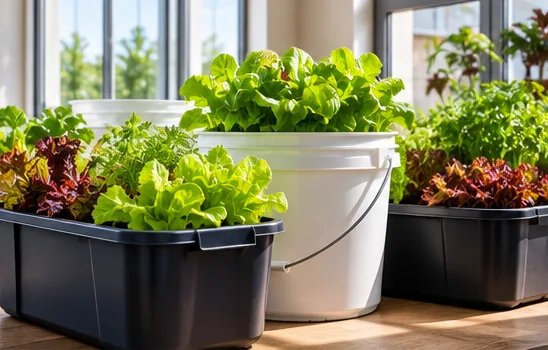
For choosing a reservoir, see also reservoirs and containers; for other health questions, harvest quality.
1. Why this matters in hydroponics
- Long contact: the solution stays in the same reservoir for weeks, and water circulates nonstop in a tower or NFT system.
- A warm solution: near a grow light, on a balcony or in summer, the reservoir heats up. And heat speeds up whatever migrates out of a plastic.
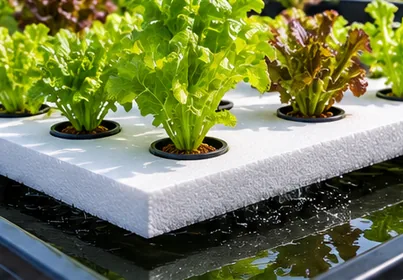
- Lots of parts: reservoir, lid, net pots, tubing, pump, polystyrene raft, fittings, 3D-printed parts, sometimes reclaimed jugs or bottles.
- Roots in direct contact, and a harvest that is often eaten raw.
Oklahoma State, in its hydroponic tower guide, recommends food-grade materials whenever you modify the design. That is the basic rule: a material made for food has been checked by its manufacturer for that kind of contact.
2. Resin codes and the food-grade marking

The number molded inside the triangle of arrows only identifies the resin, for recycling. What matters for contact with what you eat is a food-grade or food-safe marking (in Europe, the glass-and-fork symbol or the words “suitable for food”, provided for by EU Regulation 1935/2004). In the European Union, plastics intended for food must also meet migration limits set by Regulation 10/2011.


| Code | Where you find it | In hydroponics |
|---|---|---|
| 1 PET | Bottles, clamshells and trays | Short-term use, kept cool, made opaque |
| 2 HDPE | Jugs, buckets, tubs | Good choice, preferably food-grade |
| 3 PVC | Rigid pipe, flexible tubing | Rigid pipe rated for drinking water: yes; flexible: avoid |
| 4 LDPE | Films, flexible polyethylene tubing | Good choice |
| 5 PP | Tubs, boxes, net pots | Good choice, preferably food-grade |
| 6 PS | Insulation boards, seedling cells | Floating rafts: yes, away from heat |
| 7 Other | Polycarbonate, blends | Avoid without a food-grade marking |
| No code | Salvaged items, toys, industrial packaging | Keep out of contact with the solution |
3. What the rules and studies say
Heat
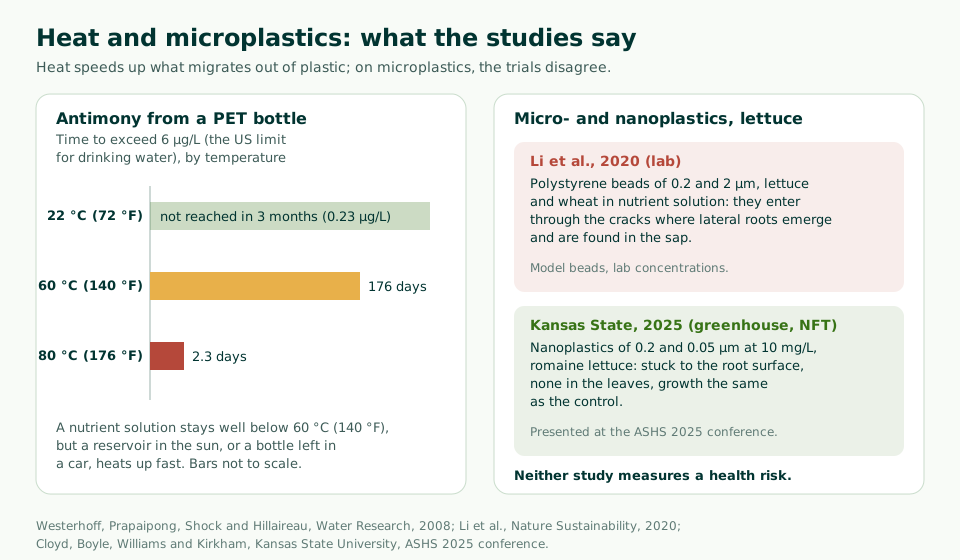
- Westerhoff and colleagues (Arizona State University, 2008) stored PET water bottles at different temperatures. At 22 °C (72 °F), antimony, a residue of the catalyst used to make PET, did not rise significantly in three months and stayed around 0.2 µg/L.
- At 60 °C (140 °F), it took 176 days to exceed the US drinking water limit (6 µg/L); at 80 °C (176 °F), 2.3 days. A nutrient solution never gets that hot, but a reservoir in the sun or a jug left in a car heats up fast.
Bisphenol A and plasticizers
- Bisphenol A is used to make polycarbonate and epoxy resins. The European Union has banned it in food contact materials (Regulation 2024/3190), with a main transition period that ended on July 20, 2026.
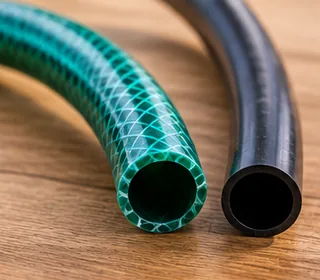
- Flexible PVC plastics contain plasticizers. In Europe, four phthalates (DEHP, DBP, BBP, DIBP) have been limited to 0.1% in most articles since July 2020 (Regulation 2018/2005), but an old garden hose may still contain them.
Microplastics: the worrying side
- Li and colleagues (Chinese Academy of Sciences, Nature Sustainability, 2020) grew lettuce and wheat in nutrient solution with 0.2 and 2 µm polystyrene beads. The beads entered through the cracks where lateral roots emerge and were found in the sap.
- These are model beads, at lab concentrations: the study shows it is possible, not what actually happens in a home garden.
Microplastics: the reassuring side
- At Kansas State, Cloyd and colleagues added 0.2 and 0.05 µm nanoplastics at 10 mg/L to NFT systems growing romaine lettuce (ASHS conference, 2025). The particles stayed stuck to the root surface; none were found in the leaves, and growth was the same as the control.
- The authors call for trials under realistic conditions. Neither study measures a health risk.
4. Checker: is my container suitable?
Turn the item over, find the code in the triangle and any food-grade marking, then tell us where it will be used: the checker gives an opinion and the precautions to take.
An indicative opinion, not a certification: when in doubt, choose a new container marked as food-grade.
5. The method: audit your system in fifteen minutes
- List the parts that touch the solution: reservoir, lid, net pots, tubing, pump, floating raft, fittings, printed parts.
- Turn each part over and note the code and whether it has a food-grade marking. Run them through the checker.
- Replace first any flexible PVC tubing of unknown origin (garden hose, garden center tubing) with polyethylene or silicone, or tubing rated for drinking water (potable water).
- Set aside jugs that held chemicals and plastics with no code; keep them for storage, out of contact with the solution.
- Make it opaque and keep it in the shade: a reservoir in the sun heats up, turns green, and the plastic ages faster. Cover it or move it.
- Rinse new parts with clean water before the first solution, and clean them between crops (see cleaning and disinfecting).
6. Tips
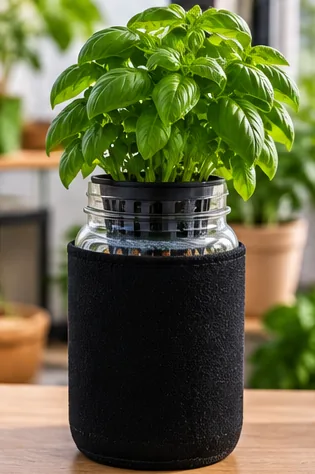
- Glass for Kratky: a glass jar covered with a sock or black tape sidesteps the plastic question entirely (see the Kratky method).
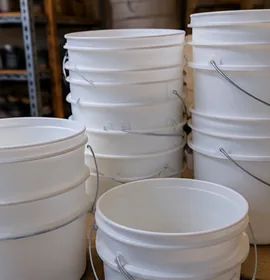
- Reclaimed food-grade buckets (bakery, deli) are usually HDPE or PP and marked: excellent reservoirs once washed.
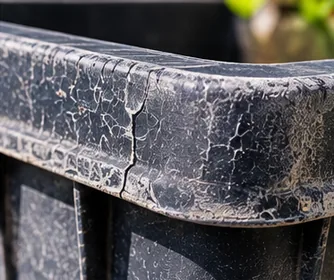
- Plastic that turns chalky, yellows or cracks when touched has been damaged by light: replace it, it is starting to crumble.
- Print in PETG rather than PLA for parts in contact with the solution (see filaments and parts).
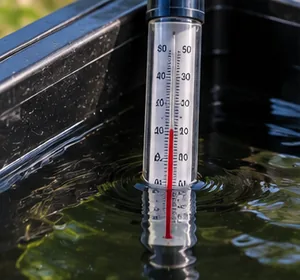
- A thermometer in the reservoir in summer: it tells you at a glance whether both the roots and the plastic are comfortable.
7. Common mistakes
| Mistake | Why it is a problem | The fix |
|---|---|---|
| Assuming code 2 or 5 is enough | The code identifies the resin, not food suitability | Look for a food-grade marking (in Europe, the glass-and-fork symbol) |
| PVC garden hose in a tower | Plasticizers, unknown origin | Polyethylene, silicone or drinking-water-rated tubing |
| Reclaimed chemical jug | Residues, plastic not made for food | Reclaimed food-grade bucket (bakery, deli) |
| Clear reservoir in full sun | Hot solution, algae, aging plastic | Opaque reservoir, in the shade |
| Old polycarbonate water bottle or box | May contain bisphenol A | HDPE, PP or glass |
| PLA printed parts | Break down in warm water | PETG or ASA |
8. Key takeaways
Have a question about a specific container? Post a photo of the code and the marking on the forum.
Frequently asked questions
What is the safest plastic for a hydroponic reservoir?
A tub or bucket made of high-density polyethylene (code 2) or polypropylene (code 5) that also carries a food-grade or food-safe marking (in Europe, the glass-and-fork symbol). The code alone tells you the resin, not that the manufacturer has checked it for food contact.
Can I use plastic bottles for the Kratky method?
For a short crop, kept cool and out of the sun, yes, as long as you make them opaque. PET bottles are designed for single use: at room temperature, Westerhoff and colleagues measured no rise in antimony over three months, but heat clearly speeds it up. A covered glass jar remains the best choice for Kratky.
Are PVC pipes dangerous for a tower or NFT system?
Rigid PVC pipe rated for drinking water (potable water) is widely used. Flexible PVC tubing, on the other hand, contains plasticizers: choose flexible polyethylene or silicone tubing, or tubing rated for drinking water or food contact.
Do hydroponic plants absorb microplastics?
The question is still open. Li and colleagues (2020) showed in the lab that 0.2 and 2 µm polystyrene beads entered lettuce and wheat roots through the cracks where lateral roots emerge. A Kansas State team working with NFT found no trace of nanoplastics in lettuce leaves (2025). Neither study measures a health risk.
Are 3D-printed parts safe in contact with the nutrient solution?
For net pots, collars or fittings, PETG or ASA work better than PLA, which breaks down in warm water. Prusa Research does advise against using prints as food containers, though: the layers trap bacteria and the colorants are not always certified. See our article on filaments.
- P. Westerhoff, P. Prapaipong, E. Shock and A. Hillaireau, Antimony leaching from polyethylene terephthalate (PET) plastic used for bottled drinking water, Water Research 42(3), 2008
- L. Li, Y. Luo et al., Effective uptake of submicrometre plastics by crop plants via a crack-entry mode, Nature Sustainability 3, 2020
- A. Cloyd, D. Boyle, K. Williams and M. B. Kirkham, Kansas State University, No evidence for polystyrene nanoplastic uptake by lettuce grown in nutrient film technique hydroponics systems, ASHS annual conference, 2025
- Regulation (EC) 1935/2004 on materials in contact with food
- Regulation (EU) 10/2011 on plastic materials in contact with food
- Regulation (EU) 2024/3190 on bisphenol A
- Regulation (EU) 2018/2005 (phthalates, REACH)
- Oklahoma State University Extension, Building a Vertical Hydroponic Tower (HLA-6724)