Equipment
pH and EC meters: choosing, calibrating and caring for your measuring tools
Pen, meter with a replaceable probe, test strips or drops: which tool to use to measure the pH and EC of your solution, how to read the ppm of a TDS meter, calibrate at two points, measure correctly, store the pH probe and know when to replace it.
A good meter won't grow your lettuce, but it prevents almost every nutrient solution mistake: too strong, too weak, too acidic. You still have to pick the right tool, read the right unit, calibrate it and store the probe properly. Here is the complete how-to, jargon-free.
1. What we measure, and why
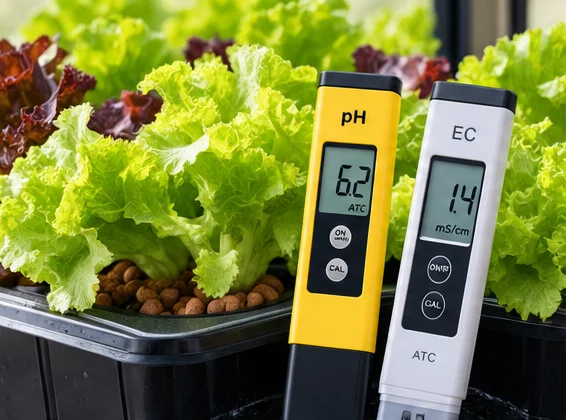
- EC (electrical conductivity) tells you how much nutrient salt is dissolved in the water: it is the concentration of the solution. It is expressed in mS/cm (or in µS/cm, a thousand times larger).
- pH tells you whether the solution is acidic or alkaline. It determines nutrient availability: outside the right range, the plant runs short of iron or phosphorus even if the solution contains them. Oklahoma State University puts the nutrient solution between 5 and 6, often around 5.5.
- Finally, the temperature of the solution changes the EC reading and the amount of dissolved oxygen: see DWC and air pumps.
Oklahoma State University's rule: check pH and EC every day, at the same time, and adjust EC first, then pH. The full method is detailed in pH and EC of the solution.
2. Which tool should you choose?
| Tool | Best for | Strengths | Limitations |
|---|---|---|---|
| Test strips, drops | First Kratky jar | Cheap, nothing to calibrate | pH only, read by eye, not very accurate |
| pH pen | One or two reservoirs | Compact, fast, can be calibrated | Built-in probe: when it dies, you replace the whole pen |
| EC (or TDS) pen | Any system | Rugged, low maintenance | Check the unit: EC or “ppm” |
| pH, EC and temperature combo meter | One main system | One device, three readings | If the pH part fails, the whole device is affected |
| Meter with replaceable probe | Several reservoirs, daily use | pH probe can be replaced on its own, often more accurate | Higher upfront cost |
| Connected sensors | Continuous monitoring | History, alerts | Calibration and manual checks still required; see automation |
What to check before buying
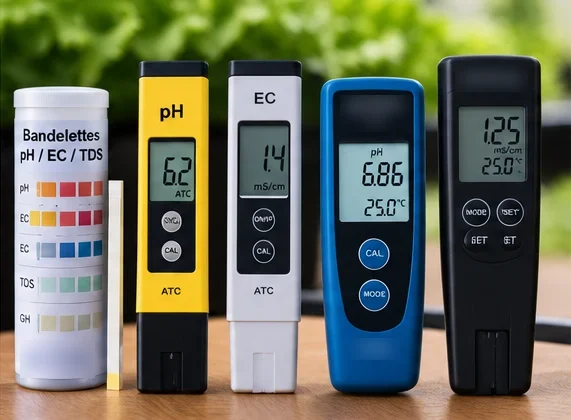
- Automatic temperature compensation (ATC): essential for EC, whose value changes by 0.5 to 3% per degree Celsius according to the USGS.
- EC display (mS/cm or µS/cm), not just ppm.
- Two-point calibration for pH (pH 7 and pH 4).
- Resolution of 0.1 or better for pH, 0.1 mS/cm for EC.
- Replaceable probe or a reasonable replacement price: the pH probe is a wear part.
- Buffers and storage solution easy to find.
3. EC, TDS, ppm: don't mix up the units
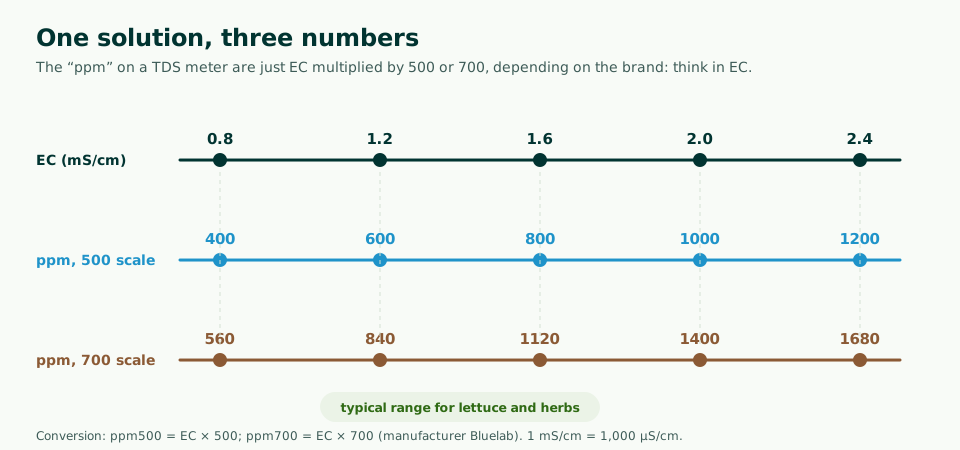
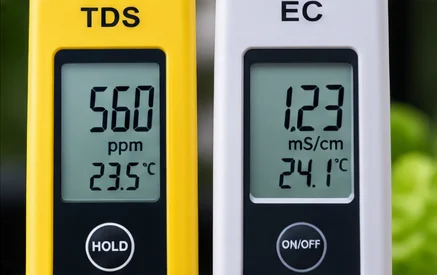
Many cheap meters display “ppm” (or TDS, total dissolved solids). They actually measure EC, which they multiply by a factor chosen by the manufacturer: 500 or 700. The same solution can therefore read 700 ppm on one meter and 980 ppm on another.
4. Calibrating
Two-point calibration of a pH meter
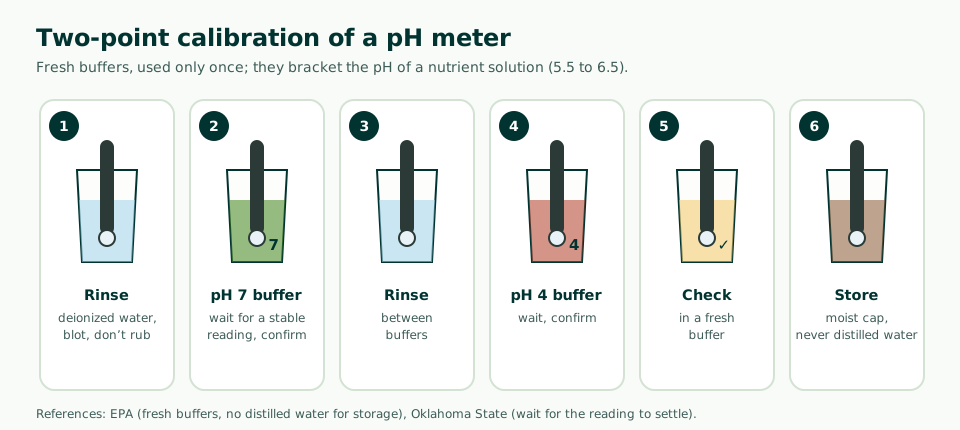
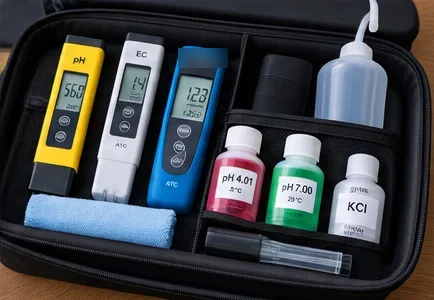
- Get readypH 7 and pH 4 buffers, at room temperature, 20 to 25 °C (68 to 77 °F) according to the EPA, poured into two small clean cups. A little in the bottom is enough.
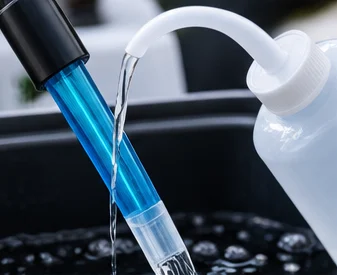
- Rinse the probeWith deionized water, then blot with soft paper, without rubbing: the EPA calls for blotting, not wiping.
- pH 7 bufferDip, stir gently, wait for the value to settle (this can take a minute or two, notes Oklahoma State University), confirm as described in the manual.
- RinseBetween two buffers, always: otherwise the first contaminates the second.
- pH 4 bufferSame steps. pH 4 and pH 7 bracket the pH of a nutrient solution: the EPA calls for buffers that bracket the values to be measured.
- Check and discardDip again in a little fresh pH 7 buffer: the reading should be very close to 7. Then discard the used buffers: the EPA uses them only once, never reused.
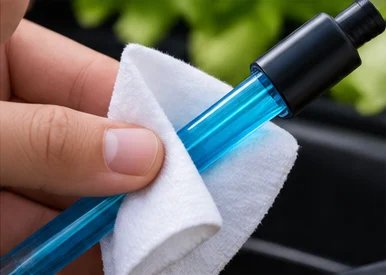
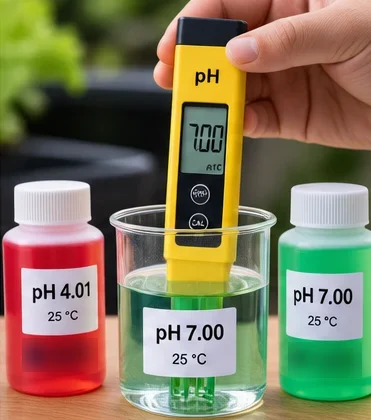
For EC, same principle with a single calibration solution, usually 1.41 mS/cm (Oklahoma State). The USGS notes that a conductivity meter holds its calibration well: no need to redo it constantly, but check it regularly in the reference solution.
Some meters display the “slope” after calibration. For its lab pH meters, the EPA requires a slope of 100% ± 5%: below that, the probe is aging.
5. Measuring correctly
- Stir the solution before measuring, then wait for the reading to settle (Oklahoma State).
- Always in the same spot, at the same time: not right after adding nutrients or a pH adjuster; let the pump or the air pump and air stone mix it.
- EC first, pH second: adding nutrients shifts the pH (Oklahoma State).
- Rinse the probe with clean water after each measurement.
- Write it down: date, EC, pH, temperature. The history is what reveals drift.
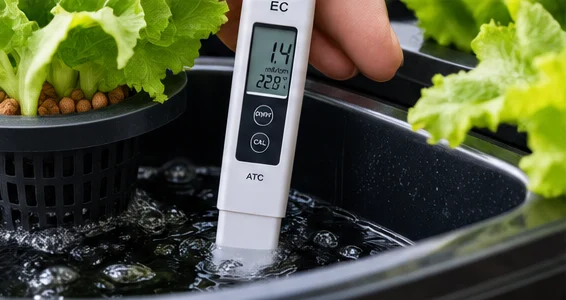
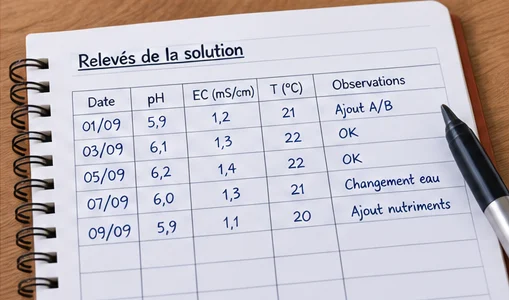
6. Storage and maintenance
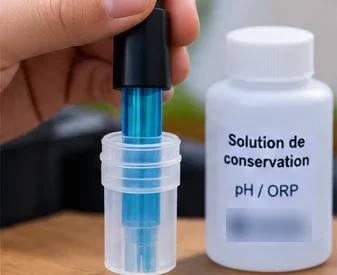
- EC probe: rinse with tap water and store in the liquid specified by the manufacturer (Oklahoma State).
- Clean biofilm or nutrient deposits with a suitable cleaning solution, then recalibrate.
- Buffers tightly closed, away from heat, and replaced according to their date.
- Batteries: a weak battery gives erratic readings before it dies.
When should you replace the pH probe?
| Symptom | What's happening | What to do |
|---|---|---|
| Reading slow to settle | Dirty or aging probe | Clean, soak in storage solution, recalibrate |
| Calibration rejected | Slope too low | Clean, fresh buffers; otherwise replace |
| Drift from one day to the next | Worn or dried-out probe | Replace the probe or the pen |
| Discrepancy with a second meter | One of them is wrong | Measure in a fresh buffer to settle it |
7. Common mistakes
| Mistake | Consequence | The fix |
|---|---|---|
| Confusing ppm 500 and ppm 700 | Solution 40% too strong or too weak | Think in EC |
| Reusing buffers | Skewed calibration | Fresh buffers, discarded after use |
| pH probe stored dry or in distilled water | Sluggish probe, then dead | Cap with storage solution |
| Measuring right after an addition | Local reading, not the reservoir's | Mix, wait, then measure |
| No temperature compensation | EC that varies with the room | ATC meter |
| Correcting pH before EC | Two corrections instead of one | EC first, pH second |
To go further: adjusting pH and EC, nutrients, and your questions on the forum.
Frequently asked questions
Do I need a pH meter and an EC meter, or a combo meter?
Both work. A combo meter is handy for a single reservoir; two separate meters let you replace the pH probe, which wears out faster, without throwing away the EC part. Oklahoma State University mentions both options.
Are test strips and drops good enough?
For the pH of a first Kratky jar, a color test gives you a ballpark figure. As soon as you correct often or grow demanding plants, a calibrated electronic meter is more accurate and faster. For EC, there is no simple alternative to a conductivity meter.
How often should I calibrate?
pH, regularly: before an important series of measurements, and whenever in doubt; a weekly check in a pH 7 buffer is a good habit. EC holds its calibration well according to the USGS: check it from time to time with the calibration solution.
My pH probe takes a long time to settle. What should I do?
Clean it, let it soak in its storage solution, then recalibrate. If it stays slow, refuses calibration or drifts from one day to the next, it is at the end of its life: replace the probe, or the pen.
What is the difference between µS/cm and mS/cm?
A factor of one thousand: 1 mS/cm = 1,000 µS/cm. A lettuce solution around 1.2 mS/cm reads 1,200 µS/cm on some meters.
- Oklahoma State University Extension, Electrical Conductivity and pH Guide for Hydroponics (HLA-6722)
- U.S. Environmental Protection Agency, Calibration and Maintenance of pH Meters (SOP EQ-01-10)
- U.S. Geological Survey, Specific Conductance (Techniques and Methods 9-A6.3)
- Bluelab, What are the different conductivity scales?