Part IV · Grow
Harvest quality: what to know about nitrates and hygiene in hydroponics
Do hydroponic lettuces contain more nitrates? What EFSA and the EU limits say, how to lower nitrate levels through light, dosing and harvest time, and which hygiene rules to follow from water to plate for a safe harvest.
“I read that hydroponic lettuce is loaded with nitrates.” The question comes up often on the forum. The answer comes in two parts: nitrates depend mainly on light and dosing, not on growing without soil; and a safe harvest also depends on hygiene, from the reservoir water all the way to the plate.
1. Where do nitrates come from?
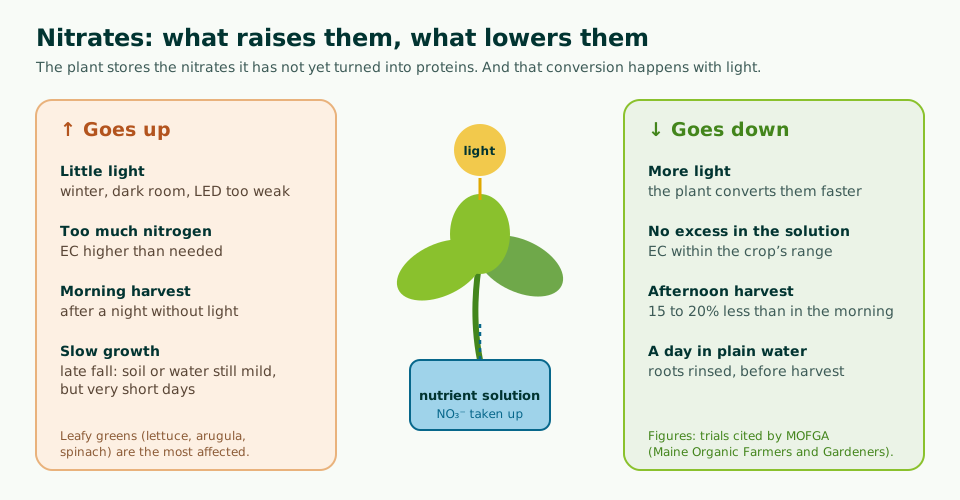
Nitrate is the main form of nitrogen that plants take up, in the ground as in hydroponics. The plant then turns it into proteins, and that conversion requires light. Until it has finished the job, it stores the surplus in its leaves and stems.
That is why leafy greens, lettuce, arugula, spinach, are naturally the richest in nitrates, and why they contain more in winter, when days are short (MOFGA, EFSA).
2. Is it dangerous?
The European Food Safety Authority (EFSA) settled the matter in 2008: the benefits of a diet rich in vegetables outweigh the risk from nitrates. A few benchmarks from its opinion:
- The acceptable daily intake is 3.7 mg of nitrate per kg of body weight, or about 260 mg a day for a 70 kg (154 lb) adult.
- A typical consumer, who eats about 400 g of varied vegetables a day, stays within the limits.
- Heavy eaters of leafy greens, about 2.5% of Europeans, may exceed it; for arugula, EFSA cites a threshold of about 47 g a day.
- Washing, peeling and cooking reduce exposure further.
3. EU limits, for reference
The European Union sets maximum levels for vegetables sold: Regulation (EU) No 1258/2011, carried over by Regulation (EU) 2023/915. A home garden is not subject to them, but these figures give an order of magnitude. An indoor crop under LEDs compares with the “under cover” values.
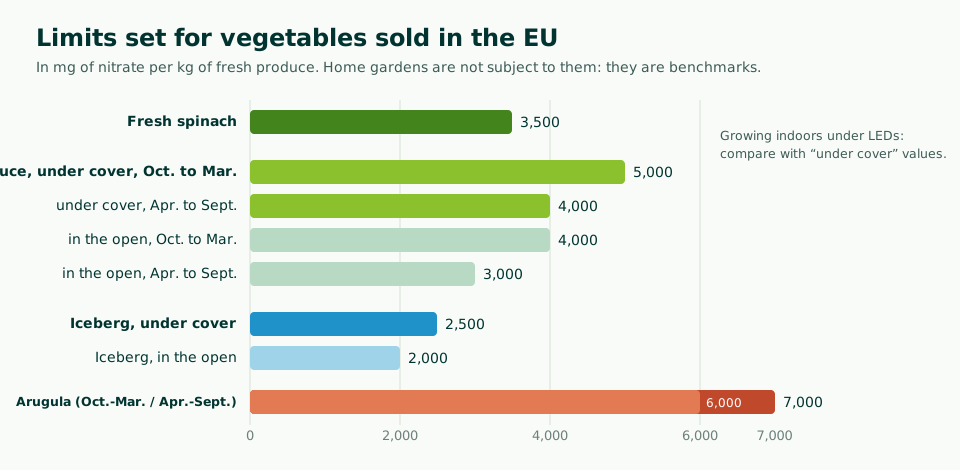
For comparison, the Luxembourg authorities measured an average of about 2,070 mg/kg in spinach, 1,010 in iceberg lettuce and 4,330 in arugula sold in Luxembourg.
4. Lowering nitrates at home
- Give it light. This is the main lever. In a recent trial on NFT-grown lettuce, a stronger LED brought nitrates down from about 2,440 to 2,090 mg/kg, with bigger, sweeter lettuces (Nitrogen journal, 2026). See grow lights.
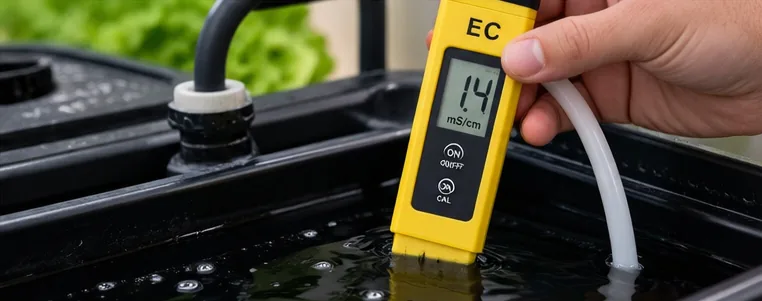
- Don’t overdose. Stay within the crop’s EC range: above it, the plant takes up more nitrogen than it converts. See pH and EC.
- Harvest in the afternoon. After a day of light, the lettuce has converted part of its nitrates: 15 to 20% less than in the morning according to trials cited by MOFGA.
- A day in plain water. Roots rinsed, plant set in plain water for a day before harvest: nitrates drop with no loss of quality (MOFGA). Handy in Kratky or DWC, for a whole-plant harvest.
- Watch out in late fall. Water still lukewarm, very short days: this is when nitrates climb the most. Supplement windowsill light.
- Mix it up. Alternate arugula, lettuce, mâche (corn salad) and fruiting vegetables: this is also the first piece of advice from health authorities.
A “low-nitrate” harvest
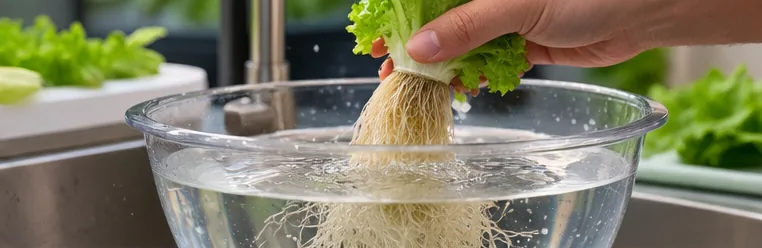
- The day before, late morningTake the lettuce out of its net pot or jar, gently rinse the roots with clean water.
- A day in plain waterSet it in a container of plain water, under the usual light, lamps on.
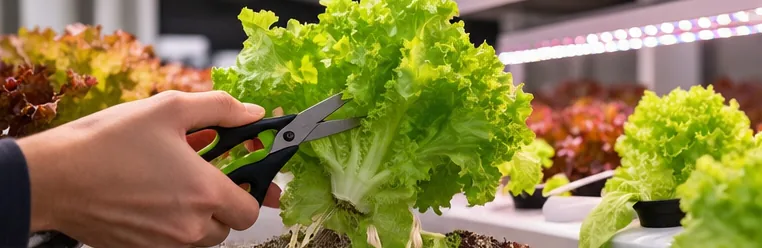
- The next afternoonHarvest after several hours of light, with clean scissors.
- Chill itRinse, spin dry, and into the refrigerator within two hours.
5. Hygiene, from water to plate
A hydroponic lettuce grows without soil, but not without microorganisms. Water flows everywhere: if it is contaminated, it can spread bacteria and molds throughout the system, and leaves, roots, trays and tools are all contact surfaces (University of Illinois Extension). The Ohio State University good practices guide sums up the essentials.
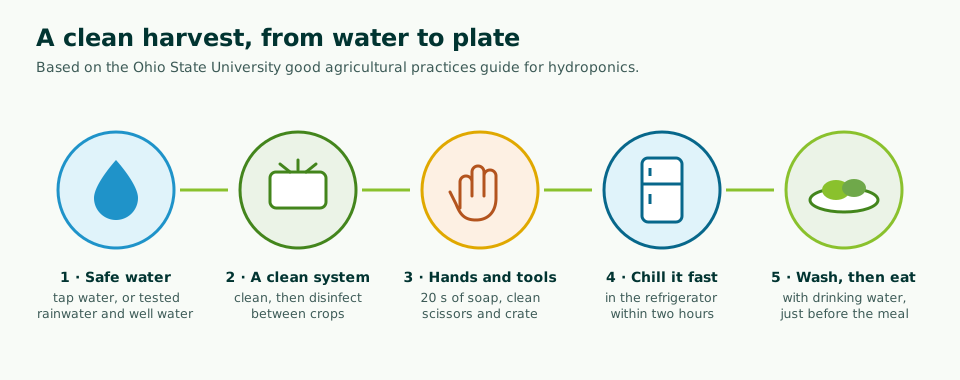
- A safe starting water. Tap water is tested by the utility. Well water or a rainwater tank should be tested at least once a season. Never untreated rainwater on the leaves. See rainwater.
- A renewed solution. A solution that sits stagnant for a long time, warm and full of debris, favors microorganisms. Remove dead leaves, keep the solution below 25 °C (77 °F) and change it regularly. See maintenance routines.
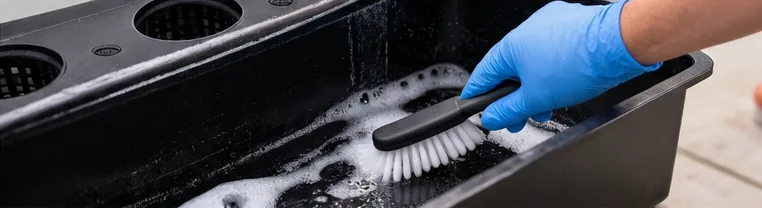
- Clean, then disinfect. “You can’t disinfect a dirty surface”: scrub and rinse first, then disinfect, between crops. The step-by-step protocol: cleaning and disinfecting between crops. Smooth materials (plastic, glass, stainless steel) clean up better than wood or used rockwool.
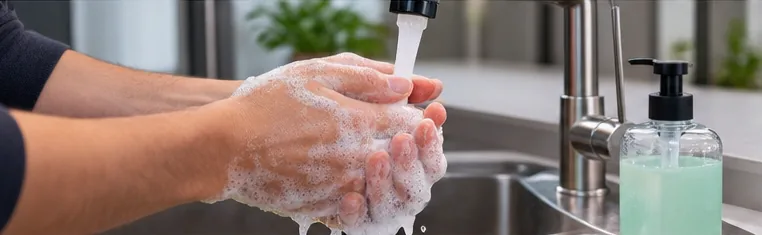
- Washed hands. At least 20 seconds with soap, under running water, before harvesting. In aquaponics, wash your hands after touching the water or the fish. See aquaponics.
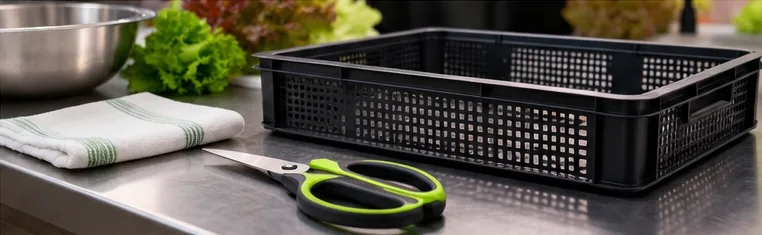
- Clean tools and containers. Scissors, crate or bowl washed, set down somewhere other than the floor.
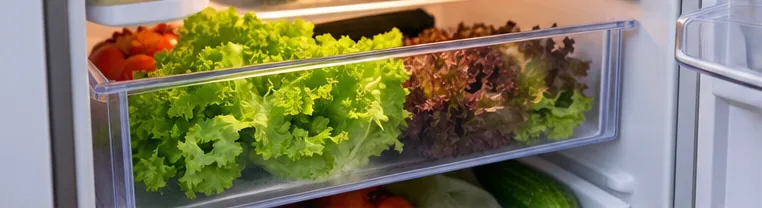
- Chill it, fast. The Ohio State University guide aims for 4 °C (39 °F) at most within two hours after harvest: at home, that means the refrigerator crisper drawer.
- No animals. Cats, birds and rodents away from the systems; a leaf soiled by droppings goes in the trash, along with the leaves around it.
- Washed before eating. With drinking water, even if the lettuce “looks clean.”
6. Microgreens and sprouts
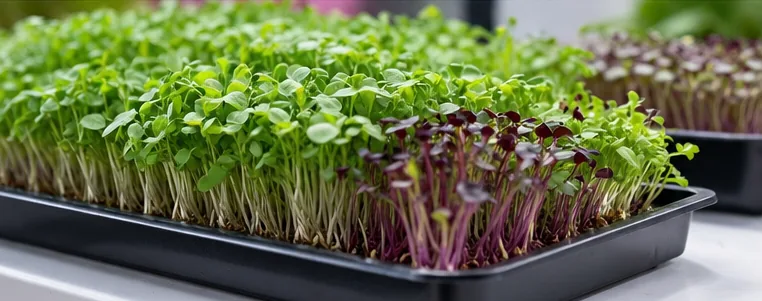
For microgreens, the risk comes mainly from the seeds: untreated seeds can carry microorganisms, which then stay on the seedlings and contaminate the water and surfaces (University of Illinois Extension). Choose seeds sold for sprouting, wash trays and jars between sowings, and throw out any tray that smells bad or gets moldy. Sprouts, which grow in warmth and darkness, demand even more rigor. See microgreens.
7. Key takeaways
Keeping track of your practices? Log the harvest time, light and EC in your online grow log, and share your observations on the forum.
Frequently asked questions
Do hydroponic lettuces contain more nitrates?
Not by nature. All leafy greens accumulate nitrates, especially when light is lacking. A poorly lit indoor lettuce in winter can contain a lot; the same lettuce well lit, with a solution dosed without excess and harvested in the afternoon, contains clearly less.
Should I stop the nutrients before harvest?
A day in plain water, roots rinsed, lowers nitrates without harming the lettuce, according to trials cited by MOFGA. No need to go further: a plant deprived of nutrients for too long turns yellow and loses flavor.
Does washing remove nitrates?
A little: 8 to 15% depending on the method, according to the Luxembourg authorities. Washing mainly removes dust and microorganisms. For nitrates, how you grow the crop is what counts.
Can I water or wash lettuce with rainwater?
For the nutrient solution, yes, with the precautions in our rainwater guide. But never spray the leaves with untreated rainwater, and always wash with drinking water before eating.
Are microgreens riskier?
The risk comes mainly from the seeds, which can carry microorganisms. Use seeds sold for sprouting, a clean growing medium and trays, and washed hands. Sprouts, which grow in the dark and warmth, call for even more precautions.
- EFSA, Nitrate in vegetables, opinion of the CONTAM Panel (2008)
- EFSA, Nitrites and nitrates added to food (2017)
- Regulation (EU) No 1258/2011, maximum levels for nitrates, carried over by Regulation (EU) 2023/915
- Luxembourg food safety authority (Sécurité alimentaire Luxembourg), Les nitrates dans l’alimentation humaine (fact sheet F-225)
- MOFGA, Nitrate Accumulation
- Ohio State University, Good Agricultural Practices Guide for Hydroponic Production Systems
- University of Illinois Extension, Food safety considerations for hydroponic production (2025)
- Cojocaru Jerca et al., Evaluating LED Light Intensity as a Low-Cost Strategy to Minimize Nitrate Accumulation in NFT-Grown Lettuce, Nitrogen (MDPI), 2026