Part III · Water and nutrients
Oxygen and solution temperature: the duo behind healthy roots
Warm water holds less oxygen, while roots need more of it. The right benchmarks for temperature and dissolved oxygen, how each system oxygenates its roots, how to cool a reservoir in summer, warm it in winter, and measure it all without lab equipment.
We watch the pH, measure the EC, choose our nutrients carefully… and often forget the water temperature. Yet it decides how much oxygen is available to the roots. Water that is too warm suffocates, water that is too cold slows everything down. Here are the benchmarks, system by system and season by season.
1. Warm water holds less oxygen
Roots breathe: they use oxygen to take up water and nutrients. In hydroponics, they only have the dissolved oxygen in the solution, measured in milligrams per liter (mg/L). And the maximum amount of oxygen water can hold, its saturation, drops as the temperature rises.
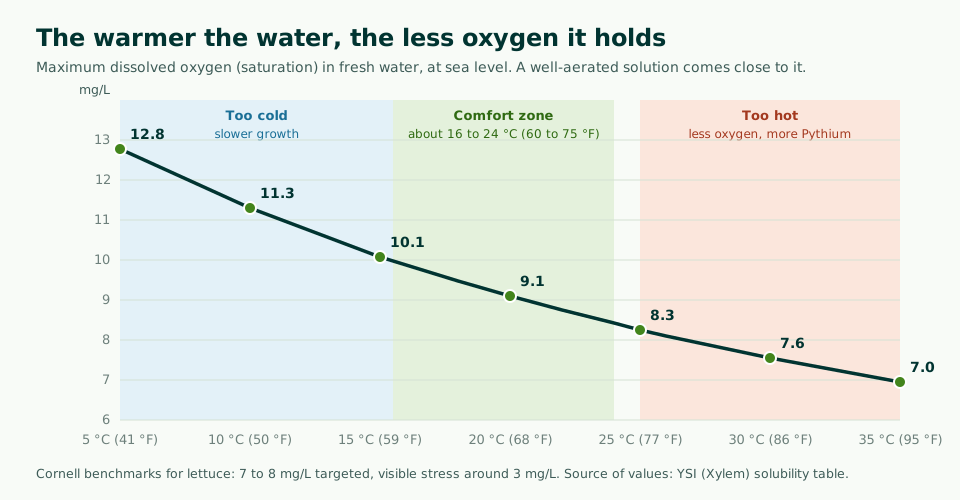
The trap is the double squeeze: as water warms up, it holds less oxygen, and at the same time roots breathe faster and need more of it. A reservoir that is doing fine at 20 °C (68 °F) can run short at 28 °C (82 °F), with nothing else having changed.
2. Benchmarks to know
| Parameter | Benchmark | Source |
|---|---|---|
| Dissolved oxygen, target | 7 mg/L, in practice kept around 8 (7 to 10); no benefit in going up to 20 | Cornell, Hydroponic Lettuce Handbook |
| Dissolved oxygen, warning | Growth slowed below 4 mg/L; visible stress around 3 mg/L; crop failure below that | Cornell |
| Temperature, general range | About 16 to 24 °C (60 to 75 °F) | University of Connecticut (J. W. Bartok) |
| Salad greens, strawberries | Rather the low end of the range; no more than 25 °C (77 °F) for lettuce | UConn; Cornell |
| Tomatoes, cucumbers | Rather the high end of the range, around 24 °C (75 °F) | UConn |
Trials confirm it. With lettuce, a root zone at 25 °C (77 °F) produced more biomass, both leaves and roots, than at 15 °C (59 °F) or 35 °C (95 °F) (Levine et al., Annals of Botany, 2023). In an NFT trial on seventeen varieties, a solution held at 21 °C (70 °F) produced lettuces 15% heavier than a solution left at the greenhouse air temperature (20 to 26.5 °C (68 to 80 °F) on average); at 18 °C (64 °F), they were sweeter than at 21 °C (70 °F) (Thakulla et al., 2021).
3. Each system oxygenates in its own way
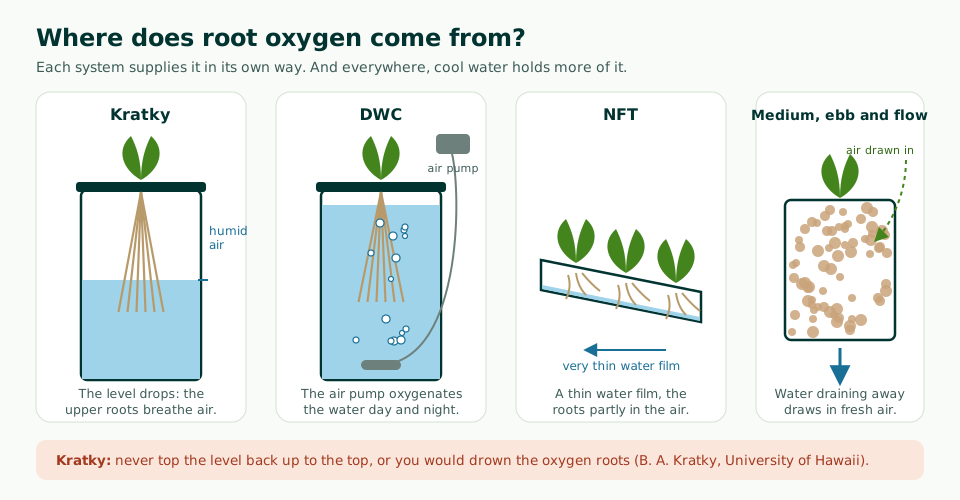
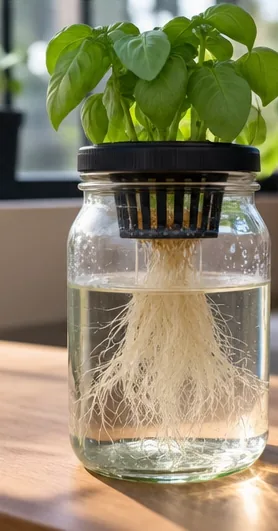
- Kratky. No pump: as the plant drinks, it lowers the level and frees up a layer of humid air. The roots that grow there, the “oxygen roots,” handle respiration; those that dip into the water take up water and nutrients. Hence the rule from B. A. Kratky (University of Hawaii, 2009): the level can stay steady or drop, never rise back up to the top, or the plant drowns. See the Kratky method.
- DWC. The roots are submerged all the time: the air pump and air stone supply oxygen, day and night. It is the system most sensitive to heat. See DWC and air pumps.
- NFT. A film of water a few millimeters deep flows along the channel; the top of the roots stays in the air. In summer, the solution warms up in channels exposed to the sun. See setting the slope of an NFT system.
- Growing medium, ebb and flow, drip. As the water drains away, it draws air in between the particles. A medium that stays waterlogged, because it is too fine or poorly drained, deprives the roots of air. See growing media.
- Towers. Water trickling down and falling back into the reservoir picks up oxygen along the way; an air pump and air stone in the reservoir is still good insurance. See building a tower.
4. Summer: when the solution heats up
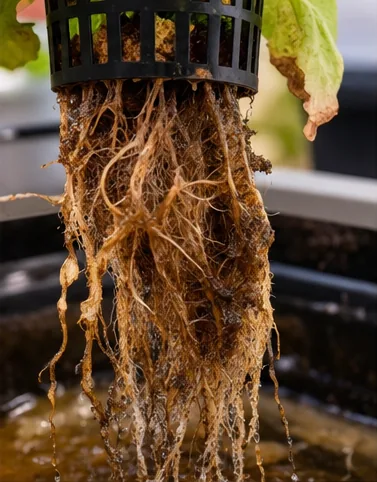
Heat piles up every problem: less oxygen, roots that need more of it, a solution that evaporates and gets more concentrated, and above all Pythium, the waterborne organism that rots roots. In a University of Arizona trial on hydroponic spinach, Pythium aphanidermatum caused severe rot, even plant death, within three to four days at 21 and 27 °C (70 and 81 °F), while at 17 °C (63 °F) it did not reduce the harvest (Gold and Stanghellini, 1985).
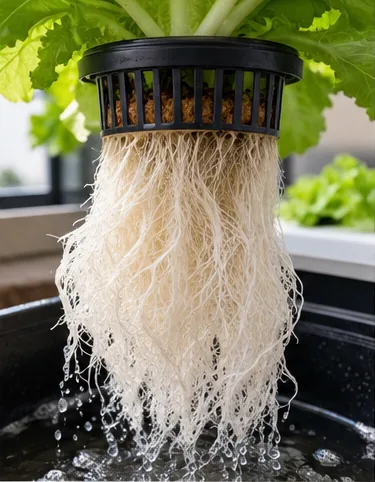
Cooling pays off. In Texas, a solution cooled to 23 °C (73 °F), instead of about 30 °C (86 °F) without control, held 7.5 mg/L of oxygen instead of 6.7, and produced 9 to 21% more lettuce depending on the trial (Hooks et al., 2022).
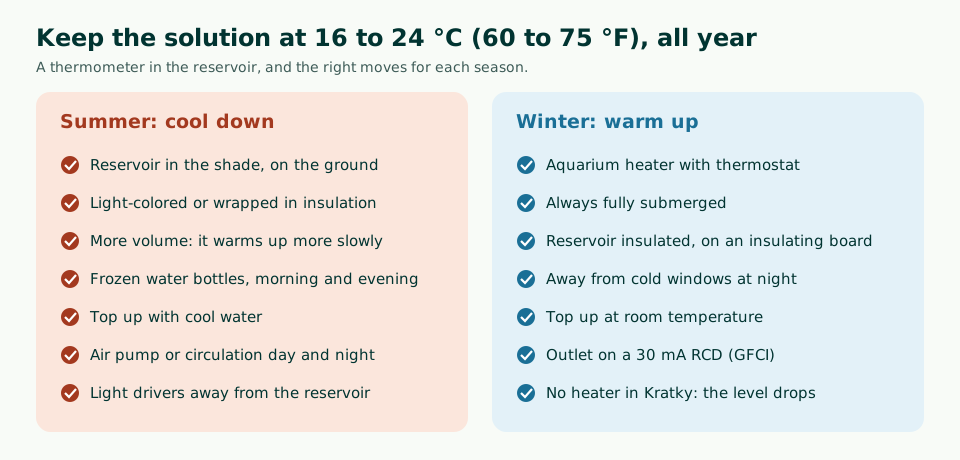
- In the shade and on the ground. A reservoir on a patio in full sun or on a high shelf near a picture window heats up fast. See the patio.
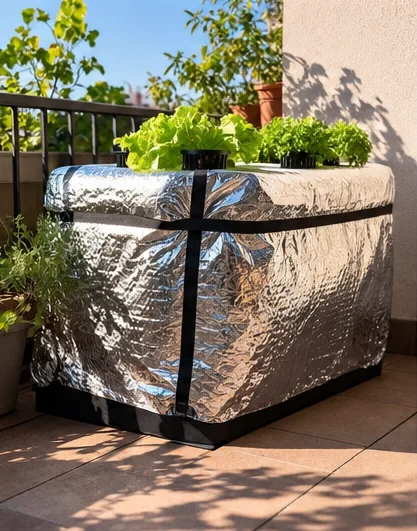
- Light-colored or wrapped. An opaque but light-colored reservoir, or one wrapped in reflective insulation, heats up less than a black reservoir in the sun.
- More volume. A large reservoir takes longer to heat up than a small bucket: in summer, 40 L (10 gal) is better than 10 L (2.5 gal).
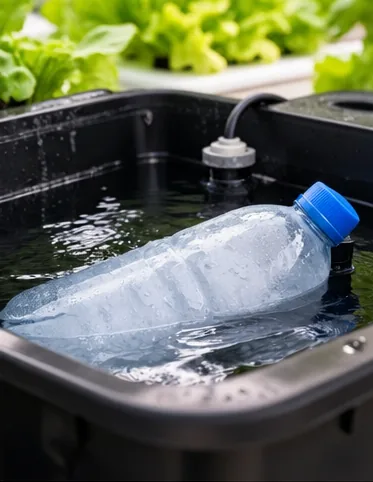
- Frozen bottles. A clean, closed water bottle placed in the reservoir brings the temperature down during heat waves. Swap it morning and evening.
- Cool top-ups. Top up the level with cool tap water rather than with a watering can that has been sitting in the sun.
- Aeration day and night. Air pump or circulation with no breaks during hot spells.
- Heat from equipment. Light driver, submersible water pump: anything that gives off heat near or in the reservoir warms the solution. Move the driver away, and use a pump that sits outside the water when possible. See choosing a pump.
- For a large system, an aquarium chiller; Cornell sets its ponds to start cooling at 26 °C (79 °F).
Getting through a heat wave without losing your roots
- As soon as heat is forecastFreeze three or four water bottles, from half a liter to 1.5 L (17 to 50 oz), well washed and closed.
- Move or protect the reservoirIn the shade, on the ground; otherwise, wrap it in an emergency (Mylar) blanket, silver side facing out.
- In the morningCheck the solution temperature. Above 24 °C (75 °F), put a frozen bottle in the reservoir.
- In the eveningMeasure again, replace the bottle, top up the level with cool water. Check the EC: evaporation pushes it up.
- A look at the rootsWhite and firm: all is well. Brown, slimy, smelly: see diseases and pests.
5. Winter: when the solution cools down
Conversely, a cold solution slows everything down: the plant takes up less and grows fewer, smaller leaves (University of Connecticut). This is common in a sunroom, a garage, a poorly heated room or near a window at night. In the Texas trial, a solution heated to 22 °C (72 °F), instead of 16 to 20 °C (61 to 68 °F) without control, produced from 18% to more than double the red lettuce, depending on varieties and trials (Hooks et al., 2022).
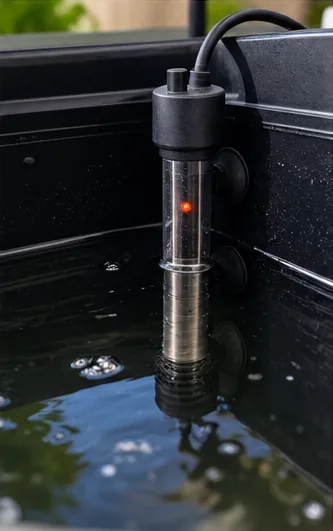
- An aquarium heater with thermostat, set around 20 °C (68 °F), in constant-level reservoirs: DWC, NFT or tower reservoir.
- Always fully submerged, at the depth stated by the manufacturer, and unplugged before taking the device out of the water.
- No heater in Kratky. The level drops by design: the device would end up out of the water.
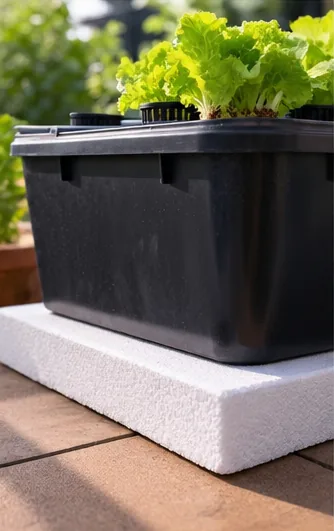
- Insulate. A sheet of polystyrene foam or cork under the reservoir, rather than cold tile; insulating panels on the sides.
- Away from windows at night. A windowsill can lose several degrees in a few hours in winter.
- Room-temperature top-ups. Let top-up water sit for a few hours at room temperature.
- Electrical safety. Water and electricity: an outlet protected by a 30 mA residual current device (RCD, the European counterpart of a GFCI), a drip loop on the cords, a raised power strip.
6. Measuring without lab equipment
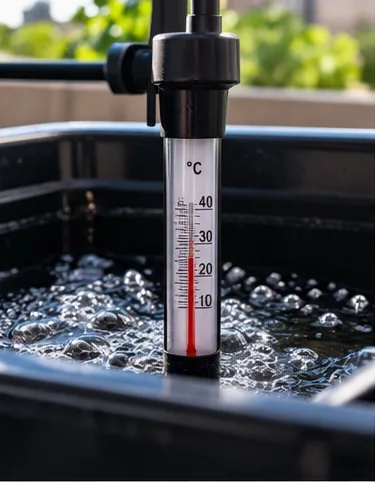
- A thermometer in the reservoir. Kitchen or aquarium thermometer: it is the most useful tool in this article. Measure at the same time each day, plus once in late afternoon on hot days.
- A min-max thermometer or a connected probe to know the day and night extremes. See automating your garden.
- The roots, your best indicator. White to cream, firm, with lots of fine root hairs: all is well. Brown, soft, slimy, smelly: lack of oxygen or Pythium. See diagnosing problems.
- A dissolved oxygen meter? Useful for a large system, but a reliable model costs much more than a pH tester. For a hobby garden, well-aerated water at the right temperature is enough: it comes close to saturation on the curve above.
7. Common mistakes
| Mistake | Consequence | The fix |
|---|---|---|
| Filling a Kratky up to the lid | Oxygen roots drowned, plant wilts | Top up only to the bottom of the roots, or not at all |
| Small black reservoir in full sun | Solution above 28 °C (82 °F), brown roots | Shade, a bigger reservoir, light-colored wrapping |
| Turning off the air pump at night | Oxygen at its lowest for hours | Aeration 24 hours a day in DWC |
| Heater in a reservoir whose level drops | Device out of the water, risk of breakage | Only for constant-level reservoirs |
| Never measuring the temperature | Problem discovered when the roots rot | A thermometer in the reservoir, readings written down |
| Topping up with very cold or very warm water | Shock for the roots | Top-up water at room temperature |
8. Key takeaways
Log your temperature readings along with pH and EC in your online grow log, and share your heat-wave tips on the forum.
Frequently asked questions
What is the right temperature for a nutrient solution?
Between about 16 and 24 °C (60 and 75 °F) for most crops, according to the University of Connecticut: the low end of the range for salad greens and strawberries, the high end for tomatoes and cucumbers. Cornell recommends not exceeding 25 °C (77 °F) for lettuce.
Do I need to buy a dissolved oxygen meter?
Not for a hobby garden. A reliable dissolved oxygen meter costs much more than a pH tester. A well-aerated solution comes close to saturation: by watching the temperature and how the roots look, you know what matters.
My roots are brown and slimy. Is it a lack of oxygen?
Often, or Pythium, which thrives precisely in warm, oxygen-poor water. Check the temperature, the air pump or the circulation, then follow our guide to diseases. Healthy roots are white to cream, firm, with no smell.
Can I put an aquarium heater in a Kratky setup?
No. In Kratky, the level drops on purpose: the heater would end up out of the water, which is dangerous for the device. Keep it for constant-level reservoirs (DWC, NFT or tower reservoir), always fully submerged.
Should I leave the air pump running at night?
Yes. Roots breathe day and night, and it is at night that oxygen drops the most in an unaerated reservoir. In DWC, the air pump runs 24 hours a day.
- YSI (Xylem), Oxygen Solubility Table (XA00055)
- Cornell University CEA, Hydroponic Lettuce Handbook (2013)
- J. W. Bartok Jr., University of Connecticut, Maintaining hydroponic solution temperature, Greenhouse Management
- B. A. Kratky, Three non-circulating hydroponic methods for growing lettuce, Acta Horticulturae 843, 2009
- S. E. Gold and M. E. Stanghellini, Effects of temperature on Pythium root rot of spinach grown under hydroponic conditions, Phytopathology 75, 1985
- Hooks, Sun, Kong, Masabni and Niu, Effect of nutrient solution cooling in summer and heating in winter on the performance of baby leafy vegetables in deep-water hydroponic systems, Horticulturae, 2022
- Thakulla, Dunn, Hu, Goad and Maness, Nutrient solution temperature affects growth and °Brix parameters of seventeen lettuce cultivars grown in an NFT hydroponic system, Horticulturae, 2021
- Levine et al., Controlling root zone temperature improves plant growth and pigments in hydroponic lettuce, Annals of Botany, 2023