Getting started
Your first month of hydroponics, week by week: from first sowing to first harvest
Sow, strengthen, transplant, observe: a beginner's first month of hydroponics, week by week, with a cut-and-come-again lettuce. The steps, the measurements, the signs to read, the mistakes to avoid, and a calculator that gives you the dates for your own schedule.
Your gear has arrived, and so have the seeds. Now what? The first month is when you learn the most, and when you make the most mistakes: too much fertilizer, not enough light, corrections every single day. Here is a beginner's first month, week by week, with one easy crop: cut-and-come-again lettuce. The steps, the measurements, what to look for, and a calculator to set up your own schedule.
If you don't have a system yet, start with the 5 essentials and the Kratky jar: no pump, hardly any gear, and everything you need to learn.
1. What to know before day one
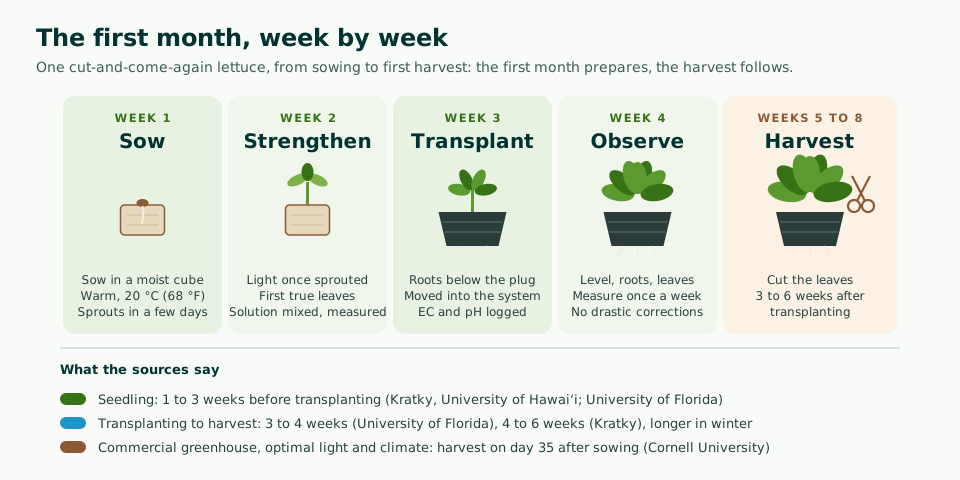
Let's be honest: the first month rarely ends with a salad on your plate. Lettuce first spends 1 to 3 weeks as a seedling, then 3 to 4 weeks in the system according to the University of Florida, or 4 to 6 weeks according to the University of Hawaiʻi, before the first harvest; winter stretches all of that out (Kratky). The University of Saskatchewan counts 6 to 8 weeks in total. Even Cornell, in a commercial greenhouse with light and climate dialed in, harvests on day 35.
- One crop only. Cut-and-come-again lettuce germinates fast, grows without a pump and is harvested leaf by leaf. Fruiting crops (tomatoes, peppers, strawberries) can come later.
- One small system. One to three Kratky jars or a small reservoir: enough to learn, not enough to lose everything.
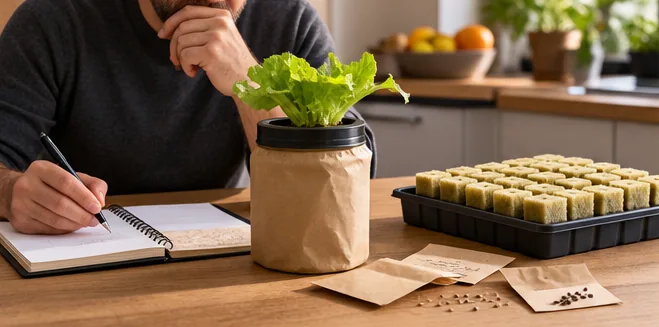
- A logbook from day one. Sowing date, variety, EC and pH, what you see. The grow logbook is made for exactly that.
- Light above all. It is what's most often missing indoors. Check your window with the lighting calculator before you sow.
2. Week 1: sow
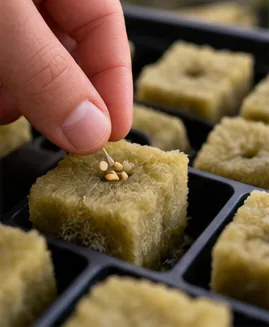
- Moisten the medium: rockwool cubes, coco coir pellets or seed plugs, well soaked then drained (see sowing and transplanting).
- Sow shallow: two or three seeds per cube, barely covered. You will keep the best seedling.
- Keep it mild: Cornell germinates its lettuce at 20 °C (68 °F) for the first 24 hours. A draft-free spot in the house, away from the heater, works fine.
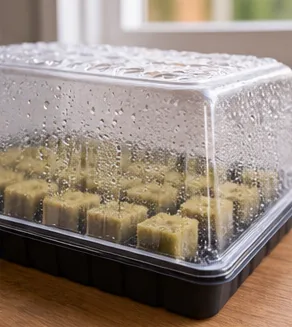
- Keep moist, not soaked: a lid or a perforated plastic film holds in humidity; open it for a few minutes every day.
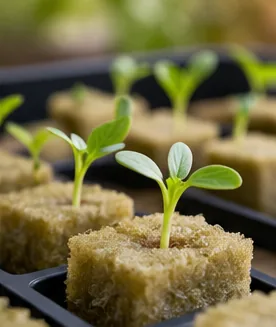
- Watch for sprouting: the first shoots show up within a few days, usually within the week (University of Saskatchewan). Write the date in your logbook.
3. Week 2: strengthen
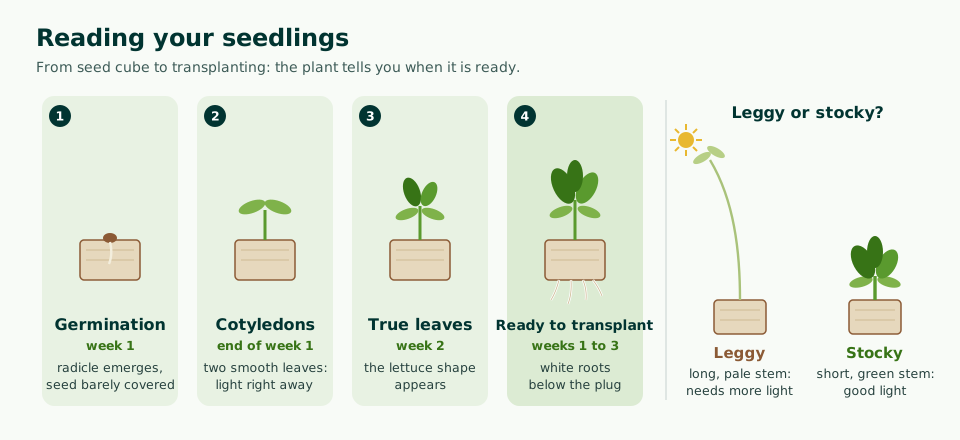
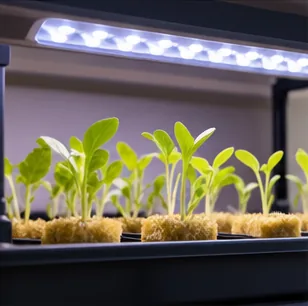
- Light as soon as they sprout. Remove the lid and put the seedlings under the lamp or in front of your brightest window. With an LED tube, the University of Saskatchewan places it about 30 cm (12 in) above the plants.
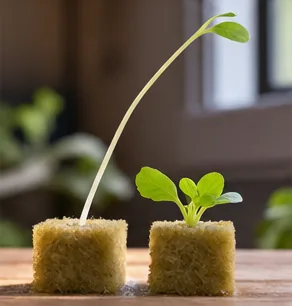
- Read the stem. Short, green and sturdy: all is well. Long, pale and leaning toward the window: the seedling is getting leggy, it needs more light.
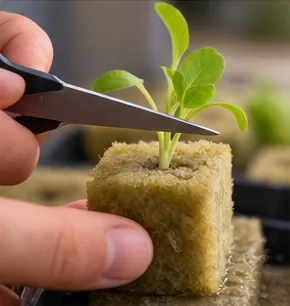
- Thin out. Keep one seedling per cube; snip the others with scissors at the surface of the medium, without pulling them out.
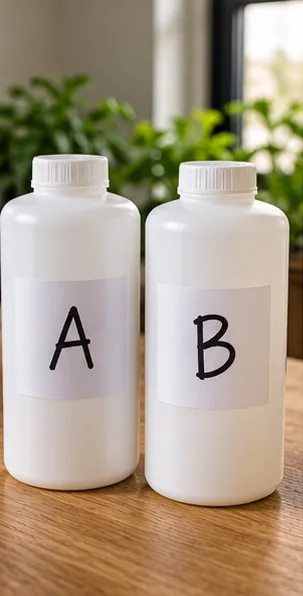
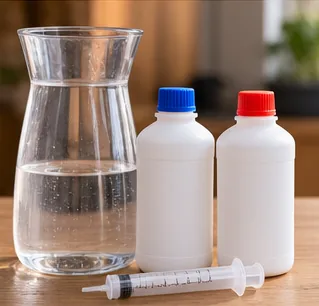
- Mix the nutrient solution. In a pitcher: water, then part A, stir, then part B, stir; never mix concentrated A and B together. Use the manufacturer's dose, then measure: see pH and EC and the nutrient calculator.
| Lettuce target | Value | Source |
|---|---|---|
| EC | around 1.2 to 1.5 mS/cm (lower in hot weather, higher in cool weather) | Cornell; University of Florida; Kratky, University of Hawaiʻi |
| pH | 5.5 to 6.5 (5.6 to 6 in Cornell's greenhouse) | Kratky; University of Florida; Cornell |
| Air | about 24 °C (75 °F) by day, 19 °C (66 °F) at night in a greenhouse | Cornell |
| Dissolved oxygen | 7 mg/L targeted, crop failure below 3 mg/L | Cornell |
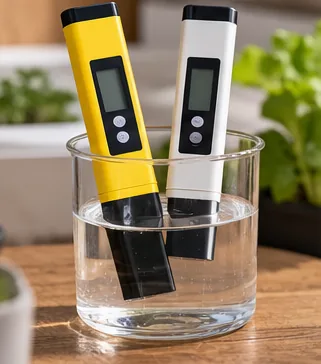
No lab needed: a calibrated EC pen and pH pen are enough (see the testers). For oxygen, a well-run Kratky jar or an air pump and air stone do the job; the reasons are in oxygen and temperature.
4. Week 3: transplant
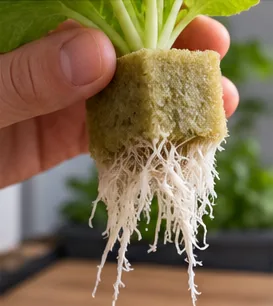
The right time is when the seedling has its first true leaves and white roots are poking out below the cube. Depending on light and season, that is one to three weeks after sowing (Kratky; University of Florida). Cornell transplants on day 11, but under round-the-clock greenhouse lighting.
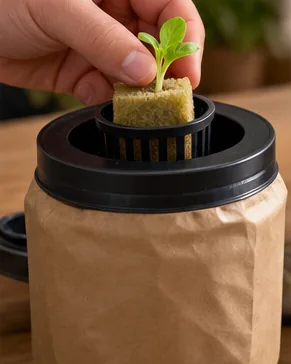
- Fill the system with the measured solution. In Kratky, the bottom of the net pot just touches the solution at the start; the University of Florida fills up to the middle of the net pots.
- Set the cube in the net pot, wedged with a few clay pebbles if needed, its base in contact with the solution.
- Write it in your logbook: date, EC, pH, volume, water temperature.
- Put it under light right away, in the same spot as the previous weeks, or a better one.
- Stop topping up a Kratky jar: as the level drops, the solution leaves an air gap where the upper roots breathe. If you do top up, never all the way to the net pot.
5. Week 4: observe
The temptation in week four is to step in every day. Resist it: a growing plant doesn't need help, it needs to be watched. The full routine is in 5 minutes a day, 30 a week.
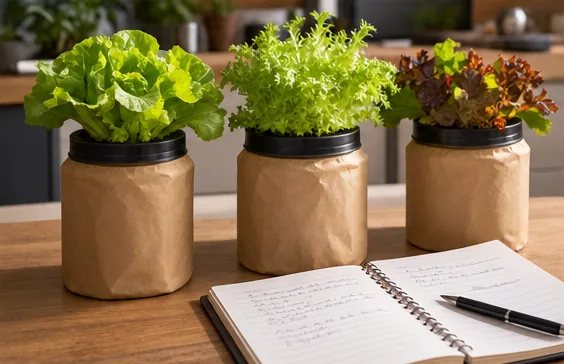
Every day, one minute
- The level: it drops, that's normal, the plant is drinking.
- The leaves: green and firm.
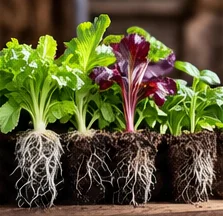
- The visible roots: white or cream, not brown or slimy.
Once a week
- EC and pH written in the logbook, with the date.
- A photo of the plant, always from the same angle.
- The outside of the tub or jar cleaned, the lamp at the right height.
A symptom? Before correcting, think it through: diagnosing problems explains how to trace back from the leaf to the cause. In a Kratky jar, the University of Florida notes that after the start, there is rarely any need to adjust the pH or the solution.
6. Your first-month schedule
Enter the sowing date and where the plants will grow: the calculator gives you sprouting, transplanting, measuring days and the window for the first harvest, based on the timings from the Universities of Hawaiʻi and Florida and from Cornell.
Ranges, not promises: variety, warmth and above all light make the call. From your second crop on, your logbook will fine-tune your own schedule.
7. How-to: the day-one checklist
Time: one hour, spread over the month. Level: beginner.
- Day -7: check the light at your spot, calibrate the pH and EC pens, clean the jars or tub.
- Day 0: sow two or three seeds per moist cube, write down the date.
- As soon as they sprout: light, thin to one seedling per cube.
- When roots come out of the cube: mix the solution, measure, transplant, write it down.
- Every week: EC, pH, photo, logbook.
- On transplanting day: sow the next batch, so you can keep harvesting without a gap (see succession sowing).
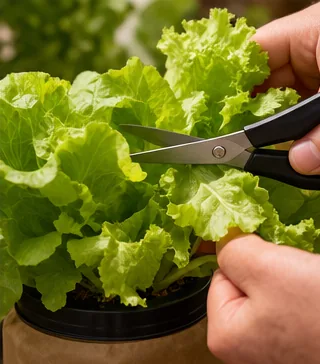
- First harvest: cut the outer leaves, let the heart grow back.
8. First-month mistakes
| Mistake | Result | The fix |
|---|---|---|
| Starting with tomatoes or strawberries | Slow, demanding, discouraging | Cut-and-come-again lettuce first |
| Sowing too deep | Slow or no sprouting | Seeds barely covered |
| Leaving seedlings without light after sprouting | Leggy, fragile plants | Lamp or best window as soon as they sprout |
| Transplanting with no visible roots | The cube dries out, the plant stalls | Wait for roots below the plug |
| Doubling the nutrient dose “to speed things up” | Burnt tips, stunted growth | Manufacturer's dose, measured EC |
| Correcting the pH every day | Plants stressed by the swings | Weekly measurement, gentle correction |
| Clear container | Algae, smothered roots | Everything opaque |
| Topping up a Kratky jar to the net pot | No more air gap, roots suffocate | Let it drop, or top up without reaching the net pot |
9. Key takeaways
Share your first month on the forum: one photo a week, and members will help you read your plants.
Frequently asked questions
How long does it take to harvest your first lettuce in hydroponics?
Allow 1 to 3 weeks as a seedling before transplanting, then 3 to 4 weeks according to the University of Florida, or 4 to 6 according to the University of Hawaiʻi, before the first cut: roughly 5 to 8 weeks after sowing at home, longer in winter. In a commercial greenhouse with optimal light and climate, Cornell harvests on day 35.
What is the best first crop for a hydroponics beginner?
A cut-and-come-again lettuce: it germinates fast, grows without a pump in a Kratky jar, gets by on a simple nutrient solution and can be harvested leaf by leaf. Basil is a good second choice. Tomatoes, peppers and strawberries can come later, once you know how to read your measurements.
When should a seedling be transplanted into the system?
When it has its first true leaves and white roots are poking out below the cube or pellet, usually one to three weeks after sowing. A seedling transplanted with no visible roots stays dry; one left too long in its cube runs out of steam.
My seedlings are long, pale and leaning: what should I do?
They are stretching for light. Move the lamp closer or run it longer, or set them in front of your brightest window as soon as they sprout. A stem that has already stretched will not get shorter: set it a little deeper in the net pot when transplanting, or sow again.
Do I need to measure pH and EC every day at the start?
No. Measure the solution when you mix it, write the values down, then check once a week. Beginners often correct too much and too fast; a pH that drifts a little within the recommended range is not a problem. In a Kratky jar, the University of Florida notes there is rarely any need to adjust after the start.
- B. A. Kratky, University of Hawaiʻi CTAHR, A Suspended Net-Pot, Non-Circulating Hydroponic Method for Commercial Production of Leafy Vegetables, VC-1, 2010
- H. Eason, University of Florida IFAS Extension, “Set It and Forget It” Hydroponic Lettuce, HS1488, 2025
- Cornell University CEA Program, Cornell CEA Lettuce Handbook, 2013
- J. Schaeffer, University of Saskatchewan, Hydroponic lettuce, 2018