Part V · Care
Hydroponic tomatoes: mistakes to avoid and how to diagnose problems
Functional diagram, not to scale.
Blossom end rot, dropping flowers, cracked or poorly colored fruit, leggy plants, curling leaves: the most common mistakes with hydroponic tomatoes, their causes and their fixes, in a diagnostic table.
A tomato plant that produces nothing, fruit that turns black or cracks: the causes are almost always the same, and almost always avoidable. Before you correct anything, measure: pH, EC, air and solution temperature, light hours and intensity. That is the method from Diagnosing: think before you correct.
The diagnostic table
| Symptom | Likely causes | What to do |
|---|---|---|
| Dry black spot on the bottom of the fruit (blossom end rot) | Not enough calcium in the fruit: EC too high, irregular water, damaged roots, intense heat | Replace the solution, steady the watering, check the calcium in your nutrients and the roots. Remove affected fruit. |
| Flowers that yellow and drop | Excess nitrogen, heat around 34 °C (93 °F), nights below 13 °C (55 °F), water or salt stress, no pollination | Vibrate the flower clusters, correct the temperature, switch to a “fruiting” fertilizer. |
| Cracked fruit | Swings in water, sudden growth spurts, large day-night temperature differences | Regular watering, stable EC, crack-resistant varieties. |
| Misshapen, scarred fruit (“catfacing”) | Cool weather during flowering, ribbed and beefsteak varieties are susceptible | Wait for milder nights, protect the greenhouse. |
| Uneven ripening, yellow shoulders | Heat above about 34 °C (93 °F), lack of potassium, excess nitrogen, viruses, whiteflies | Provide shade, adjust the nutrients, inspect the leaves. |
| White scorch on the fruit (sunscald) | Fruit exposed after overly heavy leaf removal | Remove leaves only below the ripening truss. |
| Lower leaves curling | Heavy fruit load, overly severe pruning, too much water | Often harmless; prune less, check the drainage. |
| Leaves turning yellow | Shading of the lower leaves (normal), or a lack of nitrogen, potassium, magnesium | Check the EC and the formula; magnesium is often lacking with soft water. |
| Tall, spindly plant, few flowers | Insufficient light | More light (DLI above 20), a closer or more powerful LED. |
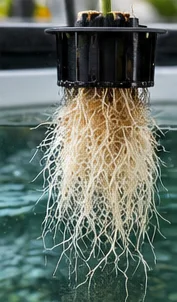
| Brown, mushy roots, bad smell | Solution too warm, lack of oxygen, Pythium | Solution around 22 to 24 °C (72 to 75 °F), aeration, full cleanout; see the encyclopedia: Pythium. |
| Mottled, blistered leaves, spotted fruit | Viruses (ToMV, ToBRFV) | Isolate and destroy the plant, disinfect all equipment. Do not save seeds. |
Symptoms and causes based on Mississippi State University Extension and the University of Alaska Fairbanks; Celsius temperatures converted from the original Fahrenheit figures and rounded.
The ten most common mistakes
1. Putting a big tomato in a tower
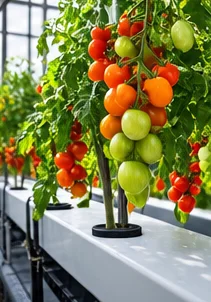
Pockets too small, roots invading the column, shade on every level: standard tomatoes belong in a Dutch bucket or a grow bag. In a tower, micro tomatoes only.
2. Underestimating light
This is the number one failure indoors. In a University of Florida study, plants grown at 20 mol/m²/day and a constant 21 °C (70 °F) produced no ripe fruit in twelve weeks. Aim higher, and do not count on a window in winter.
3. Forgetting pollination
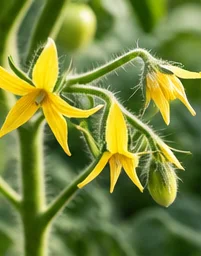
Without wind or insects, the flowers drop without setting fruit. Vibrate each cluster every other day.
4. Topping up the solution without ever changing it
The EC climbs, some elements build up while others run out. Top up with plain water, and replace the solution about every two weeks.
5. Pushing nitrogen to “grow green”
A lush plant, huge leaves and… no fruit: excess nitrogen is the most common cause of blossom drop according to Mississippi State. At flowering, switch to a fertilizer richer in potassium.
6. Letting the suckers grow
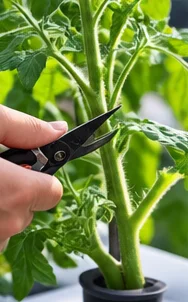
An unpruned indeterminate becomes a jungle: small fruit, disease, an unmanageable plant. One pass every 7 to 10 days is enough.
7. Removing leaves too much or too early
Leaves feed the fruit and protect it from the sun. Only below the ripening truss, two or three at a time.
8. Letting the solution heat up
A reservoir in full sun quickly goes above 28 °C (82 °F): less oxygen, roots turning brown, Pythium. Use an opaque, light-colored reservoir in the shade, and keep the solution around 22 to 24 °C (72 to 75 °F).
9. Neglecting hygiene
In a recirculating system, a pathogen travels with the water to every plant. Wash your hands before touching the tomatoes, disinfect pruners and scissors between plants, and do not bring in suspicious plants. The ToBRFV virus, which spreads through hands, tools and seeds, has been regulated in the European Union since 2025.
10. Saving seeds from F1 hybrids
Seeds from an F1 tomato give uneven plants, often disappointing ones. To produce your own seeds, start with an open-pollinated variety: see our seed guide.
Unsure about a diagnosis? Post a photo and your measurements in the forum.
Frequently asked questions
Why are the bottoms of my tomatoes turning black?
That is blossom end rot: the growing fruit is short on calcium. In hydroponics, the cause is rarely a lack of calcium in the solution; it is more often an EC that is too high, an irregular water supply, damaged roots or heat that makes the leaves transpire at the expense of the fruit. Affected fruit will not recover: remove it and fix the cause.
Why do my tomato flowers drop without setting fruit?
The most common causes are excess nitrogen, heat around 34 °C (93 °F) that sterilizes the pollen, nights below 13 °C (55 °F), water or salt stress, and, indoors, a lack of pollination. Vibrate the flower clusters every other day and check the temperature.
My tomatoes stay yellow-orange and will not turn red. Why?
Above about 34 °C (93 °F), lycopene, the red pigment, does not form properly. A lack of potassium or an excess of nitrogen also causes uneven ripening. Harvest at the breaker stage and let them finish ripening at room temperature, out of the sun.
- Mississippi State University Extension, Tomato Troubles: Common Problems with Tomatoes
- University of Alaska Fairbanks Cooperative Extension, Pollination and Fruit Development in Tomatoes
- Oregon State University Extension, Grow your own tomatoes and tomatillos (EC 1333)
- Oklahoma State University Extension, Electrical Conductivity and pH Guide for Hydroponics (HLA-6722)
- Effects of Nutrient Solution Management and Environment on Tomato in Small-scale Hydroponics, HortTechnology 30(6), 2020 (University of Florida)
- Commission Implementing Regulation (EU) 2024/2970 (ToBRFV, EUR-Lex)