Part IV · Grow
Asian greens in hydroponics: bok choy, mizuna, tatsoi and komatsuna
Fast, compact and generous, Asian greens are among the easiest leafy vegetables to grow hydroponically. The four main ones, what trials say about EC and light, how to keep them from bolting, whole-head or cut-and-come-again harvests, and a harvest calculator.
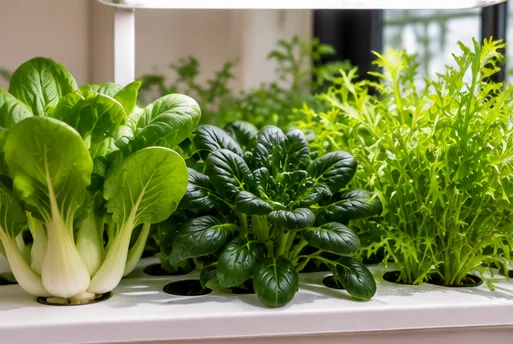
They grow fast, stay compact, tolerate cool weather and can be eaten raw, stir-fried or in soup: Asian greens are among the easiest leafy vegetables to grow hydroponically, right after lettuce. Bok choy (pak choi), tatsoi, mizuna, komatsuna: here is how to tell them apart, what trials say about EC and light, and how to harvest them before they bolt.
See also the bok choy, tatsoi, mizuna and komatsuna crop guides, and the lettuce and salad greens guide.
1. Four greens, one species
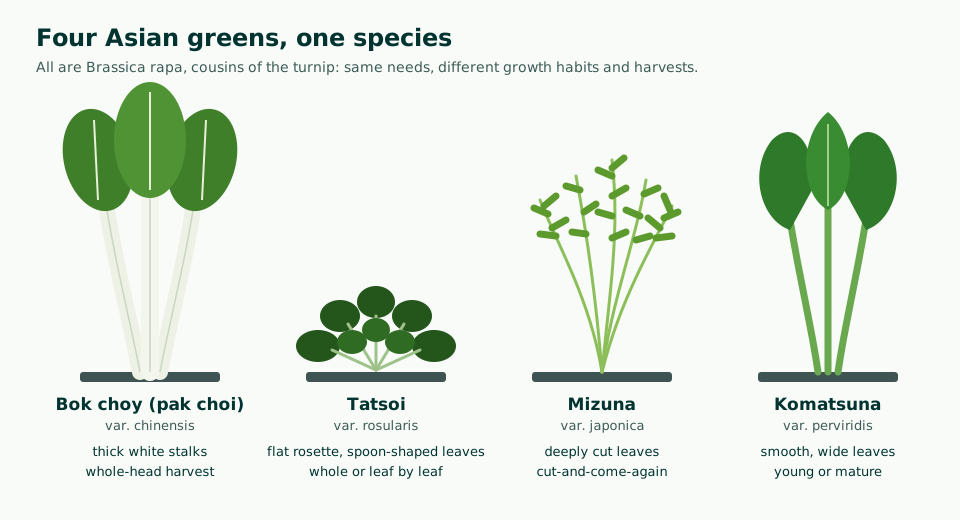
| Crop | Growth habit | Harvest | Best for |
|---|---|---|---|
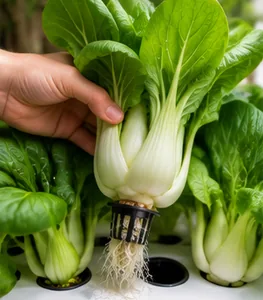
| Bok choy (pak choi) | Upright, thick white or green stalks | Whole, young or mature | Stir-fries, soups; the best known |
| Tatsoi | Flat rosette, dark green spoon-shaped leaves | Whole or leaf by leaf | Salads, stir-fries; stays low |
| Mizuna | Clump of finely cut leaves | Leaf by leaf, several cuts | Salad mixes; the most productive over time |
| Komatsuna | Wide, smooth leaves on green stems | Young or mature | Raw or cooked, mild flavor |
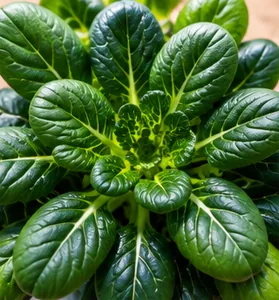
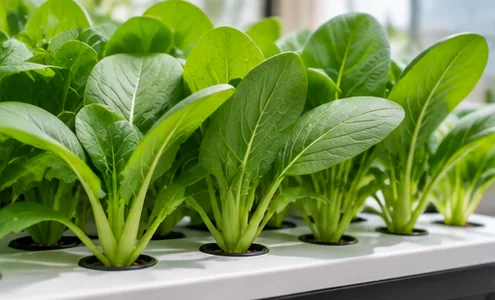
Choy sum, harvested for its flowering stems, and mustard greens, with a spicier taste, are grown the same way.
2. What the trials say
EC
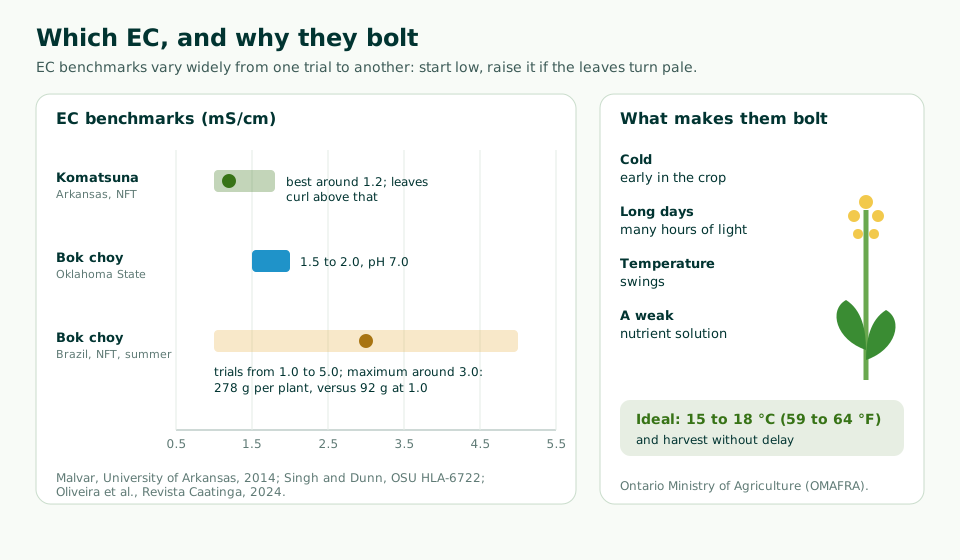
- Oklahoma State gives an EC of 1.5 to 2.0 mS/cm and a pH of 7.0 for bok choy.
- University of Arkansas (Malvar, 2014): in NFT, komatsuna tested from 1.0 to 1.8 gave its best fresh weight around 1.2; above that, the leaves curled and became misshapen.
- Brazil (Oliveira et al., 2024): in NFT, in the semi-arid midsummer, bok choy reached 278 g per plant around 3.0, versus 92 g at 1.0. A higher EC did, however, reduce stalk firmness and sugars.
Light and temperature
- University of Georgia (Palmer and van Iersel, 2020): with the same total light (16 mol/m²/day), mizuna produced 18.7% more biomass under 20 h of lighting than under 10 h.
- Cornell (Allred, 2017): as microgreens, mizuna gained weight with more light and grew faster when the temperature went from 14 to 22 °C (57 to 72 °F).
- NASA: in the VEG-04 experiment (2019), mizuna was harvested at 4, 6 and 8 weeks from the same plants on the International Space Station.
3. Preventing bolting
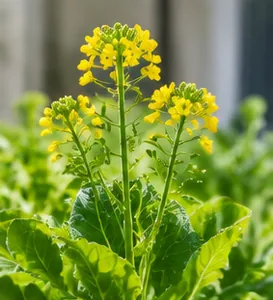
A bok choy that “bolts” stretches its central stem, toughens and turns bitter: the harvest is lost. The Ontario Ministry of Agriculture lists four triggers.
- Cold early in the crop: do not sow in a cold room or, in early spring, on an unprotected balcony.
- Long days: bok choy is sensitive to day length. Indoors, avoid very long lighting; if it bolts, shorten it.
- Temperature swings: a reservoir next to a radiator, or by a south-facing window that is hot during the day and cold at night.
- A weak nutrient solution: keep an eye on EC, especially late in the crop.
4. Calculator: when to harvest, how much to sow
Choose the crop, the sowing date, the number of heads you want per week, the temperature and the lighting duration: the calculator gives the harvest window, the sowing schedule and the risk of bolting.
Ontario's timings are for bok choy grown in the ground; in hydroponics, under good light, the harvest often comes sooner, especially for baby greens.
5. Step by step: from sowing to harvest
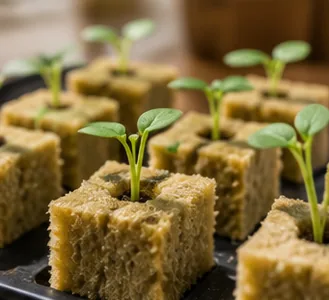
- Sow two or three seeds per rockwool cube or per pot of growing medium, barely covered (see sowing and transplanting). Germination is quick.
- Thin to the strongest seedling, then transplant into a net pot when the roots come out of the cube.
- Space according to the harvest you want: close for baby greens, wider for a mature bok choy or a tatsoi rosette.
- Adjust the nutrient solution: EC around 1.5 to start, pH around 6 to 7 (Oklahoma State gives 7.0 for bok choy), checked twice a week.
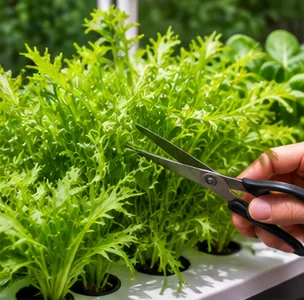
- Harvest bok choy and tatsoi whole, at the base, as soon as they reach the size you want; mizuna leaf by leaf or by cutting the clump a few centimeters above the crown.
- Resow every week or every two weeks for a continuous harvest (see succession sowing).
6. Tips
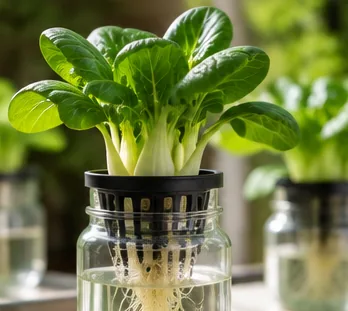
- Baby bok choy is harvested whole when very young: ideal for Kratky or a small reservoir.
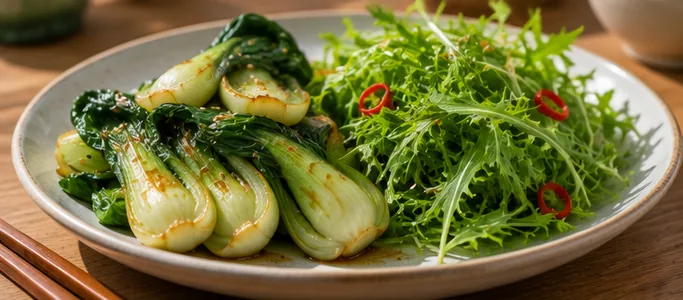
- Red mizuna and dark green tatsoi brighten up a baby greens mix, cut with scissors.
- Microgreens of mizuna or mustard in about ten days, on a tray (see microgreens).
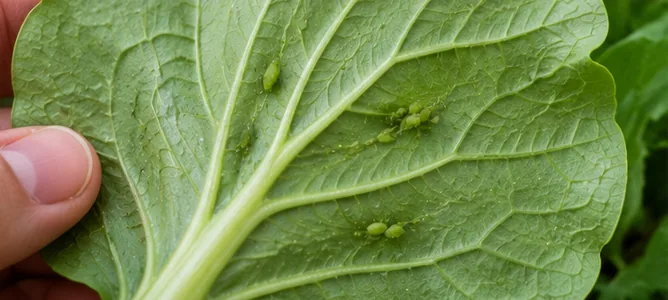
- Check the undersides of the leaves: aphids and caterpillars love brassicas (see diseases and pests).
- Insect netting on a balcony, right from planting.
7. Common mistakes
| Mistake | Consequence | The fix |
|---|---|---|
| Sowing in a cold room in spring | Early bolting | Sow somewhere warm, then 15 to 18 °C (59 to 64 °F) |
| Very long lighting for bok choy | Flower stalk, bitter taste | Moderate lighting duration, harvest younger |
| EC too high for komatsuna | Curled leaves | Bring it back down to 1.2 to 1.5 |
| Waiting “one more week” | Bok choy bolts, tough stalks | Harvest as soon as it reaches the right size |
| Cutting mizuna at the base | The clump does not grow back | Cut a few centimeters above the crown |
| Sowing everything at once | Everything ready the same week | Sow every week |
8. Key takeaways
Growing Asian greens? Share your EC readings and crop timings on the forum.
Frequently asked questions
What EC for bok choy in hydroponics?
Oklahoma State gives 1.5 to 2.0 mS/cm with a pH of 7.0. Trials vary a lot: at the University of Arkansas, komatsuna, a close cousin, grew best around 1.2 in NFT, while a Brazilian trial in midsummer found a maximum around 3.0 for bok choy. Start around 1.5, raise it if the leaves turn pale, lower it if they curl.
Why is my bok choy bolting?
The Ontario Ministry of Agriculture lists cold early in the crop, long days, temperature swings and a lack of nutrients. Keep the crop between 15 and 18 °C (59 and 64 °F), avoid very long lighting and a weak nutrient solution, and harvest without delay: a bok choy that is ready will not get any better.
Can you harvest mizuna several times?
Yes: cut the outer leaves or the whole clump a few centimeters above the crown, and it grows back. In NASA's VEG-04 experiment, mizuna was harvested at 4, 6 and 8 weeks from the same plants on the International Space Station.
Bok choy or pak choi: what is the difference?
None: bok choy and pak choi are two spellings of the same vegetable, Brassica rapa var. chinensis. Both common names come from Cantonese. There are white-stemmed and green-stemmed types, with wide or narrow stalks.
Are Asian greens good for Kratky?
Yes, they are good candidates: short cycle, modest needs, compact plants. A young bok choy or a tatsoi does well in a Kratky jar or tub; mizuna, harvested in several cuts, needs a bit more nutrient solution over time.
- F. A. de Oliveira et al., Production and quality of pak choi grown in different hydroponic systems and electrical conductivities, Revista Caatinga 37, 2024
- L. P. Malvar, Growth and Biomass Accumulation of Komatsuna Greens as Affected by Nutrient Solution Electrical Conductivity, University of Arkansas, 2014
- S. Palmer and M. W. van Iersel, Increasing Growth of Lettuce and Mizuna under Sole-Source LED Lighting Using Longer Photoperiods with the Same Daily Light Integral, Agronomy 10(11), 2020 (University of Georgia)
- J. A. Allred, Environmental and Cultural Practices to Optimize the Growth and Development of Three Microgreen Species, Cornell University, 2017
- G. D. Massa et al., VEG-04 Pick-and-Eat Crop Production on the International Space Station, NASA, 2021
- Ontario Ministry of Agriculture (OMAFRA), Bok choy
- H. Singh and B. Dunn, Oklahoma State University Extension, Electrical Conductivity and pH Guide for Hydroponics, HLA-6722