Part IV · Grow
Cucumbers and cucurbits in hydroponics: varieties that need no pollination, trellising, settings, zucchini and melons
The cucumber is the most generous cucurbit in hydroponics, as long as you pick a variety that does without bees and train it well. Cucumber types, EC, pH and temperature settings, umbrella trellising, hand-pollinating zucchini and melons, a harvest calculator and the mistakes to avoid.
A single well-trained cucumber plant can bear fruit for weeks, while a lettuce is harvested only once. It is the star cucurbit of hydroponics, and the easiest in the family if you choose a variety that does without bees. Zucchini, melons and watermelons take up more room and ask you to play pollinator. Here is how to choose, set up, train, adjust and harvest.
Quick benchmarks are in the cucumber, zucchini, melon and compact watermelon crop guides. Here, we follow the plant from sowing to harvest.
1. The family at a glance
| Plant | Pollination | Space | In hydroponics |
|---|---|---|---|
| English or mini cucumber | Not needed (parthenocarpic) | Climbing, needs trellising | The best choice, indoors as well as outdoors |
| Regular cucumber, pickling cucumber | Required | Climbing or trailing | Easy outdoors with insects, with a paintbrush indoors |
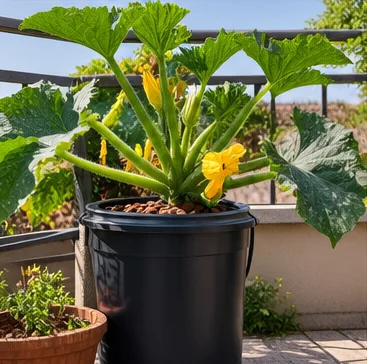
| Zucchini | Required, except parthenocarpic varieties | Large bushy plant | Possible in a large bucket, preferably on a balcony |
| Melon | Required | Trailing, train it on a net | For patient gardeners, heat and light are a must |
| Compact watermelon | Required | Trailing | A challenge: few fruits for a lot of space |
2. Choosing your cucumber
A “parthenocarpic” cucumber sets fruit without pollination. It is the cucumber of commercial hydroponic greenhouses, in two sizes (University of Florida; Auburn University):
Long English
- 30 to 35 cm (12 to 14 in), 300 to 400 g, thin skin, seedless.
- The classic at the grocery store, shrink-wrapped in plastic.
- Big fruits, so fewer of them: for a vigorous, well-lit plant.
Mini, or Beit Alpha
- 12 to 20 cm (5 to 8 in), 80 to 120 g, crunchy, seedless.
- Easier to train and pick, grown more and more.
- The best choice for indoors and the balcony.
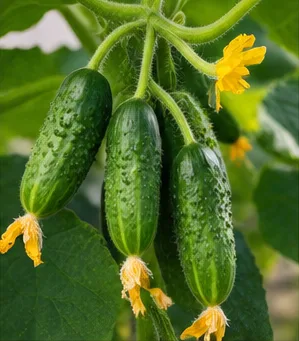
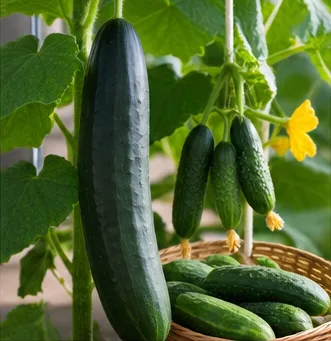
Regular garden cucumbers and pickling cucumbers carry male and female flowers and need insects. For containers, NC State University compared many varieties in 12 L (3 gal) tubs: dwarf varieties (Spacemaster, for example) were among the most productive, and three plants per tub yielded more than one or two (Crane, Wehner and Naegele, 2018).
3. The right settings
| Benchmark | Value | Source |
|---|---|---|
| Air temperature | 27 to 29 °C (81 to 84 °F) ideal; growth and harvest slow down below 18 °C (64 °F); fruit no longer sets above 32 °C (90 °F) | University of Florida; Auburn University; Penn State |
| pH | 5.5 to 6.0 (Florida); 5.5 to 6.5 (Auburn); 5.0 to 5.5 (Oklahoma State) | Three sources, one overlap: 5.5 to 6.0 |
| EC | 1.7 to 2.0 mS/cm (Oklahoma State); 2.0 to 2.5 (Auburn) | Start around 2.0, then adjust |
| Nitrogen | 60 to 80 ppm for the first two weeks, 100 to 120 at flowering, 120 to 140 after the first harvest | Auburn University |
| Watering in a growing medium | 10 to 25% of the water should run out of the pot (drainage) | Auburn University |
| Space | 0.45 to 0.65 m² (5 to 7 sq ft) per plant in a well-lit greenhouse | University of Florida |
| Air humidity | Above 70%, diseases spread | Auburn University |
Heat first. The cucumber is a midsummer plant: on a balcony in Belgium or northern France, set plants out once the nights are mild: a growing medium below 15 °C (59 °F) can be fatal to this summer plant (Penn State). Indoors, a warm spot near a south-facing window works, or a grow light (see the lighting calculator).
Light makes the fruit. In a very bright greenhouse, above 30 mol of light per m² per day, it takes only about ten days from flower to pickable fruit (Auburn University). Under weaker light, everything slows down: allow more time.
4. Which system?
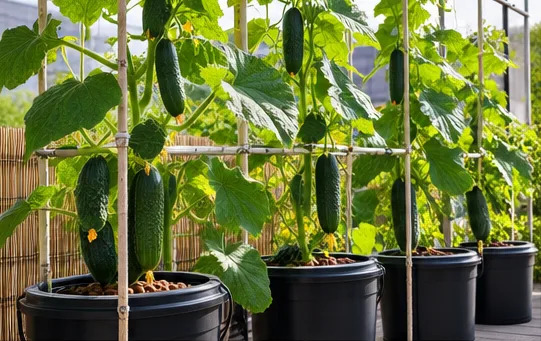
The cucumber grows a big root system and a big plant: it needs a generous volume of water or growing medium and a sturdy support.
- Drip-fed bucket (Dutch bucket): the commercial greenhouse system, with perlite or coco coir. See drip irrigation and Dutch buckets.
- DWC reservoir with an air pump and air stone: very good for one or two plants, as long as the water stays cool and oxygenated. See DWC and oxygen in the nutrient solution.
- Vertical tower: poorly suited, the net cups are too small for such a big plant and the fruits too heavy.
- Kratky: possible for a dwarf plant in a large tub, but the level drops fast once the plant is mature: plan on topping up.
5. Trellising and pruning: the umbrella

- Tie a string above the plant, to a wire or a sturdy bar, and gently wind it around the stem as it climbs.
- No fruit at the bottom: remove all small fruits and all suckers on the first 60 to 75 cm (24 to 30 in) (University of Florida), or up to the sixth or seventh true leaf (Auburn University). The plant builds its leaves and roots first.
- Above that, one fruit per leaf: keep the small fruit in the axil of each leaf, and pinch off every sucker as soon as it appears.
- At the wire, pinch the tip and let two stems hang down, one on each side, with one fruit per leaf.
- Remove old lower leaves that are yellow or damaged, to improve airflow.
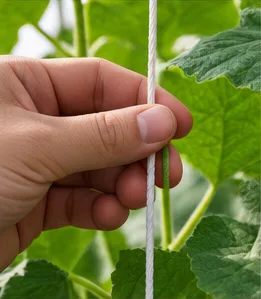
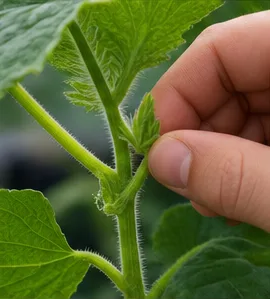
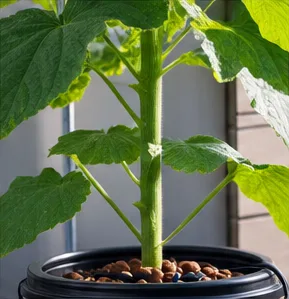
Regular cucumbers can also sprawl on the ground or on a trellis with lighter pruning, but trellising improves yield and fruit quality (Penn State Extension).
6. Pollinating by hand
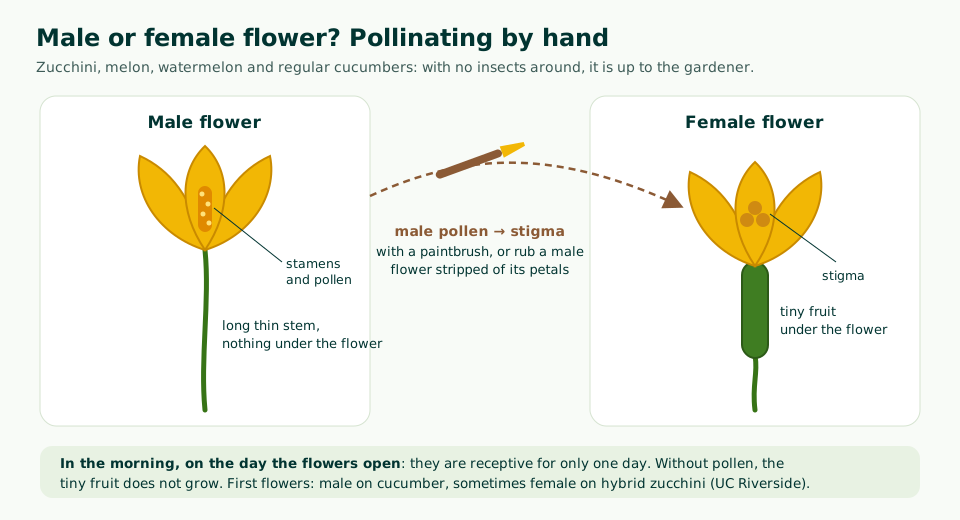
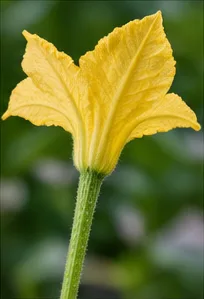
Zucchini, melons, watermelons and regular cucumbers have male flowers and female flowers. Without insects, indoors or under insect netting, hand pollination is the only way to get fruit (University of California Riverside).
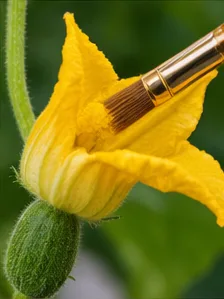
- Spot the female: a small fruit under the flower. On zucchini, its stem is very short; on cucumber and melon, males come in clusters of three to five and the female is on its own.
- The right time: in the morning, on the day the flower opens. It is receptive for only one day.
- The technique: pick up the yellow pollen from the male with a soft paintbrush, or remove the male’s petals, and dab it onto the center of the female.
- Be patient at first: on cucumber and melon, the first flowers are all male; on hybrid zucchini, they are sometimes female, and they abort because no males are open yet (UC Riverside).

Zucchini without pollination. Parthenocarpic zucchini exist. At Purdue, six varieties, including Cavili, produced more than 2.7 kg (6 lb) per plant in a closed high tunnel, with no insects, with Cavili reaching 3.9 kg (8.6 lb) (Guan, 2020). A serious option for zucchini on a sheltered balcony.
7. Zucchini, melons, watermelons: what changes
Zucchini
- Large bushy plant: one large bucket of growing medium or one DWC reservoir per plant.
- Benchmarks: EC 1.8 to 2.4 mS/cm, pH 6.0 (Oklahoma State University).
- Pick young, every two or three days: a forgotten zucchini quickly becomes huge.
Melon
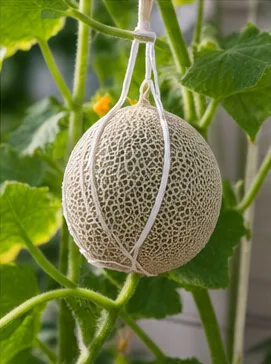
- One stem on a net; remove side shoots up to the eighth leaf, then keep the fruits on the first leaves of the side shoots (University of Florida, 2003).
- 3 to 5 fruits per plant in a greenhouse; support them in a net as they size up.
- Harvest when the fruit slips off its stem on its own.
Compact watermelon
- Choose a small-fruited variety.
- Hand pollination, fruits supported in a net.
- A challenge crop more than a high-yield one.
For all of them
- Heat, full sun or a powerful grow light.
- Moving air: powdery mildew loves crowded leaves.
- A sturdy support before the plant sprawls.
8. Calculator: my cucumbers
Enter the number of plants, the type and the sowing date: the calculator gives the space you need, the earliest first harvest and the yield of a plant in top shape. The figures come from well-lit commercial greenhouses: indoors or on a balcony, expect less.
Benchmarks: 0.45 to 0.65 m² (5 to 7 sq ft) per plant; first harvest from 7 weeks after sowing; 0.45 to 1.4 kg (1 to 3 lb) per plant per week at peak, 9 to 11 kg (20 to 24 lb) per plant over 12 weeks of harvest (University of Florida; Auburn University).
9. Step by step: from sowing to the first cucumber
Time: 7 to 10 weeks. Level: intermediate.
- Sow one seed per rockwool cube or coco coir plug, somewhere warm (see sowing and transplanting). Parthenocarpic cucumber seeds are expensive: no need to sow three per hole.
- Transplant into the final system once two or three true leaves have formed and roots are coming out of the cube.
- Set up the string the same day, before the plant flops over.
- Clean up the bottom every week: fruits and suckers on the first 60 to 75 cm (24 to 30 in).
- Measure EC and pH twice a week, top up the water every day in hot weather.
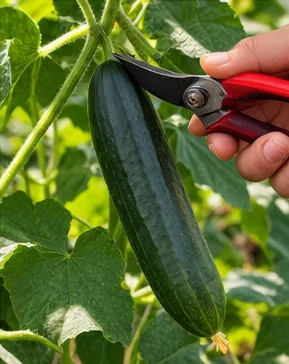
- Pick minis at around 12 to 20 cm (5 to 8 in) and long ones at around 30 to 35 cm (12 to 14 in), with pruning shears, every two or three days at peak.

10. Problems to recognize
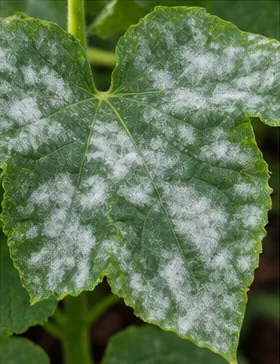
White felt on the leaves
- Powdery mildew, very common on cucurbits (Penn State).
- Improve airflow, remove affected leaves, choose resistant varieties. See diseases and pests.
Stippled leaves, fine webbing
- Spider mites, in hot, dry conditions; aphids under the leaves (Penn State).
- Magnifying glass every week, spray the leaves with water, beneficial insects.
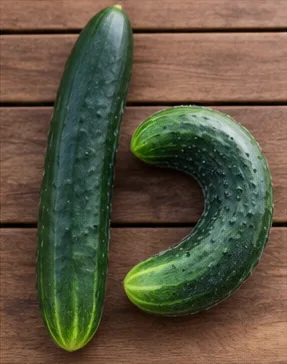
Curved or hook-shaped fruit
- Lack of water or potassium (Auburn University).
- Check the reservoir and the EC.
Bitter fruit
- Overripe fruit (Auburn), or a parthenocarpic cucumber that got pollinated (Penn State).
- Pick earlier, keep insects away.
Small fruits turning yellow
- Too many fruits at once (Auburn); on zucchini or regular cucumber, failed pollination.
- Pick more often, pollinate in the morning.
Plant wilting in the heat
- Roots suffocating in water that is too warm.
- Reservoir in the shade, air pump and air stone. See oxygen and temperature.
11. Common mistakes
| Mistake | Consequence | The fix |
|---|---|---|
| Sowing a garden cucumber indoors | Flowers but no fruit | Parthenocarpic variety, or a paintbrush |
| Leaving fruit at the bottom of the plant | Exhausted plant, small harvest | Nothing on the first 60 to 75 cm (24 to 30 in) |
| Keeping all the suckers | A jungle, small fruit, diseases | Pinch every week |
| Picking too late | Bitter fruit, next ones abort | Pick every two or three days |
| Setting plants outdoors too early | Plant stalled by the cold | Wait for mild nights |
| Leaving the air humid and still | Powdery mildew | Ventilate, space the plants |
| Pollinating in the afternoon | Fruit does not set | In the morning, on the day’s flower |
| Forgetting the reservoir level in summer | Curved fruit, wilted plant | Daily check |
12. Key takeaways
Are your cucumbers already climbing, or are your zucchini flowering without fruit? Share your photos on the forum: a photo of the flower is often enough for a diagnosis.
Frequently asked questions
Which cucumber should I choose for indoor hydroponics?
A parthenocarpic cucumber, which sets fruit without pollination: the long English type (30 to 35 cm, 12 to 14 in) or the mini, also called Beit Alpha (12 to 20 cm, 5 to 8 in). These are the cucumbers grown in commercial hydroponic greenhouses (University of Florida, Auburn University). Indoors, the mini is easier: smaller, more numerous fruits and a more manageable plant.
Do cucumbers need to be pollinated?
Not parthenocarpic varieties: they set fruit on their own, and it is even better to keep bees away, because a pollinated fruit can turn bitter, seedy and misshapen (Penn State Extension). Regular garden cucumbers and pickling cucumbers, on the other hand, need pollen: indoors, you have to move it with a paintbrush.
What EC and pH settings for cucumbers?
University sources do not quite agree: EC 1.7 to 2.0 mS/cm and pH 5.0 to 5.5 for Oklahoma State University, EC 2.0 to 2.5 and pH 5.5 to 6.5 for Auburn University, pH 5.5 to 6.0 for the University of Florida. A good starting point: EC around 2.0 and pH 5.5 to 6.0, then adjust to the plant’s vigor.
Why do my small cucumbers turn yellow and fall off?
Most often, the plant is carrying too many fruits at once: a forgotten or oversized fruit makes the next ones abort (Auburn University). Pick more often and keep the bottom of the plant free of fruit. On a zucchini or a regular cucumber, it is often a pollination failure.
Can you grow zucchini or melons hydroponically?
Yes, but they are big plants that need room, a large reservoir or bucket, and almost always hand pollination. Parthenocarpic zucchini do exist: at Purdue, six varieties produced more than 2.7 kg (6 lb) per plant in a closed high tunnel, with no insects (Guan, 2020). For melons, the University of Florida trains a single stem on a net and counts 3 to 5 fruits per plant.
- R. C. Hochmuth, University of Florida IFAS, Greenhouse Cucumber Production, Florida Greenhouse Vegetable Production Handbook, vol. 3, CV268, 2018
- C. Blanchard, J. Pickens and D. Wells, Alabama Cooperative Extension System (Auburn University), Greenhouse Cucumber Production, 2022
- Penn State Extension, Growing Cucumbers in High Tunnels
- H. Singh and B. Dunn, Oklahoma State University Extension, Electrical Conductivity and pH Guide for Hydroponics, HLA-6722, 2016
- H. Johnson Jr., University of California Riverside, Fruit Set Problems in Squash, Melons, and Cucumbers in Home Gardens, leaflet 21242, 1980
- W. Guan, Purdue University Extension, Summer Squash Cultivar Selection for High Tunnel Production, 2020
- A. Crane, T. Wehner and R. Naegele, NC State University, Cucumber Cultivars for Container Gardening, HortScience, 2018
- E. Lamb, N. Shaw and D. Cantliffe, University of Florida IFAS, Galia Muskmelon Production in Greenhouses, 2003