Part III · Water and nutrients
Rainwater: how much does my hydroponic garden need, and what size tank should I plan for?
What lettuce and tomatoes really drink in hydroponics, what your roof yields month by month in Belgium, and the tank size that bridges the gap. With a water balance calculator, two worked examples, how to link tanks in series, minimum treatment and level monitoring.
Collecting rainwater is good. Knowing how much you need and what size tank to plan for is better: too small, it overflows in winter and runs dry in June; too big, it weighs a ton on the patio for nothing. This article does the math, month by month, between what your roof yields and what your garden drinks. For the complete chain (roof, filters, tank, regulations), see our guide rainwater and hydroponics.
1. Rain falls when it wants to
In Uccle (Belgium), an average of 837 mm (33 in) per year falls (IRM climate normals, 1991-2020). But not evenly:
| Month | Normal rainfall | Month | Normal rainfall |
|---|---|---|---|
| January | 75.5 mm | July | 76.9 mm |
| February | 65.1 mm | August | 86.5 mm |
| March | 59.3 mm | September | 65.3 mm |
| April | 46.7 mm, the driest | October | 67.8 mm |
| May | 59.7 mm | November | 76.2 mm |
| June | 70.8 mm | December | 87.4 mm, the wettest |
The mismatch is obvious: it rains mostly in winter, when the patio garden is dormant, and the driest month, April, falls right when you replant. That is what the tank is for: storing winter rain for spring.
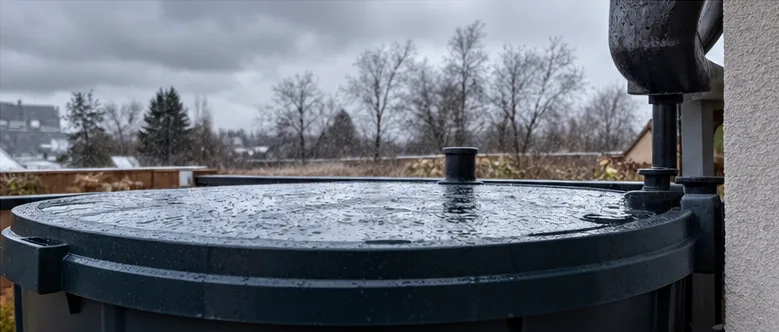
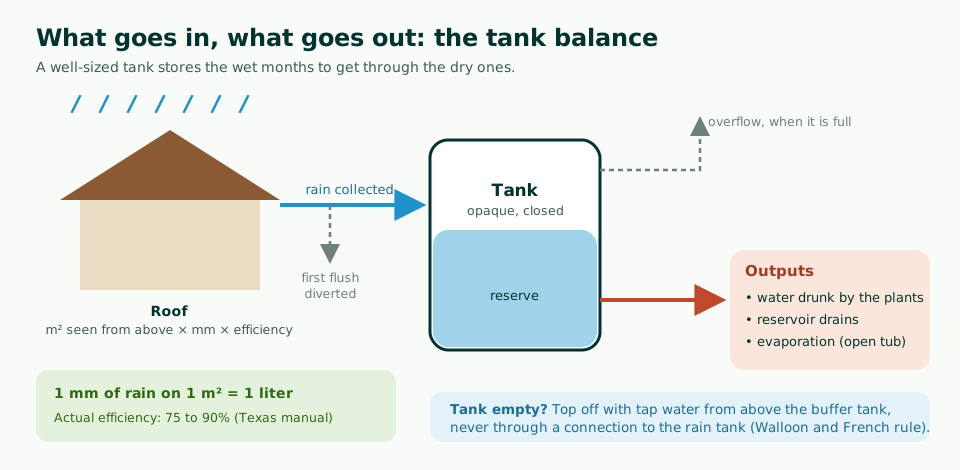
As a reminder, 1 mm of rain on 1 m² of roof yields 1 liter (area measured from above), and the Texas manual on rainwater harvesting uses an actual efficiency of 75 to 90%.
2. What a hydroponic garden really drinks
| Item | Benchmark | Source |
|---|---|---|
| Lettuce | 2.1 to 3.9 L per plant over a 28-day cycle, or about 0.08 to 0.14 L per day. Lowest: DWC in fall; highest: NFT in summer | Yang et al., Scientia Horticulturae, 2024 |
| Tomato in production | 1.1 L per plant per day on average, from 0.09 to 2.25 L depending on the weather | Florakis et al., Frontiers in Plant Science, 2023 (greenhouse in Greece, May to July) |
| Herbs, strawberries, others | No reliable published figure for a home garden: measure it | The marker-line method, in going on vacation |
| Drains | The reservoir volume, every time you drain; many home growers drain a DWC every two to three weeks | See DWC and air pumps |
| Evaporation | Higher with exposed gutters: in the 2024 study, NFT used 24 to 52% more water than DWC | Yang et al., 2024 |
For tomatoes, the Greek figure is a high benchmark: a Belgian patio is cooler and less sunny than a Mediterranean greenhouse in summer. Nothing beats your own measurement, over one week.
3. The water balance calculator
Enter your roof, your tank and your plants: the calculation uses Uccle’s normal rainfall month by month, simulates the tank level and tells you what share of the need the rain covers. Hover over a month for details.
The calculation works by month, with a year of normal rainfall: a three-week drought in the middle of a month does not show up, hence the dry-days margin. For the annual rainfall in your town and your roof’s yield alone, there is also the collectable rainwater calculator.
4. Three worked examples
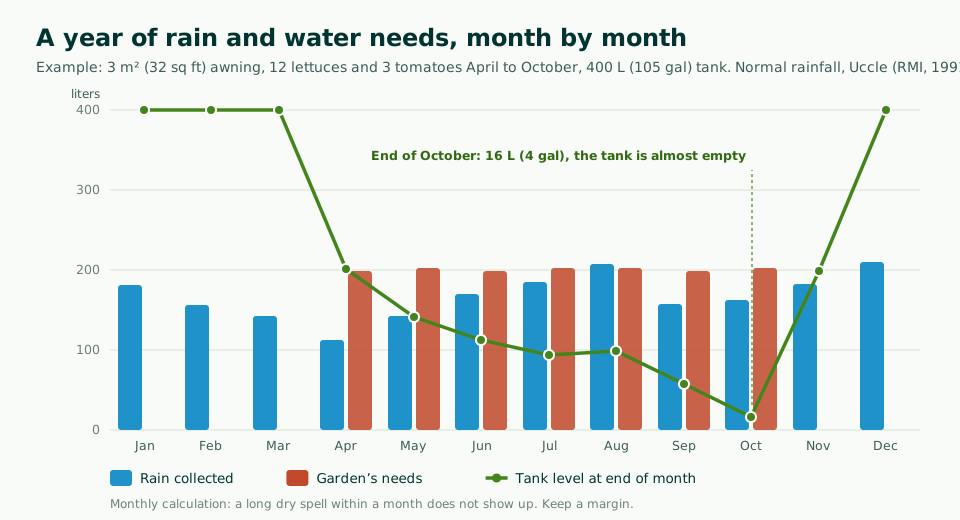
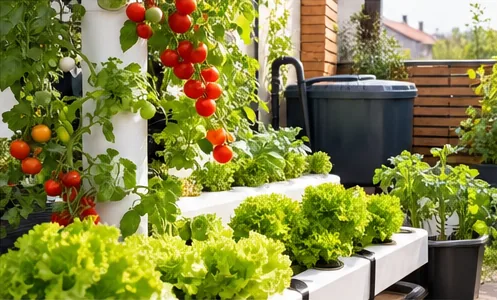
Same garden in all three cases: 12 lettuces and 3 tomatoes from April to October, a 40-liter (10 gal) reservoir drained one and a half times a month, or about 200 liters (53 gal) per month and 1,400 liters (370 gal) over the season.
| Roof | Collectable rain per year | Recommended tank | What happens |
|---|---|---|---|
| 2 m² (22 sq ft, small awning) | ≈ 1,340 L (354 gal) | About 650 L (170 gal) | Even with a large tank, about 70 L is missing in October: a little tap water at the end of the season |
| 3 m² (32 sq ft, patio awning) | ≈ 2,010 L (531 gal) | About 400 L (105 gal) | The tank, full in March, drops to 16 L by the end of October: tight, but enough in a normal year |
| 10 m² (108 sq ft, garden shed) | ≈ 6,700 L (1,770 gal) | About 250 L (66 gal) | The roof fills the tank quickly: a small one is enough, the rest goes to the overflow |
The lesson: the smaller the roof, the bigger the tank must be to store winter rain. And beyond a certain point, enlarging the tank no longer helps if the roof does not yield enough over the year.
5. The setup, tailored to the balance
- Every small surface counts. Awning, shed, carport, sunroom: each square meter seen from above yields about 670 liters (177 gal) per year in Uccle, at 80% efficiency. Check the roofing material in our guide before connecting a downspout.
- In an apartment, the downspout is often shared: talk to the building manager before cutting into it. Failing that, a small awning on the balcony, if allowed, already makes a real difference.
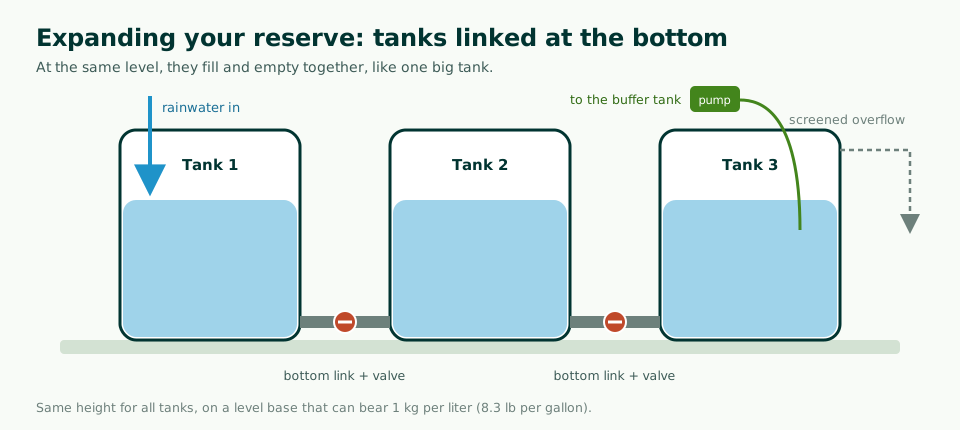
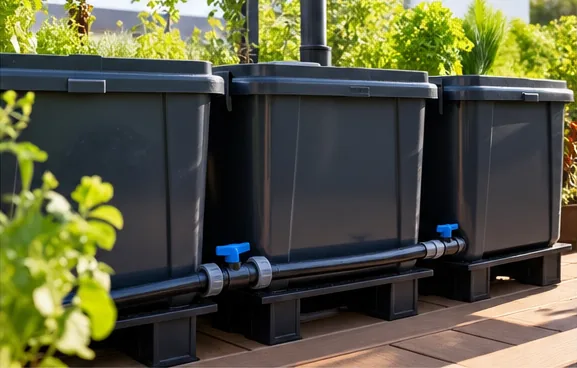
- Tanks in series rather than one big one: easier to carry, place and clean one at a time.
- A level gauge with a float, or simply a measuring stick dipped through the opening: it tells you whether the balance holds.
- The weight. 1 liter = 1 kilo: 400 liters is 400 kilos (880 lb) on the patio. See patio constraints.
Linking two tanks at the bottom
- A shared, perfectly level basePavers or a reinforced pallet, able to bear the full weight. Both tanks must be at exactly the same height.
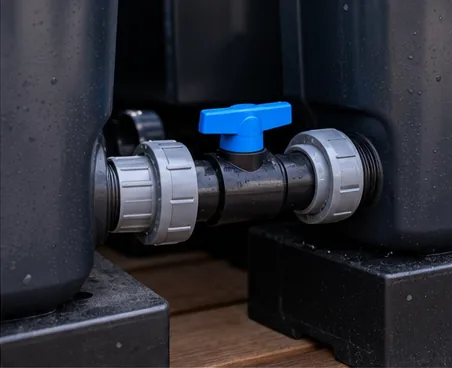
- Drill at the bottomA hole a few centimeters (about an inch) from the bottom of each tank, with a hole saw, for a watertight bulkhead fitting.
- Connect and add a valveFlexible hose or PVC between the two bulkhead fittings, with a valve to isolate one tank during cleaning.
- Split inlet and outletRain comes into the first, the screened overflow and the pump are on the last.
- TestFill the first one: the level should rise at the same time in the second. Check for leaks after 24 hours.
6. Treatment, without overdoing it
Our complete guide details each step; here is the minimum for rainwater going into a hydroponic garden:
- Divert the first flush and filter before the tank: gutter guard, filtering downspout diverter.
- Store out of the light, in an opaque, closed tank, screened against mosquitoes.
- Filter finely before pumps and drip emitters: 20 to 30 µm cartridge.
- Disinfect if needed: UV lamp if there are lots of bird droppings or for vegetables eaten raw.
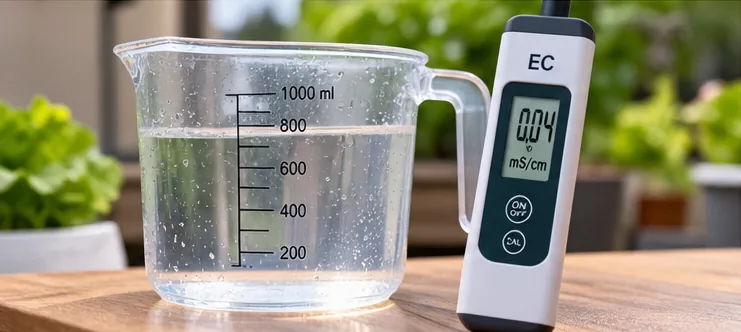
- Measure the EC and pH of the raw water every time you fill the buffer tank. Rainwater is very low in minerals and its pH shifts quickly: use a soft-water nutrient or a calcium-magnesium supplement, and keep a close eye on pH. Enter its EC in the nutrient calculator (“calibrated” tab) to dose accurately.
- Never drinkable: not for drinking, not for washing harvests.
7. Maintenance, from the balance side
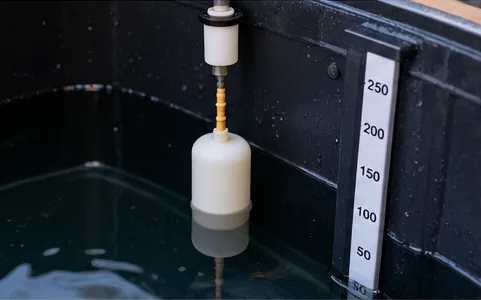
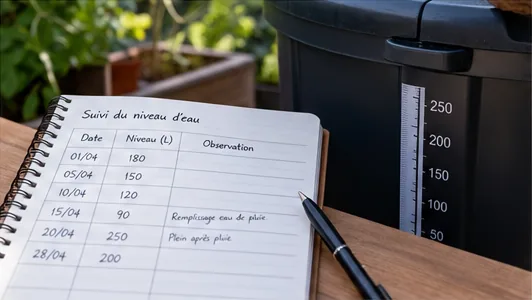
- Every week in season: read the tank level. Record it in your online logbook, under weather or readings: within one season, you will know whether your tank is the right size.
- When the tank drops fast: cut losses (lids on the tubs, NFT gutters in the shade) before buying another tank.
- At the end of winter: check that the tank is full and clean before April, the driest month of spring.
- Every year: clean the tank and service the filtration chain, as described in our guide.
8. Common mistakes
| Mistake | Consequence | The fix |
|---|---|---|
| Sizing on annual rainfall alone | Empty tank in April or June | A month-by-month balance, plus a dry-days margin |
| Forgetting the drains | Need underestimated: nearly a third in our examples | Count the reservoir at every drain |
| Large tank under a tiny roof | It never fills | Check the collectable rain over the year |
| Tanks in series at different heights | One overflows while the other stays empty | A shared, perfectly level base |
| Connecting tap water to the tank | Risk to the public water supply, prohibited | Top off from above the buffer tank |
9. Key takeaways
Have you measured your plants’ water use? Share your numbers on the forum: they will help others size their tank.
Frequently asked questions
What size tank for a hydroponic garden on a patio?
For a dozen lettuces and a few tomatoes from April to October, a few hundred liters is often enough: about 400 liters (105 gal) with a 3 m² (32 sq ft) awning in Belgium, according to our monthly balance. Run the numbers with your plants, your roof and your season in the article’s calculator.
How much water does a lettuce use in hydroponics?
Between 2.1 and 3.9 liters over a 28-day cycle for a butterhead lettuce, according to a 2024 study: less in DWC and in fall, more in NFT and in summer. That is about 0.08 to 0.14 liter per plant per day.
My roof is too small, what can I do?
Keep tap water as a backup, poured in from above the buffer tank, never through a connection to the rain tank. Every liter of rain is still a liter saved, and rainwater mixed with tap water remains low in minerals.
Should you empty the tank in winter?
An above-ground tank exposed to frost should be drained and its pipes purged before winter. A frost-protected tank can stay full: it will be ready for April, the driest month of spring.
Can you connect several tanks together?
Yes: tanks set at the same level and linked at the bottom fill and empty together. A valve on each link lets you isolate one for cleaning.
- IRM (Royal Meteorological Institute of Belgium), climate normals in Uccle, 1991-2020 period, total precipitation
- Texas Water Development Board, The Texas Manual on Rainwater Harvesting
- Yang, T. et al., Growth, phytochemical concentration, nutrient uptake, and water consumption of butterhead lettuce in response to hydroponic system design and growing season, Scientia Horticulturae, 2024
- Florakis, Trevezas and Letort, Predicting tomato water consumption in a hydroponic greenhouse: contribution of light interception models, Frontiers in Plant Science, 2023
- Barbosa, G. L. et al., Comparison of land, water, and energy requirements of lettuce grown using hydroponic vs. conventional agricultural methods, International Journal of Environmental Research and Public Health, 2015