3D workshop & DIY
3D-printable hydroponic towers: two MakerWorld models put to the test
Functional diagram, not to scale.
A small solar-pump tower for the desk or balcony, an 11-basket vertical system on a threaded rod for indoors: what they do, what else you need to buy, print settings and what to watch out for.
On MakerWorld, hydroponic towers are among the most downloaded models in the garden section. We picked two very different ones: a small fully printed tower that runs on sunshine, and a more technical vertical system for growing herbs indoors. Here is what you print, what you buy on top, and what to watch for on the growing side.
1. Hydroponic Water Tower, by Cole
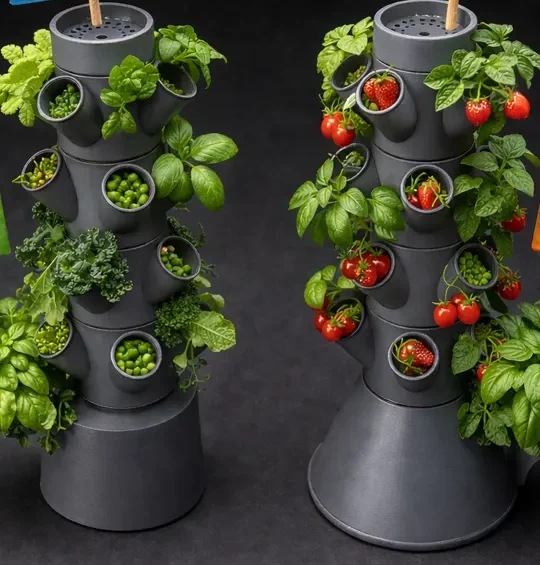
A compact tower, designed for a desk, a countertop, a greenhouse or a balcony. Everything is printable; the only part you buy is a small solar fountain pump, which lifts water from the reservoir with no battery or outlet. Two bases are offered: a compact one and a larger one that holds more water.
| What for | Herbs, lettuce, small fruits |
|---|---|
| Printing | 4 plates; about 21 h at 0.2 mm (0.4 nozzle) or 14 h at 0.3 mm with a 0.6 nozzle |
| To buy | A solar fountain pump |
| License | Non-commercial use, no sharing or reselling of the files |
- What we like: no cable, no outlet on the balcony, and an object small enough to get started without committing a whole weekend.
- Watch out: a solar pump stops when the sun goes behind clouds, and at night. Indoors, far from a window, it will barely run: plan for a plug-in pump or a very bright spot.
- Watch out: the author’s profile prints with a single wall. It is fast, but test the reservoir for leaks; if it seeps, add walls.
- Small reservoir: it heats up and empties quickly in summer. Cornell CEA recommends a solution that does not exceed 25 °C (77 °F): shade and frequent top-offs. See going on vacation.
2. Vertical Hydroponics System (VHS), by squirrelbrain
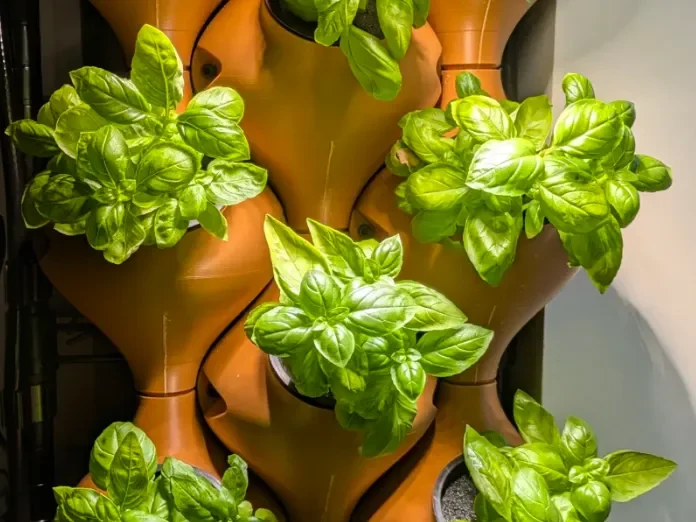
An experimental vertical system for growing herbs indoors: 11 plants in 3-inch (about 7.5 cm) baskets, stacked on an M8 threaded rod at least 730 mm (28.7 in) long. At the top, a manifold receives water from the pump and redistributes it; it trickles down from basket to basket back to the reservoir.
| What for | Indoor herbs, 11 baskets |
|---|---|
| Printing | 0.2 mm, 6 walls, 25% infill; a few sacrificial support layers to remove |
| To buy | M8 threaded rod (730 mm minimum), M5 and M8 hardware, 10 mm (3/8 in) supply and 16 mm (5/8 in) return tubing, ½ inch BSP fittings, submersible pump of at least 25 W, 3-inch baskets |
| License | Creative Commons BY-NC-SA 4.0: credit the author, no commercial use, share alike |
- What we like: six walls is a serious choice for parts that stay in water. The threaded-rod structure is rigid and can be taken apart.
- Watch out: this is a DIY project, not a kit. Budget for the hardware, the fittings and some post-processing.
- Watch out: a 25 W pump runs indoors, so you will hear it. Not in the bedroom, set on a foam pad, and on a timer if the author allows it for your crop. See the apartment garden.
- Lighting: indoors, a tower needs lights along its whole height, otherwise the bottom baskets languish. See grow lights.
3. Before printing a tower
- An opaque filament, preferably PETG for anything that stays in water or outdoors: light passing through the walls makes algae grow.
- Your baskets first: measure the actual diameter of your baskets before printing the holders.
- A plain-water test of 24 to 48 hours, in a drip tray, before planting.
- Weight in use: 1 liter of water weighs 1 kg (8.3 lb per gallon); a full tower on a shelf or balcony should stand near a wall and be secured at the top.
All our design and testing advice is in 3D printing a hydroponic tower and building your own tower.
Have you printed one of these models? Show it off on the forum, with your settings and your fails.
Frequently asked questions
Which filament for a printed hydroponic tower?
PETG is the most common choice among makers for parts that stay in contact with water and light, especially outdoors; PLA works for an indoor trial. Choose an opaque color: light passing through the walls makes algae grow in the solution.
Is a printed tower watertight?
Not always on the first try. Layers can seep, especially with few walls. Test with plain water for 24 to 48 hours in a drip tray, and reprint any leaking parts with more walls or a slightly higher nozzle temperature.
Can you sell a tower printed from these files?
No: both models are published for non-commercial use. You can print them for yourself, but not sell the files or the printed objects without their author’s permission.
- MakerWorld, Hydroponic Water Tower (model 2639451, Cole)
- MakerWorld, Vertical Hydroponics System (VHS) (model 1822018, squirrelbrain)
- Cornell University CEA, Hydroponic Lettuce Handbook