3D workshop & DIY
DIY aeroponics: how it works, what the research says and a low-pressure build
Roots hanging in the dark, misted for a few seconds several times an hour: aeroponics promises very well-aerated roots and fast growth. Low or high pressure, what university trials show, the real risks (pump failure, clogged nozzles), a step-by-step build and a cycle and electricity calculator.
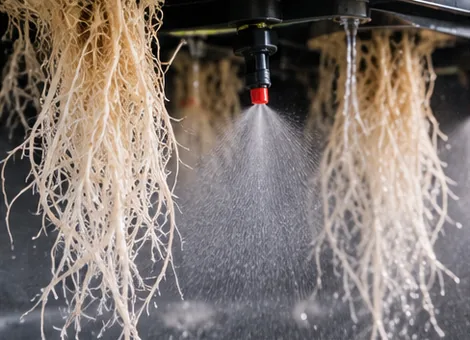
White roots hanging in the dark, a mist of nutrient solution for a few seconds every few minutes: aeroponics is the most spectacular hydroponic system, and the one that gives roots the most air. It is also the least forgiving: without misting, nothing feeds the plant anymore. Here is how it works, the difference between low and high pressure, what university trials show, and how to build a low-pressure aeroponic tub at home without falling into the traps.
To compare with other systems, see choosing your system. If you are just starting out, begin instead with the Kratky method or a DWC: they are far more forgiving.
1. How it works: roots in the air

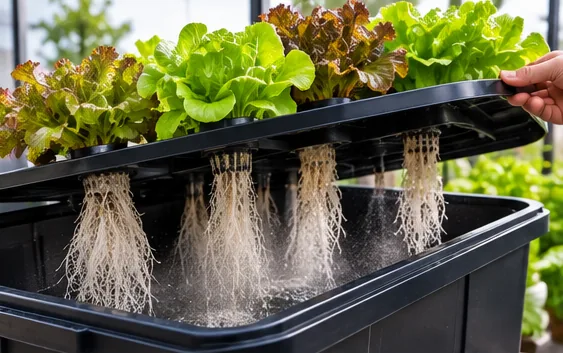
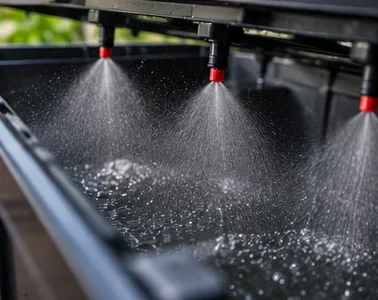
The plants are held at the crown in a lid, as in a DWC. But under the lid, there is no water around the roots: they hang in a closed chamber. Nozzles placed under the roots spray them with a fine shower or a mist of nutrient solution for a few seconds, then stop for a few minutes. The solution that runs off drips back to the bottom of the tub and the pump sends it out again on the next cycle.
- Lots of air: between two mistings, the roots are surrounded by air, and therefore oxygen. That is the strength of aeroponics.
- No reserve: unlike DWC or Kratky, the roots do not sit in water. If the misting stops, they dry out.
- Lots of settings: the review by Lakhiar and colleagues (2018) lists temperature, humidity, light, solution level, pH, EC, CO2 and the misting cycle among the things to monitor, and makes the case for sensors and automation.
2. Low pressure or high pressure?
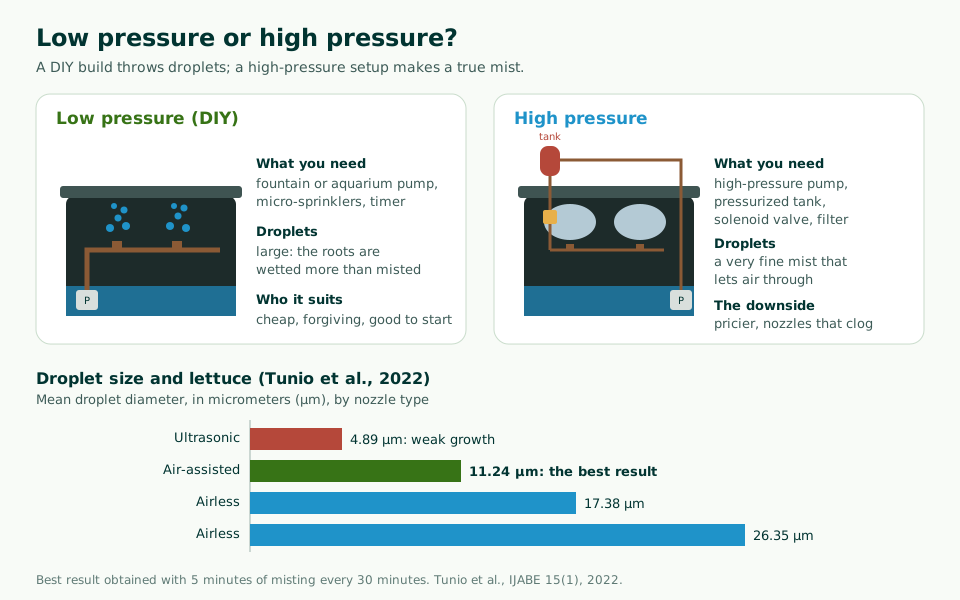
Low pressure
- An ordinary submersible pump (fountain, aquarium) and micro-sprinklers or low-flow misting nozzles.
- The droplets are large: the roots are wetted more than misted. Some call it “fake aeroponics”, but it is what you build at home.
- Cheap, easy to repair, fairly forgiving.
High pressure
- A high-pressure pump fills a pressurized accumulator tank; a solenoid valve opens for a few seconds and the fine nozzles make a mist.
- The droplets are fine and let air pass between them. This is the principle used in research and commercial setups.
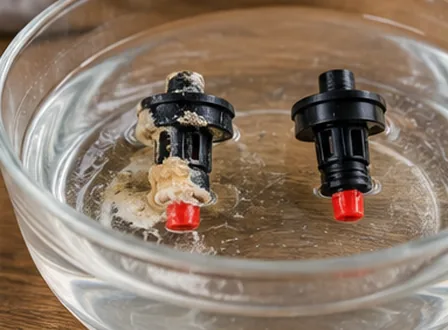
- More expensive, noisier, and the fine nozzles clog as soon as any deposit gets past the filter.
Droplet size matters, but finer is not always better. In the trial by Tunio and colleagues on butterhead lettuce (2022), the ultrasonic fogger, with the finest droplets (4.89 µm), gave the weakest growth. The best result came from an air-assisted nozzle (11.24 µm) with 5 minutes of misting every 30 minutes; the airless nozzles (17.38 and 26.35 µm) fell in between. The intervals tested ranged from 15 to 60 minutes.
3. What the research says
What works
- Growth: at Texas Tech, Newberry, Simpson and Baliga compared ‘White Boston’ lettuce in aeroponics and hydroponics over 53 days. By week five, a lettuce weighed 211 g in aeroponics versus 67 g in hydroponics, and the final biomass had doubled.
- Seed potatoes: the International Potato Center (CIP) published in 2019 a complete manual on producing seed potato minitubers in aeroponics, used in Colombia, Ecuador and Peru.
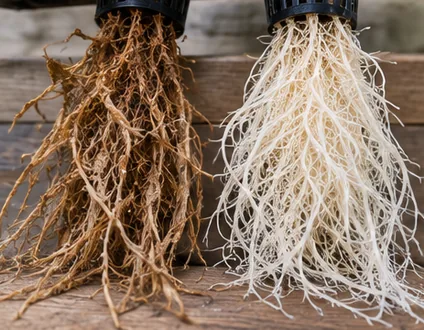
- Clean, visible roots: you spot a browning root right away, and you can photograph or measure it.
The limits
- Water: in the Texas Tech trial, aeroponics used twice as much water as hydroponics, even though water use per gram of lettuce was slightly better.
- Marketing claims: the company AgriHouse claimed 98% less water, 60% less fertilizer and 45 to 75% higher yields (NASA Spinoff, 2006). These are company figures, compared with growing in soil, not results from independent trials.
- Fragility: with no water reserve, a failure costs you quickly (Lakhiar et al., 2018).
4. The real risks, and how to avoid them
| Risk | What happens | The fix |
|---|---|---|
| Pump or timer failure | Roots dry out, plants wilt | Daily check, spare pump, alert if possible |
| Clogged nozzle | One plant no longer gets misted | Filter in front of the pump, removable nozzles, one more nozzle than needed |
| Light in the tub | Algae on the roots and in the nozzles | Opaque tub, lid with no gaps, snug-fitting net pots |
| Solution too warm | Less oxygen, brown roots | Tub in the shade, see oxygen and temperature |
| Mist leaks | Moisture and deposits around the tub | Lid seal, no unnecessary holes |
5. Calculator: cycles, water sprayed and electricity
Enter your timer cycle, the number of nozzles and their flow rate (on the package), the pump wattage and your price per kWh: the calculator gives the number of cycles per day, the pump run time, the solution sprayed and what the pump costs over a year, compared with a pump running continuously.
A nozzle’s actual flow depends on the pressure the pump can deliver at the height of the pipe: check by collecting what comes out of one nozzle for one minute. Default price per kWh: about $0.19 in the US (EIA, March 2026); adjust it to your bill.
6. The build: a low-pressure aeroponic tub
Time: one afternoon. Level: advanced. For: salad greens, herbs, young plants.
What you need
- An opaque 40 to 60 L (11 to 16 gal) tub with a lid (see tubs and reservoirs).
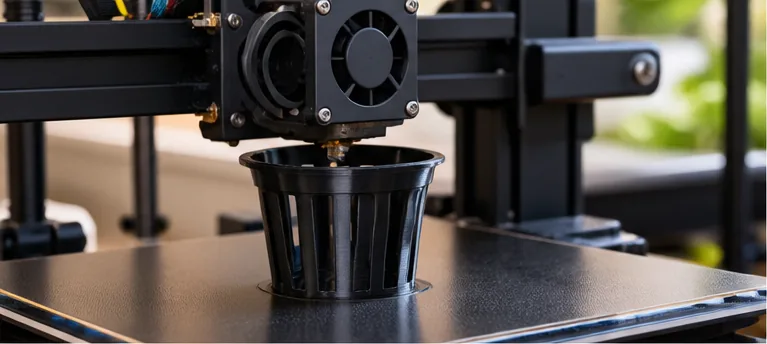
- Net pots and foam collars, or collars printed in PETG (see filaments and parts).
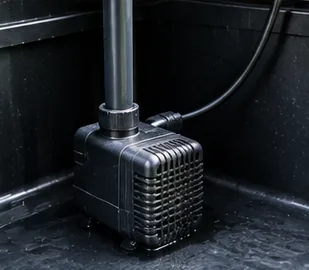
- A submersible fountain pump, chosen by its flow and head curve (see choosing a pump), and a strainer or filter.
- Rigid or semi-rigid tubing, end caps, and screw-in micro-sprinklers or misting nozzles.
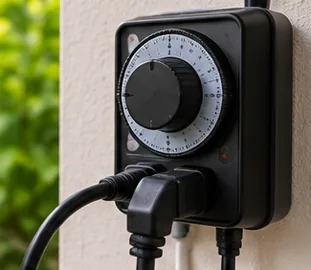
- A cycle timer adjustable to the second (15-minute mechanical pin timers will not do).
Starting settings
- Solution: the EC and pH for your crop (see pH and EC).
- Cycle: for example 30 seconds of misting and 4 to 5 minutes off, then lengthen the pause while watching the roots, as in the Texas Tech trial.
- Solution level: the pump always submerged, the roots never in the solution.
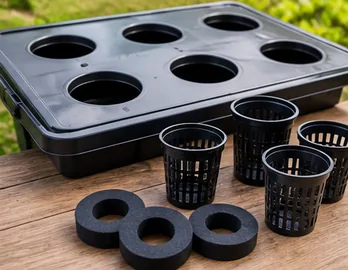
- Drill the lid: holes the diameter of the net pots, at least 15 cm (6 in) apart for salad greens.
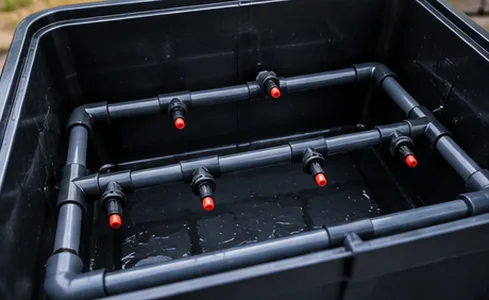
- Build the manifold: a loop or comb of pipe halfway down, under the net pots, with one nozzle pointing up under each cluster of roots. Cap the ends.
- Connect the pump at the bottom of the tub, with its filter, and run the cord out through a small light-tight grommet.
- Test with plain water, lid open: each nozzle should cover the root zone. Measure one nozzle’s flow over one minute for the calculator.
- Plug in the cycle timer on a GFCI-protected outlet, set the cycle, and check two or three full cycles.
- Fill with solution, put in the plants (roots already out of the net pot if possible) and note the cycle in your grow log.
7. Common mistakes
| Mistake | Consequence | The fix |
|---|---|---|
| 15-minute mechanical pin timer | Roots dry out between mistings | Cycle timer with one-second settings |
| No filter in front of the pump | Nozzles clogged within a few weeks | Strainer or filter, cleaned at every solution change |
| Nozzles too close to the roots | Part of the roots never gets wet | Nozzles 10 to 20 cm (4 to 8 in) below the roots, overlapping sprays |
| Roots dangling in the bottom | It is no longer aeroponics, brown roots | Low level, trim roots if needed |
| Ultrasonic fogger alone | Weak growth, solution warms up | Pump and micro-sprinklers |
| Leaving for several days unattended | One failure and everything dries out | A passive system for vacations |
8. Tips
- One extra nozzle beyond what you need: if one clogs, its neighbor still covers the roots.
- A clear inspection lid, covered with a black cloth: lift the cloth to see the roots without opening the tub.
- White vinegar to descale removed nozzles, then rinse with clean water.
- A smart plug that alerts you to a power outage, or a water level sensor (see automating your garden).
- A full cleaning of the tub, manifold and nozzles between crops (see cleaning and disinfecting).
9. Key takeaways
Built an aeroponic tub? Show it off on the forum, with your cycle, your nozzles and a photo of the roots.
Frequently asked questions
What is the difference between aeroponics and hydroponics?
Aeroponics is a form of hydroponics, with no soil. In DWC, the roots sit in the solution; in NFT, a thin film of solution flows beneath them; in aeroponics, they hang in the air and are misted at intervals. They get plenty of oxygen this way, but have no water reserve if the misting stops.
Which misting cycle should I use?
There is no universal cycle. At Texas Tech, lettuce got 30 seconds of misting followed by 4 minutes off at the seedling stage, 8 minutes during growth and 6 minutes at maturity. In the trial by Tunio and colleagues, the best result came from 5 minutes of misting every 30 minutes with an air-assisted nozzle. Start with short pauses and lengthen them while watching the roots: they should stay moist and white.
Is an ultrasonic fogger enough?
It is not the best choice. In the trial by Tunio and colleagues (2022), the 4.89 µm droplets of an ultrasonic fogger gave weaker lettuce growth than the other nozzles. A fogger also warms the solution slightly and scales up. For a DIY build, pump-fed micro-sprinklers are simpler.
Does aeroponics really use less water?
Not necessarily. The company AgriHouse claimed up to 98% less water compared with growing in soil (NASA Spinoff, 2006), but in the Texas Tech trial the aeroponic system used twice as much water as the hydroponic system, for much heavier lettuce. It all depends on the tub, evaporation and what you are comparing.
What happens if the pump fails?
Roots hanging in the air dry out quickly, since they have no water reserve. The review by Lakhiar and colleagues (2018) stresses monitoring and automation for these systems. At home: a filter in front of the pump, a spare nozzle and a spare pump, a daily check, and if possible a water level or power alert. Before leaving on vacation, a passive system is a better bet.
- I. A. Lakhiar, J. Gao, T. N. Syed, F. A. Chandio and N. A. Buttar, Monitoring and Control Systems in Agriculture Using Intelligent Sensor Techniques: A Review of the Aeroponic System, Journal of Sensors, 2018 (doi 10.1155/2018/8672769)
- M. H. Tunio et al., Influence of atomization nozzles and spraying intervals on growth, biomass yield, and nutrient uptake of butter-head lettuce under aeroponics system, International Journal of Agricultural and Biological Engineering 15(1), 2022
- P. Newberry, C. Simpson and V. Baliga, Texas Tech University, comparison of lettuce grown in aeroponics and hydroponics (poster, Urban Horticulture)
- NASA, Spinoff 2006, Progressive Plant Growing Has Business Blooming (AgriHouse)
- J. Andrade-Piedra, P. Kromann and V. Otazu (eds.), Manual for Seed Potato Production Using Aeroponics, International Potato Center (CIP), 2019