Part II · Design
A hydroponic garden in 40 m² with a small balcony: where to set it up, what to grow, what rules apply
A studio or one-bedroom apartment, a window, a ten-foot balcony: enough to eat salad greens all year round and cherry tomatoes in summer. Where to put each system, how to handle light, humidity, noise, weight on the balcony, neighbors and building rules, and what calendar to follow in Belgium.
No yard, no patio: a living room, a bedroom, a south-facing window and a balcony that fits two people on folding chairs. That is the situation of many readers, and it is exactly where hydroponics makes sense. No soil, no bag of potting mix to haul up to the fourth floor, and you can harvest salad greens all year round and cherry tomatoes in summer. The secret is not the equipment: it is putting each thing in the right place.
1. Take stock of your apartment
Before buying anything, walk around your home with three questions in mind: where is the light, where is there an outlet and a floor that can handle a leak, and where will the noise bother no one?
| Spot | Light | Constraints | For what |
|---|---|---|---|
| South-facing windowsill | Good in spring and summer, weak in winter | Hot behind the glass in summer, little room | Kratky jars of herbs, small kit |
| Kitchen or living room corner | Not enough without a light | Outlet, floor to protect, LED light in the evening | LED shelf: salad greens, microgreens, seedlings |
| Small balcony | Excellent from May to September depending on exposure | Weight, wind, neighbors, building rules, frost in winter | Cherry tomatoes, basil, strawberries, peppers |
| Bedroom | Variable | Air pump noise, grow lights at night | Avoid, except a Kratky jar with no pump |
| Bathroom | Often none | Already the most humid room | Avoid |
2. The standard layout: three zones, no more
In 40 m² (430 sq ft), it is tempting to put plants everywhere. Three well-equipped zones beat ten forgotten pots: fewer reservoirs to watch, less humidity, fewer cables.
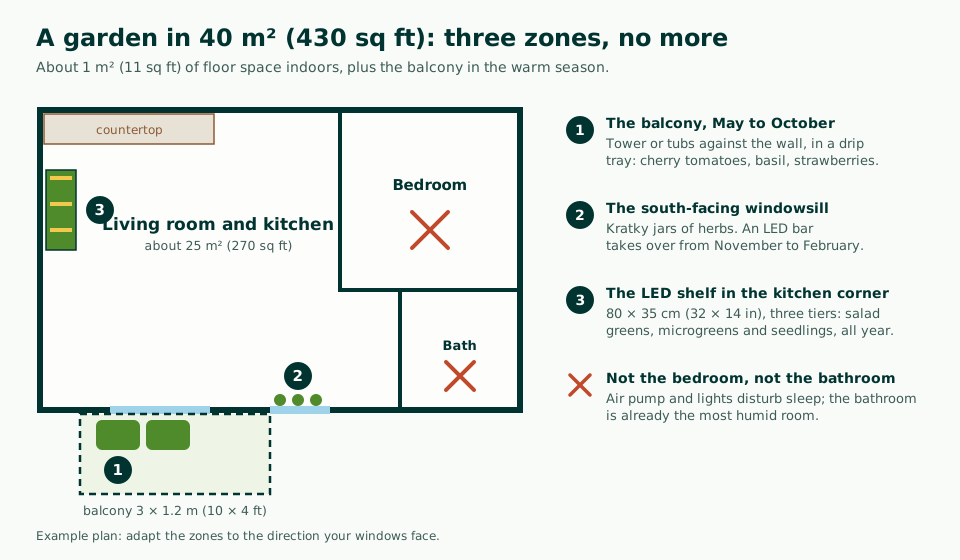
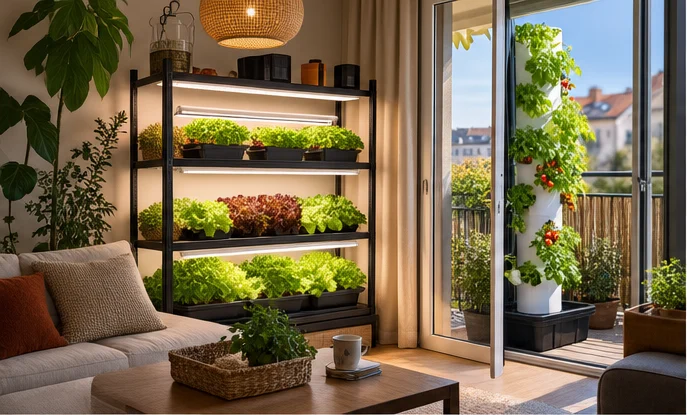
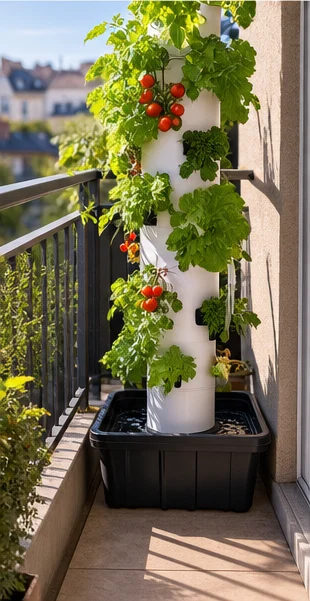
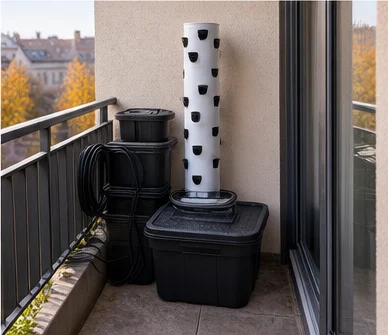
- Zone 1, the balcony: from mid-May to October, for plants that love sun and heat. One tower or two tubs, no more.
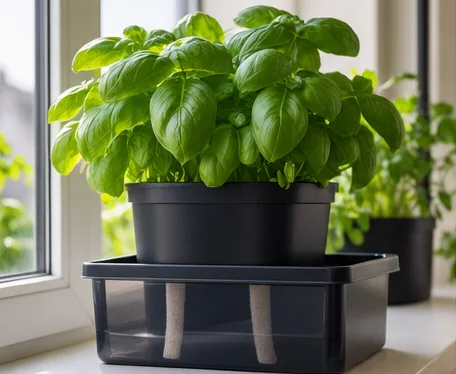
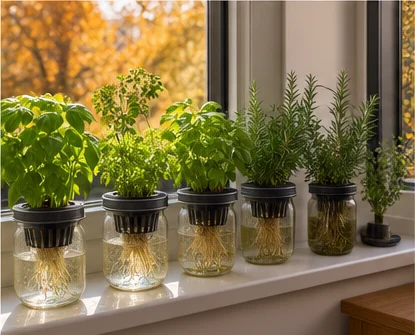
- Zone 2, the windowsill: three to six Kratky jars of herbs, no pump, no noise. See the Kratky method in a jar.
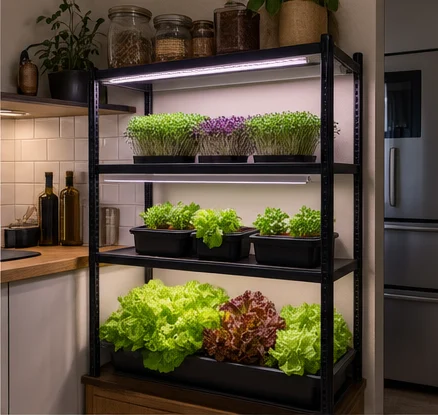
- Zone 3, the LED shelf: the heart of the apartment garden. It produces all year round, whatever the weather.
3. Indoors: light comes first
It is the number one mistake in an apartment: thinking a bright room is enough. Our eyes adapt, plants don’t. Cornell CEA aims for about 17 mol/m²/day of light for lettuce in production. Behind a window, light drops quickly as soon as you move away from the glass, and in winter Belgian days are short and gray (Virginia Cooperative Extension, Iowa State).
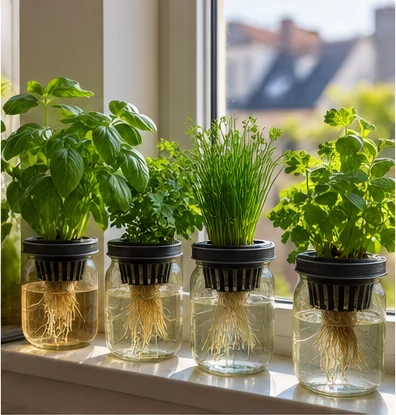
- On the windowsill: enough from April to September for herbs; a 10 to 30 W LED bar takes over from November to February.
- In the room: one LED strip light per shelf tier, on a timer, 20 to 30 cm (8 to 12 in) from the leaves. See grow lights.
- In the evening: set the lights to turn off when you watch TV or sleep. White light is easier to live with than pink-purple lighting.
4. Indoors: humidity, noise and leaks
Humidity
Plants release into the air a good share of the water they drink, and an open reservoir evaporates. In a large home, that is negligible; in 40 m² (430 sq ft) already loaded by cooking, showers and laundry drying, it needs watching. Qualitel recommends 40 to 60% humidity in a home; above 70% for long periods, condensation and mold appear.
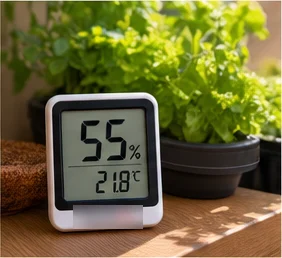
- A hygrometer next to the garden: the only way to know.
- Covered reservoirs: lid, drilled board, opaque film. That is also what keeps algae away.
- Air out every day, five to ten minutes, and don’t block the vents.
- Not against a cold wall: leave a few centimeters (an inch or two) between the shelf and an outside wall, where condensation forms first.
Noise
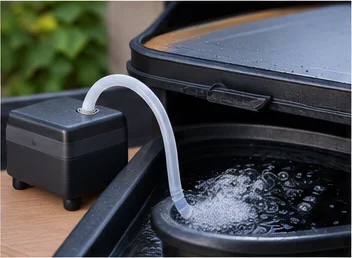
An air pump or a small water pump means a faint but constant hum. During the day you forget it; ten feet from the bed, at night, much less so. Set them on foam or a folded cloth, never directly on a shelf that resonates, and keep the bedroom for a silent Kratky jar. See DWC and air pumps.
Leaks
Hardwood floors are unforgiving, and in an apartment building the water ends up at the downstairs neighbor’s. Each system sits in a drip tray big enough to hold the entire reservoir, and outlets are higher than the water. See tubs, reservoirs and containers.
Setting up an LED shelf in an 80 × 35 cm (32 × 14 in) corner
- Choose the spotNear an outlet, on an easy-to-wipe floor, away from the bed and a few centimeters (an inch or two) from an outside wall.
- Put down a drip trayUnder the bottom tier, or one tray per tier. A washing machine drip pan does the job very well.
- Attach the strip lightsOne per tier, under the shelf above, with zip ties or hooks. Keep 20 to 30 cm (8 to 12 in) between the light and mature leaves.
- Organize the tiersSalad greens at the bottom (the heaviest), herbs in the middle, microgreens and seedlings, which are lighter, on top.
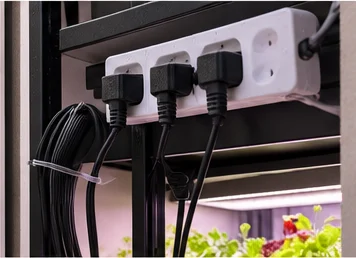
- Manage the cablesA power strip mounted high up on the upright, with the cables looping down: a drip that runs along a cable stops at the low point, not in the outlet.
- Program itOne timer for all the lights, 14 to 16 hours a day, set around your schedule. Check that it keeps the time after a power cut.
5. On the small balcony
The balcony brings something no apartment light can match: summer sun. It also brings constraints you don’t have in the living room. The balcony and patio guide covers them in detail; here is what matters on a small apartment balcony.

Weight
One liter of water weighs one kilo. A 40 L (10.5 gal) reservoir is 40 kg (88 lb) in one spot, plus the structure, the plants and you. Residential balconies are designed according to Eurocode 1; in France, the usual design value is 350 kg/m², about 72 lb/sq ft (Batiactu). That is an engineering figure, not a license to load: an old balcony, a cracked slab or exposed rebar calls for the opinion of the building manager or a professional. In any case, put the weight close to the wall, where the slab is supported, and choose several small reservoirs over one big one.
Wind
The higher you go, the windier it gets. A tower tips over from the top: tie it to a rigid point, on the inside of the railing (Oklahoma State University Extension). Nothing should stick out or hang on the outside of the railing: a planter falling from the third floor is no small matter.
Water and neighbors
Drain with a bucket, never over the railing. A drip tray under each reservoir, and an eye on the balcony drain: nutrient solution stains concrete and the balconies below. A leak into the neighbor’s home is your responsibility, and so falls under your home insurance.
Building rules and the lease
The co-ownership rules (in Belgium, the acte de base, or basic deed, and the règlement d’ordre intérieur, or house rules) often regulate the look of the facade, what can be seen from the street and what is attached to walls or railings. The lease can add its own rules. Read them before you drill: a system that stands on its own and is tied without drilling avoids most arguments.
Heat and electricity
- The reservoir in the shade: Cornell CEA recommends a solution that does not exceed 25 °C (77 °F). A south-facing balcony in July quickly heats up a black tub: umbrella, shade cloth, light color or a larger volume.
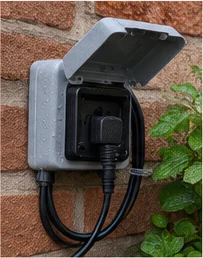
- A weatherproof outdoor outlet, protected by a 30 mA residual current device (the European equivalent of a GFCI), with the cable looping below the outlet. No extension cord running under the French door and getting crushed.
- Winter: empty, rinse and bring in pumps and reservoirs before the frosts. A full reservoir that freezes can crack.
6. Which system, where?
| System | Where | Noise | For whom |
|---|---|---|---|
| Kratky jars | Windowsill, bedroom | None | To get started, herbs, one lettuce per jar |
| All-in-one indoor kit | Countertop | Low (small pump) | People who want a finished product, no DIY |
| LED shelf and tubs | Kitchen or living room corner | Low to medium (air pumps) | Continuous salad greens, microgreens, seedlings |
| Vertical tower | Balcony | Pump running in cycles | Lots of plants on a 50 cm (20 in) square footprint |
| DWC or drip buckets | Balcony | Air pump or water pump | Cherry tomatoes, peppers, large plants |
To compare systems in detail, see which system to choose. Microgreens deserve a mention: a tray on a shelf, a harvest in one to three weeks, it is the most profitable crop per square inch.
7. The year in Belgium

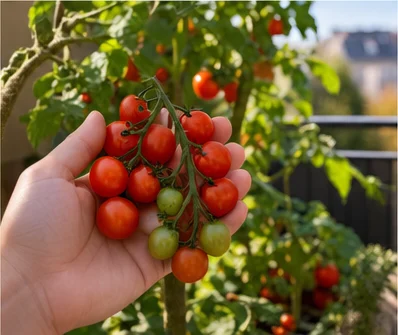
- November to February: the LED shelf does everything. Salad greens, mâche (corn salad), herbs, microgreens.
- March and April: sow the balcony’s cherry tomatoes, peppers and basil indoors. See sowing and transplanting.
- Mid-May: after the last frosts, move out to the balcony. Reassemble the system, test the pump, check every fitting.
- July and August: salad greens bolt quickly in the heat; keep them in the shade on the balcony or bring them back under LEDs. See tomatoes in hydroponics for the balcony plants.
- October: last harvest, bring the herbs in to the windowsill, empty, clean and put away the balcony system.
8. Budget and electricity
The formula: power (kW) × hours per day × 30 days × price per kWh. Three 30 W strip lights running 14 hours a day comes to 0.09 × 14 × 30 = about 38 kWh per month. At €0.45 per kWh all-in (Wallonia, September 2026, according to Selectra; €0.40 in Flanders, €0.46 in Brussels), count on about €17 per month in winter. An air pump or a small water pump adds a few watts. On the balcony, sunlight is free: one more reason to grow there in summer.
9. The most common mistakes
- Relying on room light: leggy, pale plants leaning toward the window. You needed a grow light.
- Buying everything the first month: start with a jar and a shelf, add the balcony in spring.
- The air pump in the bedroom: you unplug it at night, and the roots run short of oxygen.
- Open reservoirs: algae, gnats and humidity throughout the apartment.
- A freestanding tower on the balcony: the first gust of wind knocks it over, and the reservoir empties onto the neighbor’s.
- Forgetting the balcony system in November: a frozen reservoir cracks, a frozen pump has to be replaced.
Do you live in an apartment and already grow? Show off your setup on the forum: solutions found in 40 m² (430 sq ft) interest everyone.
Frequently asked questions
How much space do you need for a hydroponic garden in an apartment?
Less than one square meter (about 11 sq ft) of floor space indoors is enough to get started: an 80 × 35 cm (32 × 14 in) shelf with three lit tiers, plus a few jars on a windowsill. The balcony adds the warm season and the sun-loving plants.
Is a hydroponic garden noisy?
An air pump or a small water pump makes a faint but constant hum, which is mostly a nuisance at night in a small room. Set them on foam, away from the bedroom, and choose Kratky (no pump, no air pump) near rooms where people sleep or rest.
Does it add humidity to the apartment?
A little: plants transpire the water they drink, and an open reservoir evaporates. With covered reservoirs and daily airing, a small garden stays discreet. A hygrometer will tell you: aim for 40 to 60% humidity (Qualitel).
Am I allowed to set up a hydroponic tower on my balcony?
In your own home, yes, within the limits of the co-ownership rules (in Belgium, the règlement d’ordre intérieur, or house rules) and your lease if you rent. These documents often regulate what can be seen from the street, what is attached to the facade or railings, and water runoff. Read them before you drill or attach anything.
How much does the electricity for an LED shelf cost?
Three 30 W LED bars running 14 hours a day use about 38 kWh per month, roughly €17 at €0.45 per kWh (Wallonia, September 2026, according to Selectra). The cost calculator on the Calculators page runs the numbers with your own figures.
- Cornell University CEA, Hydroponic Lettuce Handbook
- Virginia Cooperative Extension, Calculating and Using Daily Light Integral (SPES-720)
- Iowa State University Extension, Sources of Supplemental Light for Indoor Plants
- Batiactu, Que disent les normes de construction pour les balcons ? (What do building standards say about balconies?) (Eurocode 1)
- Qualitel, Comment mesurer le taux d’humidité de votre logement (How to measure the humidity level in your home)
- Oklahoma State University Extension, HLA-6724
- Selectra, price per kWh in Belgium (September 2026)