Part IV · Grow
Hydroponic lettuce and salad greens: types, sowing, settings, continuous harvest and problems
Lettuce is the queen of hydroponics: fast, undemanding, perfect in Kratky as well as NFT. The six types and which ones to choose, sowing without heat, EC, pH, light and temperature settings, continuous harvest, and the three problems to know: burnt edges, bolting, legginess.
If you could pick only one crop to discover hydroponics, it would be lettuce. It grows fast, gets by on very little, needs no stakes or pollination, and fits in a jar as well as in a tower. Here is everything you need to succeed with it: the types, the varieties, sowing, settings, continuous harvest, and the problems to recognize at a glance. The quick version is in the lettuce crop guide.
1. Six types of lettuce
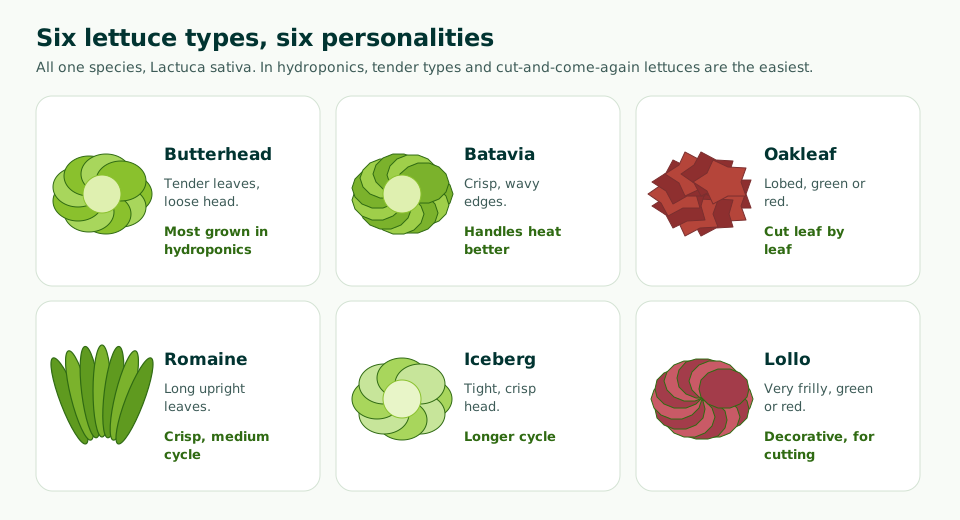
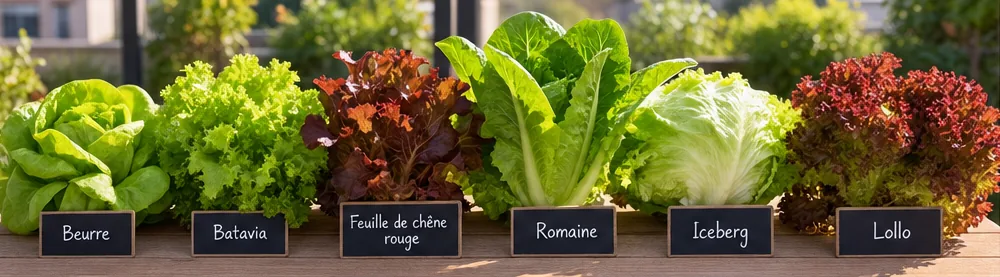
All lettuces belong to the same species, Lactuca sativa. What sets them apart is their shape: tender or crisp leaves, loose or tight heads, whole or lobed leaves.
| Type | In hydroponics | Harvest |
|---|---|---|
| Butterhead | The benchmark: Cornell grows a butterhead (“Bibb”) lettuce in its handbook | Whole head, in five to eight weeks |
| Oakleaf, lollo | Fast, decorative, perfect in Kratky and in towers | Leaf by leaf, for weeks |
| Batavia | Crisp, more heat tolerant | Head or leaves |
| Romaine | Tall: leave room overhead | Whole head or baby leaves |
| Iceberg | Tight head: longer cycle, for patient growers | Whole head |
For summer, the University of Florida got good results in a hot greenhouse with tolerant varieties such as ‘Muir’ (batavia), ‘Flandria’ (butterhead) or ‘Red Oakleaf’ (red oakleaf), and notes that butterhead, romaine, iceberg and leaf lettuces bolt more slowly than some others (Hochmuth et al., 2017). To go further on choosing seeds, see seeds.
2. The cycle, from seed to plate

The Cornell handbook describes a tightly controlled commercial cycle: sowing in a rockwool cube, 11 days as a seedling under continuous light, transplanting into a pond, spacing on day 21 (from 97 to 38 plants per m²), and harvest on day 35 of a head of about 150 g. At home, with window light or a modest lamp, the University of Florida expects more like 50 to 60 days.
3. Sow somewhere cool
Lettuce has a quirk that puzzles beginners: its seeds dislike heat. They germinate well between 15 and 20 °C (59 and 68 °F), and above 25 °C (77 °F) many refuse to germinate: this is thermodormancy, more or less pronounced depending on the variety (Starke Ayres). A failed sowing in midsummer, on a radiator or under a hot lamp, often comes down to this.
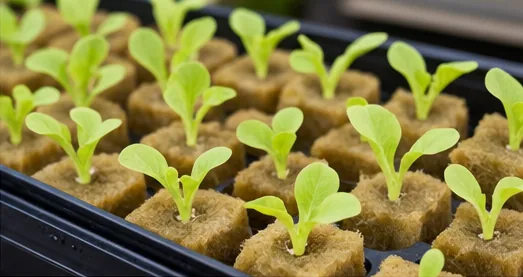
- A moist starter: rockwool cube, seed-starting sponge or coco coir plug, well soaked. See sowing and transplanting.
- One or two seeds per cube, barely covered: many varieties germinate better in light.
- Keep it cool: between 15 and 20 °C (59 and 68 °F). In summer, sow in the evening, in the coolest room, or keep the tray out of the sun.
- Light as soon as they sprout, or the seedlings stretch: 5 to 10 mol/m²/day for seedlings (Virginia Tech).
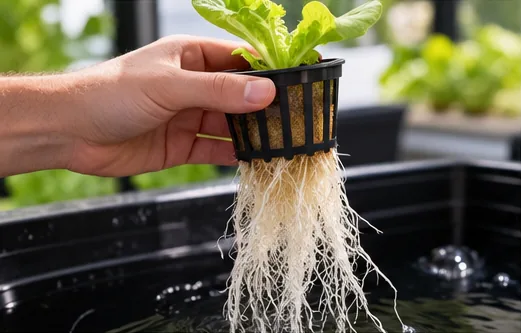
- Transplant as soon as the roots come out of the cube, around the second or third true leaf.
4. The right settings
| Parameter | Target | Source |
|---|---|---|
| EC | 1.2 to 1.8 mS/cm; or about 1.2 above the EC of the starting water; 1.4 to 1.8 for Florida | Oklahoma State; Cornell; UF/IFAS |
| pH | 6.0 to 7.0; or 5.6 to 6.0, optimum 5.8 | Oklahoma State, UF/IFAS; Cornell |
| Light | 12 to 17 mol/m²/day; 17 at Cornell, with ventilation | Virginia Tech; Cornell |
| Air | 24 °C (75 °F) by day, 19 °C (66 °F) at night | Cornell |
| Solution | No more than 25 °C (77 °F); 18 to 27 °C (64 to 81 °F) tolerated in a small system | Cornell; UF/IFAS |
| Oxygen | 7 mg/L targeted, failure below 3 | Cornell |
| Final spacing | About 20 cm (8 in) between heads; closer for baby leaves | Our crop guide |
Two sets of benchmarks coexist, and that is normal: Cornell fine-tunes a commercial pond, while Oklahoma State and the University of Florida give wide ranges for all systems. For a hobby garden, aim for the middle and observe. The details are in pH and EC, oxygen and temperature, and the dosage is calculated with the nutrient calculator (lettuce is in it with its targets). For light, see the lighting calculator, set to “salad greens.”
5. Which system?
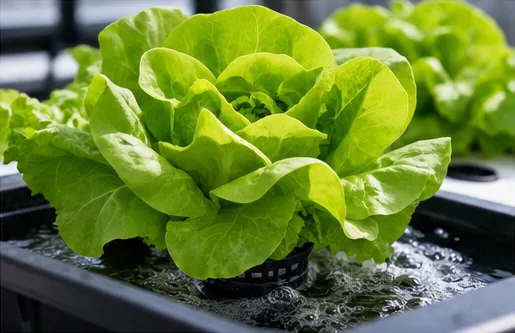
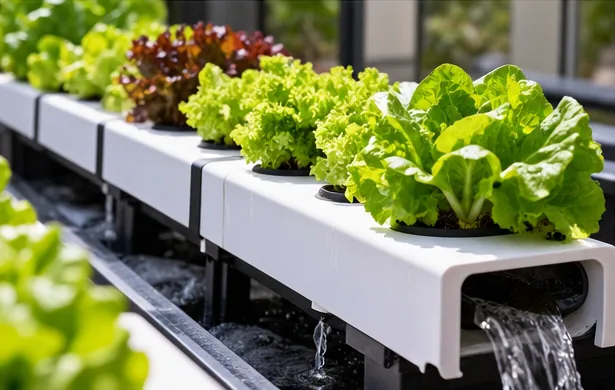
- Kratky: lettuce is the crop for which B. A. Kratky developed his method, at the University of Hawaii. A jar or a tub, a single solution for the whole cycle. See the Kratky method.
- DWC: an aerated bucket or tub, bigger and more uniform heads. In a 2024 study, a butterhead lettuce drank 2.1 to 3.2 liters (0.6 to 0.8 gal) over four weeks. See DWC and air pumps.
- NFT and towers: ideal for continuous production; NFT used slightly more water than DWC in the same study (Yang et al., 2024). See build a tower.
- Growing medium: possible, but it is the least suitable system for salad greens in our crop guides.
6. Harvest, and harvest again
Two ways to do it, which you can combine:
- The whole head: cut it flush with the net cup once the head has formed, and transplant a new plant. Simple, clean, ideal for continuous production.
- Leaf by leaf: pick the large outer leaves and leave the heart. The plant keeps producing for several weeks, until it stretches and bolts.
To never run out of salad, sow a small batch every one to two weeks: when one batch is harvested, the next is ready to transplant. Harvest in the afternoon, with clean scissors, and refrigerate within two hours: nitrates are lower and the lettuce keeps better. See harvest quality.
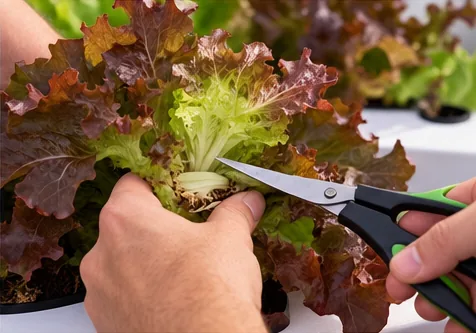
A cut-and-come-again lettuce that produces for six weeks
- Wait for the right sizeWhen the plant has about ten well-developed leaves, roughly three to four weeks after transplanting.
- Cut from the outsidePick the three or four largest leaves, at the base, with clean scissors. Always leave the heart and the young leaves.
- Keep an eye on the solutionA plant that regrows feeds: check the level and the EC every week.
- RepeatAbout every week, as long as the plant stays low and bushy.
- Stop in timeAs soon as the stem stretches and the leaves turn bitter: harvest everything, and transplant a young plant.
7. The three problems to recognize

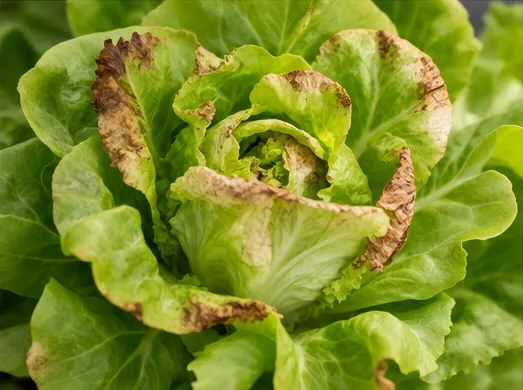
- Burnt edges in the heart (tipburn). It is not a lack of calcium in the solution but a transport problem: the young inner leaves transpire little and calcium does not reach them. Cornell prevents it with a fan blowing over the plants; without that ventilation, it recommends lowering light from 17 to 12 mol/m²/day.
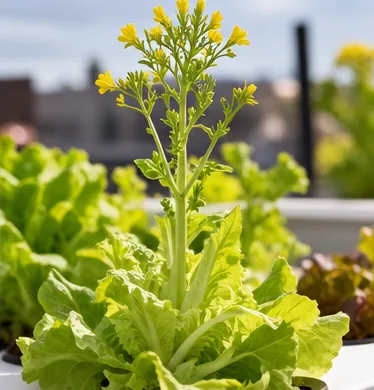
- Bolting and bitterness. The stem stretches, the leaves toughen and turn bitter. Heat is the main cause: in a greenhouse that exceeded 35 to 43 °C (95 to 109 °F) every day, the University of Florida got bitter, unsellable lettuce, and aims for 15 to 21 °C (60 to 70 °F). Sow somewhere cool, keep the room and the solution cool, harvest without waiting.
- Legginess. Long, pale plants leaning toward the window: they lack light. See natural light or LED.
- Also: brown roots from warm water (Pythium), aphids on the undersides of leaves. See diseases and pests and diagnosing problems.
8. Common mistakes
| Mistake | Consequence | The fix |
|---|---|---|
| Sowing on a radiator or in the heat | Seeds that don’t germinate | Sow between 15 and 20 °C (59 and 68 °F) |
| Forgetting light at sprouting | Leggy seedlings that flop over | Bright window or lamp from germination on |
| Solution too strong for young plants | Dry edges, slow growth | Start at the low end of the EC range |
| Lots of light without air | Burnt edges in the heart | A small fan on the plants |
| Sowing everything on the same day | Too much lettuce at once, then nothing | A small batch every one to two weeks |
| Letting the lettuce bolt | Tough, bitter leaves | Harvest on time, grow cool |
9. Key takeaways
Log your sowings, transplants and harvests in the online journal, and show off your best heads on the forum.
Frequently asked questions
Which lettuce should I grow in hydroponics as a beginner?
A butterhead or an oakleaf: tender, fast and forgiving. Oakleaf and lollo can be harvested leaf by leaf for several weeks. Save iceberg for later: its tight head needs a longer cycle.
Why won’t my lettuce seeds germinate?
Often because it is too warm: above 25 °C (77 °F), many lettuce seeds go into thermodormancy and do not germinate. Sow between 15 and 20 °C (59 and 68 °F), somewhere cool, for example near a window in the cool season or in an unheated room.
What EC for hydroponic lettuce?
Between 1.2 and 1.8 mS/cm according to Oklahoma State University, with a pH of 6 to 7. The Cornell handbook aims for about 1.2 mS/cm above the EC of the starting water, with a pH of 5.6 to 6. Start at the low end of the range with young plants.
Why are the edges of the inner leaves turning brown?
This is marginal necrosis, or tipburn: calcium does not reach the young inner leaves, which transpire little. Keep air moving over the plants with a small fan, and do not increase light without ventilation: Cornell drops from 17 to 12 mol/m²/day when air movement is lacking.
My lettuce is bolting and turning bitter, what should I do?
That is bolting, encouraged by heat. Harvest right away, and for the next batches, sow in the cool season, keep the room and the solution cool, and choose slow-bolting varieties.
- Cornell University CEA, Hydroponic Lettuce Handbook (2013)
- Oklahoma State University Extension, Electrical Conductivity and pH Guide for Hydroponics (HLA-6722)
- University of Florida IFAS Extension, Growing Lettuce in Small Hydroponic Systems (HS1422)
- Hochmuth et al., Summer Lettuce Production and Bitterness, University of Florida (2017)
- Starke Ayres, Lettuce and Thermodormancy
- Virginia Cooperative Extension, Calculating and Using Daily Light Integral (SPES-720)
- B. A. Kratky, Three non-circulating hydroponic methods for growing lettuce, Acta Horticulturae 843, 2009
- Yang et al., Scientia Horticulturae, 2024