Part IV · Grow
Sowing and growing beans and peas hydroponically: from sowing to trellising
Functional diagram, not to scale.
Large seeds to soak or not, direct sowing in the net cup, warmth for beans, cool conditions for peas, string, netting and tendrils, spacing, pollination: every step to get legumes established in a hydroponic system.
Legumes have large seeds packed with reserves: they come up fast and get off to a strong start. Their two requirements: not having their roots disturbed, and finding something to climb very early on for the pole varieties. Second article in the series.
1. Preparing the seeds
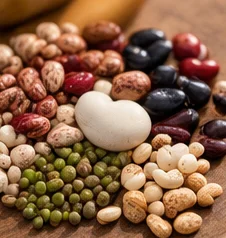
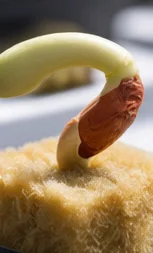
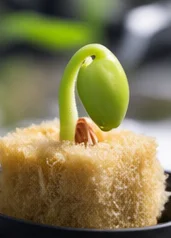
- Whole seeds: the University of Minnesota points out that split pea seeds germinate poorly, especially in cool, damp conditions. Discard damaged seeds.
- A short soak: a few hours in lukewarm water can speed up emergence. No more than one night: a seed left to soak up water too long splits and rots.
- Treated seeds: some commercial seeds are coated with a colored fungicide. Avoid them in a recirculating system.
- Inoculant: the rhizobia sold for legumes are not needed in hydroponics with a complete nutrient solution (see the article on the nutrient solution).
2. Sowing directly in place
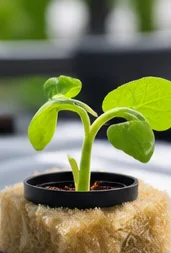
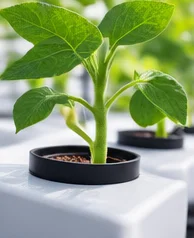
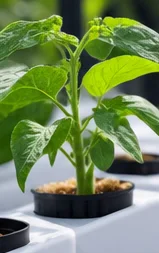
Legumes do not handle transplanting well. So sow directly in the final cube or net cup, filled with clay pebbles, perlite or coco coir, 2 to 3 cm (about 1 in) deep.
Sowing beans in a Dutch bucket
- Prepare the bucketPerlite or a rinsed coco and perlite mix, moistened with a weak nutrient solution.
- SowTwo to three seeds per bucket for pole beans, 2 to 3 cm (about 1 in) deep, with the seed’s eye facing down.
- Keep it warmA lukewarm growing medium, at least 18 °C (64 °F), ideally warmer: in the cold, the seeds rot (University of Minnesota).
- Water sparinglyMoist but not soggy until the seedlings emerge, in one to two weeks.
- Set up the supportStretch the string or net from the day you sow: young stems look for support very early.
- Start the nutrient solutionA weak solution as soon as the first true leaves appear, then normal drip irrigation.
3. Density and spacing
| Crop | Recommended density |
|---|---|
| Bush bean | 3 to 4 plants per net cup or one every 10 cm (4 in) in a reservoir; in the ground, the University of Minnesota spaces them 10 cm (4 in) apart |
| Pole bean | 2 to 3 plants per Dutch bucket, one stake or string per plant |
| Dwarf peas | In a tight clump: the plants hold each other up |
| Climbing peas | A row of plants every 5 cm (2 in) at the foot of a net |
| Fava beans | 1 to 2 plants per bucket, stiff stem |
4. Giving them something to climb
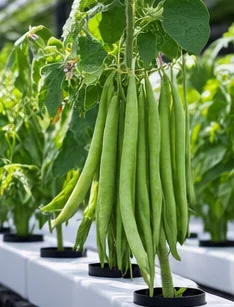
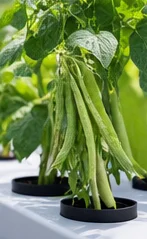
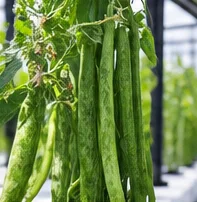
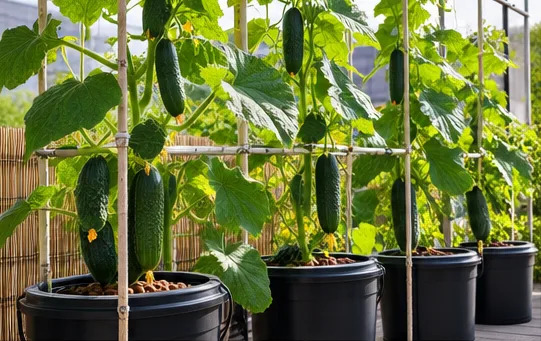
- Pole beans: they twine around a vertical support. A string stretched from the bucket to an overhead wire, or a bamboo cane, is enough. Help the first turn along in the direction the plant twists.
- Peas: they cling with their tendrils to a fine mesh. Use a net with 10 to 15 cm (4 to 6 in) openings or wire mesh; a single string is not enough for them. Tall varieties reach 1.5 m (5 ft).
- Bush and dwarf types: no stake, except under a heavy load; a ring of string around the clump keeps it from flopping over.
5. Temperature and light
| Crop | Ideal temperature | Avoid |
|---|---|---|
| Beans | Moderate warmth, about 20 to 27 °C (68 to 81 °F) during the day | Cold at sowing; very hot days and nights, which make the flowers drop |
| Peas | 13 to 18 °C (55 to 65 °F) | Above 29 °C (84 °F), production stops (University of Minnesota) |
| Fava beans | Cool conditions, like peas | Heat and stuffy air (black aphids) |
All of them need plenty of light to flower and fill their pods: full sun outdoors or a powerful LED grow light 14 to 16 hours a day. The DLI calculator helps you check your lighting.
6. Flowers and pollination
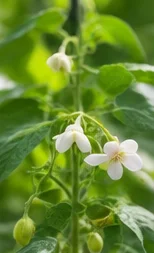
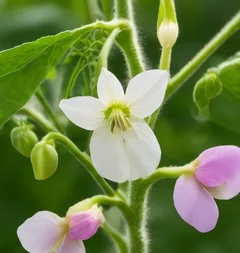
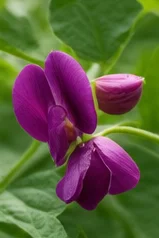
Beans and peas have flowers that usually pollinate themselves, often before they even open. Indoors, a gentle air movement (a fan) or a light shake of the stems is enough. If the flowers drop without forming pods, look first at heat or water stress (see tips and mistakes).
7. The calendar in Belgium
| Crop | Outdoors or unheated greenhouse | Indoors under LEDs |
|---|---|---|
| Beans | Sow from late May to July, when the growing medium is lukewarm | Year-round in a warm room |
| Peas | Sow from March to April, then August to September | Winter, in a cool room |
| Fava beans | Sow from February to April | Winter, somewhere cool |
| Pea shoots | Year-round, continuously | |
Next in the series: adjusting the nutrient solution and understanding nitrogen.
Frequently asked questions
Should I soak bean seeds before sowing?
It is not essential. Soaking for a few hours can speed up emergence, but soaking too long makes the seeds split and rot. Above all, sow in a lukewarm medium: a bean sown in the cold often rots before it germinates.
How many bean plants per bucket?
Two or three pole bean plants per Dutch bucket of about 10 L (2.5 gal), or three to four bush beans per net cup in a large reservoir. Peas, which are slimmer, can be planted more densely, in a clump, at the foot of a net.