Part IV · Grow
Hydroponic herbs: 30 tips for outstanding herbs
Functional diagram, not to scale.
Sow in clumps, root supermarket basil, pinch in the right place, isolate the mint, keep cilantro cool, ventilate against downy mildew, pesto ice cubes: thirty tips, from sowing to your plate.
The basics are in the previous articles of this series. Here are thirty small habits that make the difference between herbs that survive and herbs that overflow their net pots, in order from sowing to your plate.
Sowing and starting
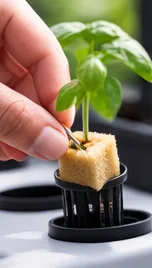
- Sow in clumps: 3 to 5 basil seeds, 10 to 20 chive seeds per cube. The harvest comes weeks earlier.
- Soak parsley 12 to 24 hours before sowing, and sow several small batches: it sprouts slowly and unevenly.
- Split cilantro: each “seed” is a small fruit that holds two.
- Don’t cover the tiny seeds of oregano and thyme: they germinate in light.
- A heat mat for basil: at around 23 to 26 °C (73 to 79 °F), it sprouts in less than a week (Iowa State).
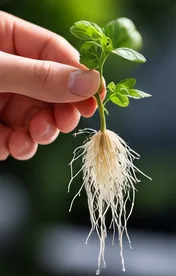
- Root supermarket basil: 8 to 10 cm (3 to 4 in) stems in a glass of water, roots in one to two weeks.
- Cut cuttings below a node: that is where roots form best (Purdue).
- Divide old chives into sections of 5 to 10 bulbs: they bounce back like young plants.
Setting up and fine-tuning
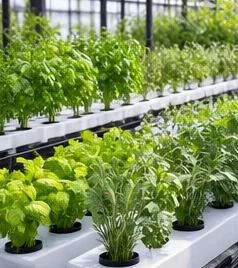
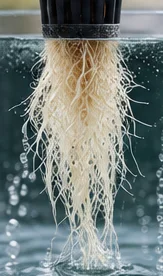
- Isolate mint in its own reservoir: its roots clog tubing and return lines.
- Give a free-draining growing medium to thyme, rosemary and sage: they hate permanently soaked roots.
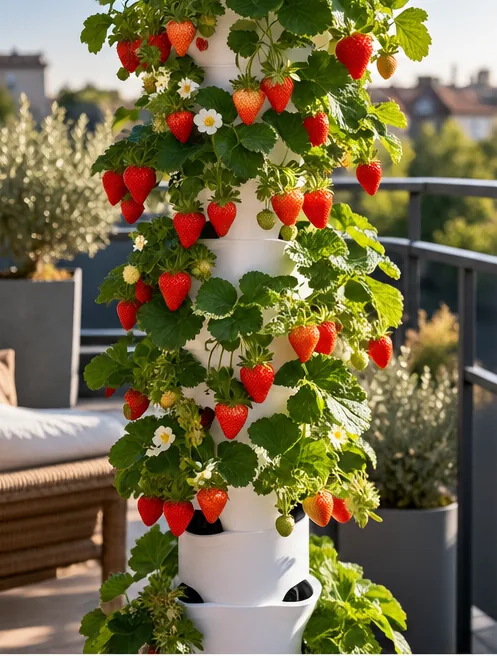
- Basil at the top, cilantro at the bottom of the tower: in the warmest and the coolest spots.
- Aim for 12 to 15 mol/m²/day of light or more (Iowa State): dense, compact, fragrant herbs.
- EC 1.2 to 1.6 and pH 5.8 to 6.2 for a mixed system; go up toward 1.8 to 2.2 if parsley dominates (Oklahoma State).
- Keep the pH below 6.2 for basil: above that, it quickly runs short of iron.
- Nutrients with magnesium: basil is a heavy user (Iowa State).
- Replace the solution about every two weeks rather than topping it up indefinitely.
Maintenance
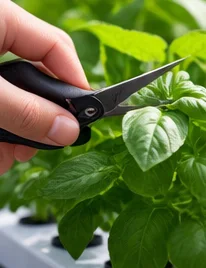
- Pinch early: once there are 4 to 5 sets of leaves, cut the basil top above a pair of leaves.
- Never more than a third of the foliage at a time.
- Cut off basil flower spikes as soon as they show.
- Harvest parsley from the outside, the center keeps producing.
- Shear chives to 3 or 4 cm (about 1.5 in): they grow back in a few weeks.
- A small fan running continuously: less downy mildew, sturdier stems, fewer aphids.
- Humidity below 85 % and leaves never wet: that is the number one defense against basil downy mildew (Cornell).
- Plan the next generation: basil from seed or cuttings every 6 to 8 weeks, cilantro every 3 to 4.
Harvesting and storing
- Harvest in the morning, after the dew, and just before flowering for maximum aroma (University of Minnesota).
- Basil does not go in the fridge: above 10 °C (50 °F), stems in water (UC Davis).
- Keep mint and parsley away from ripe fruit: ethylene turns them yellow (UC Davis).
- Dry Mediterranean herbs (thyme, oregano, rosemary, sage); freeze tender herbs.
- Make herb ice cubes, chopped in a little olive oil, for your winter dishes.
- Let one plant go to seed: cilantro and dill give you seeds and spices, to share at the seed swap.
A question, a photo of your herbs? Head over to the forum.
Frequently asked questions
How can I have basil all year round indoors?
An LED grow light set to 14 to 16 hours a day, a room above 18 °C (64 °F), a solution around EC 1.0 to 1.6 and pH 5.5 to 6.0, regular pinching, and a new generation from cuttings or seed every 6 to 8 weeks.
What is the most common mistake with herbs?
Harvesting by pulling off the big lower leaves instead of cutting the tops. The plant gets leggy, bare and flowers. Cut above a pair of leaves: it branches out and becomes bushy.
- Iowa State University (C. Currey), Herbs 101: a production guide, Greenhouse Management
- Oklahoma State University Extension, Electrical Conductivity and pH Guide for Hydroponics (HLA-6722)
- Cornell University, Managing Basil Downy Mildew in the Greenhouse
- UC Davis Postharvest Research and Extension Center, Herbs (Fresh Culinary)
- University of Minnesota Extension, Preserving herbs by freezing or drying
- Purdue University, Propagate Herbs Now for Yearlong Enjoyment