Part IV · Grow
Sowing, cuttings, division: starting your herbs in hydroponics
Functional diagram, not to scale.
Fast-sprouting basil, patience for parsley, cilantro seeds to split, mint cuttings in a glass of water, dividing chives: every way to start your herbs, with a table of germination times and two tutorials.
There are three ways to start an herb: from seed, from a cutting or by division. In hydroponics, all three work very well, as long as you provide warmth, humidity and light at the right time. Here is the method, herb by herb.

1. Sowing: warmth, humidity, then light

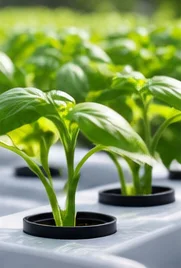
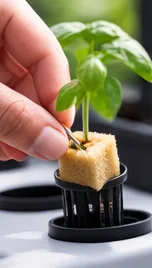
Iowa State sums up the growers’ rule: high humidity and moderate warmth, about 23 to 26 °C (73 to 79 °F), help the root emerge; as soon as the seed leaves open, lower the temperature and increase the light.
| Herb | Germination (rough guide) | Seeds per cube | The little secret |
|---|---|---|---|
| Basil | 5 to 10 days | 3 to 5 | Warmth: below 18 °C (64 °F) it sprouts poorly. Seeds barely covered. |
| Parsley | 2 to 4 weeks | 4 to 6 | Soak 12 to 24 h in lukewarm water; be patient. |
| Cilantro | 1 to 2 weeks | 2 to 3 fruits | The “seed” is a fruit holding two seeds: gently split it in two. |
| Chives | 1 to 2 weeks | 10 to 20 | Sow thickly for a clump; use fresh seed, it ages fast. |
| Dill | 1 to 2 weeks | 3 to 4 | Does not transplant well: sow directly in its final net pot. |
| Oregano, marjoram | 1 to 2 weeks | A pinch | Tiny seeds, do not cover them: they need light. |
| Thyme | 1 to 3 weeks | A pinch | Same: on the surface, constant moisture. |
| Sage | 1 to 3 weeks | 1 to 2 | Large seeds; slow but steady germination. |
| Mint, rosemary, tarragon | Mint and rosemary can be grown from seed, but slowly and unevenly; French tarragon does not produce viable seed. Take cuttings. | ||
Approximate germination times, at the right temperature; an old seed lot or a cool room makes them longer. A germination test settles it: see our seed guide.
Sowing herbs in cubes
- Prepare the cubesRockwool soaked in water at about pH 5.5, or moist coco coir plugs. Drain: moist, not soggy.
- Prepare the seedsSoak the parsley the night before; split the cilantro; the others as they are.
- Sow in clumpsThe right number of seeds per cube (table above), on the surface for tiny seeds, barely pressed in for the others.
- CoverA clear humidity dome or plastic wrap keeps the moisture in; air it out every day.
- Gentle warmthAround 23 to 26 °C (73 to 79 °F), on a heat mat if the room is cool, especially for basil.
- Uncover and lightAs soon as they sprout, remove the dome and place the LED close enough: 14 to 16 hours a day. Herb seedlings that lack light get leggy in two days.
- Feed lightlyA diluted solution from the first true leaves, then transplant when the roots come out of the cube.
2. Cuttings: cloning your best herbs
As Purdue points out, basil, oregano, lavender, rosemary, thyme and sage root easily from tip cuttings. So do mint, lemon balm and tarragon. The advantage: the cutting is an exact copy of the mother plant, and it produces weeks earlier than a seedling.
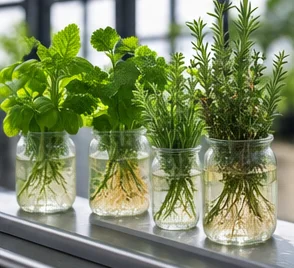
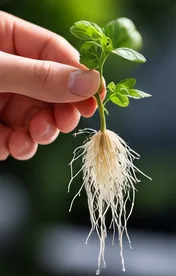
Taking an herb cutting
- Choose the stemA healthy shoot, without flowers, 8 to 10 cm (3 to 4 in) long. For rosemary and sage, a shoot from this year that is still flexible.
- Cut below a nodeThe node, where the leaves grow, is where roots form most easily.
- Strip the baseRemove the leaves from the bottom third; keep a few leaves at the top.
- Root itIn a glass of water (basil, mint, lemon balm), or in a moist rockwool cube (thyme, rosemary, sage, oregano).
- Keep it humid and shadedA dome or a clear bag, soft light and warmth: growers start cuttings with more humidity, more warmth and less light (Iowa State).
- TransplantWhen the roots are 2 to 3 cm (about 1 in) long: basil and mint in one to two weeks, thyme and rosemary more like three to four.
3. Division: the method for clump-forming perennials
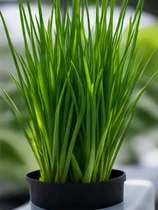
- Chives: take out the clump, rinse the roots, split it into sections of 5 to 10 bulbs, cut leaves and roots back by half, replant. An old clump that is divided bounces back vigorously.
- Mint: each piece of runner with a node and a few roots makes a new plant.
- Oregano, thyme, tarragon: older clumps are divided in spring.
4. Transplanting into the system
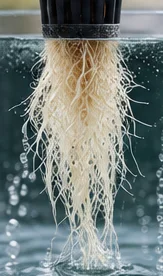
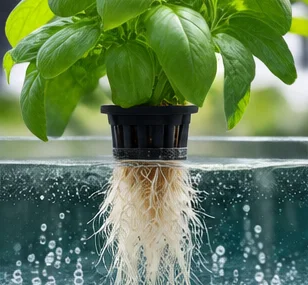
Transplant when the roots come out of the cube. In a tower or an NFT system, wedge the cubes into net pots with a few clay pebbles. Woody herbs (thyme, rosemary, sage) like a free-draining growing medium and less frequent watering. The general technique is in Sowing and transplanting in hydroponics.
5. The staggered sowing calendar
| Herb | Frequency | Why |
|---|---|---|
| Cilantro | Every 3 to 4 weeks | Bolts fast, especially in the heat. |
| Basil | Every 6 to 8 weeks | Old plants turn woody and flower. |
| Dill, chervil | Every 3 to 4 weeks | Short cycles. |
| Parsley | Twice a year | Slow to sprout, long production. |
| Perennials | Cuttings or division once a year | Rejuvenate the plants. |
Next in this series: optimizing the solution, light and climate.
Frequently asked questions
Why sow several herb seeds per cube?
Because herbs have thin stems: a clump of several plants gives a generous harvest faster than a single plant. Commercial growers do this for basil, chives and cilantro. Larger herbs such as sage or rosemary are grown one plant per net pot.
Can I take cuttings from supermarket basil?
Yes, it is actually a great trick. Cut 8 to 10 cm (3 to 4 in) stems below a node, remove the lower leaves and put them in a glass of water in the light. Roots appear within one to two weeks; then transplant into your net pots.
My parsley won’t sprout, what should I do?
Nothing unusual: parsley is slow, often two to four weeks. Soak the seeds 12 to 24 hours before sowing, keep the medium moist and warm, and sow several small staggered batches rather than just one.