Part VI · Monitor and beyond
Is hydroponics eco-friendly? The footprint in water, energy, nutrients and waste
Less water, but more electricity: hydroponics is neither green nor polluting by default. What the studies say, the weight of the grow light on the Belgian power grid, spent solution, growing media and plastic, a calculator to work out your own footprint and the levers to lighten it.
“No soil, no wasted water: hydroponics is eco-friendly!” And yet, a pump, an air pump, a grow light, bottled nutrients and lots of plastic… The truth lies in between: hydroponics saves a lot of water and space, but it uses electricity. Here is the honest footprint, item by item, with the figures from the studies, a calculator for your own garden and the levers to lighten it.
1. What the studies say
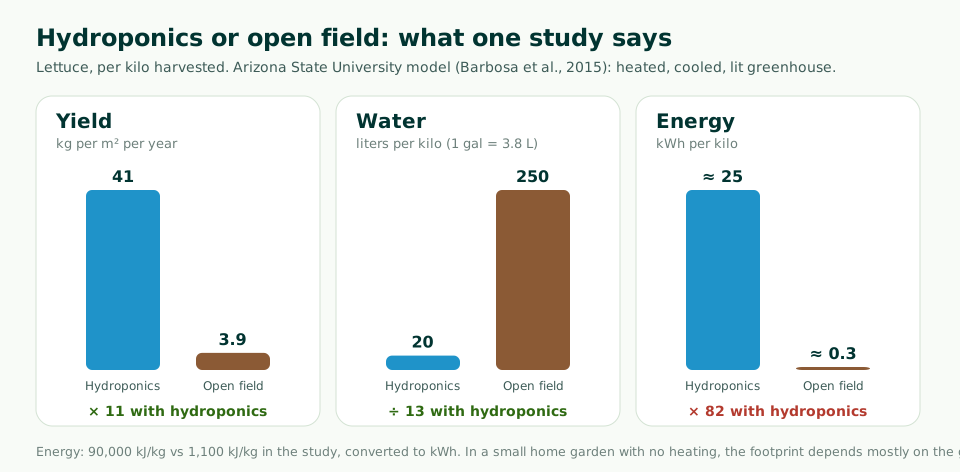
The most cited comparison comes from Arizona State University. Barbosa and colleagues (2015) modeled lettuce produced in Yuma, Arizona, in the open field and in a heated, cooled and lit hydroponic greenhouse. Per kilo of lettuce, hydroponics:
- yields 11 times more per m²: 41 kg per m² per year, versus 3.9;
- needs 13 times less water: about 20 liters (5 gal) per kilo, versus 250 (66 gal);
- uses 82 times more energy: about 90,000 kJ per kilo (25 kWh), versus 1,100 kJ (0.3 kWh).
The authors conclude that hydroponics only lives up to its environmental promise with low-carbon energy. But their greenhouse runs all year with heating, cooling and lighting: a garden on a shelf or a patio has none of that. At home, the footprint comes down mostly to the grow light.
2. Electricity: the real issue
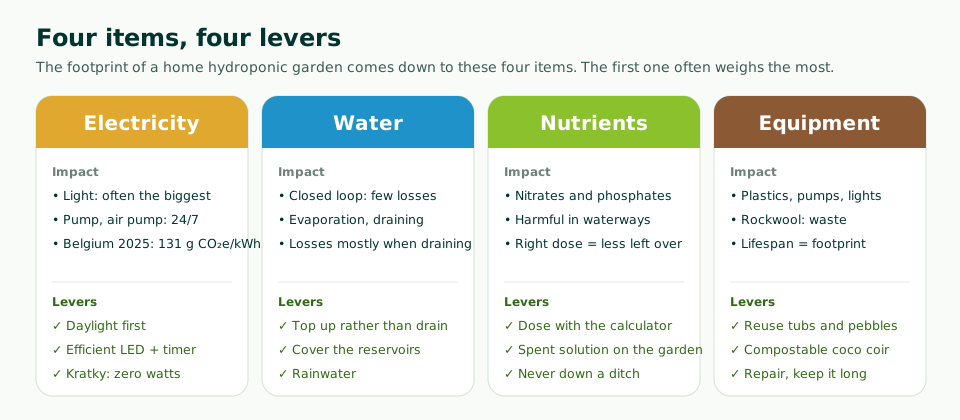
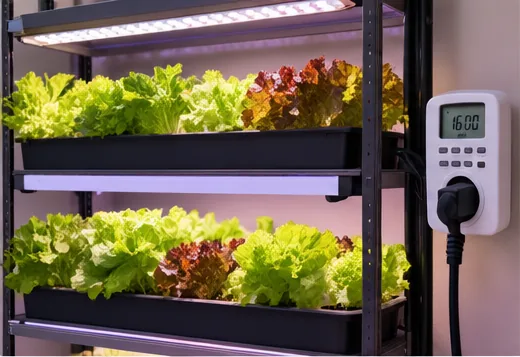
Three devices use power: the grow light, the pump (NFT, tower, ebb and flow) and the air pump (DWC). The pump and the air pump are low-wattage, but the air pump runs 24 hours a day. The light, on the other hand, is powerful and on for many hours.
To go from kWh to climate impact, you need the carbon content of the grid. In Belgium, thanks to nuclear, wind and solar, one kWh weighed about 128 g of CO₂e in 2024 and 131 g in 2025, according to the Université de Liège report based on Elia figures.
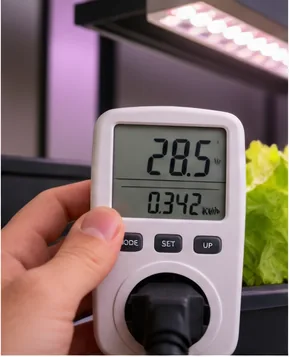
To find out a device’s real power draw, a plug-in power meter placed between the outlet and the light displays the watts and counts the kWh: that is the number to enter in the calculator below.
- Daylight first. In spring and summer, a well-oriented window or a patio is enough for many crops. The light fills in during winter. See natural light or LED and the lighting calculator.
- An efficient LED, which delivers lots of useful light per watt (µmol/J), at the right height. See grow lights.
- A timer: not one hour of light more than needed.
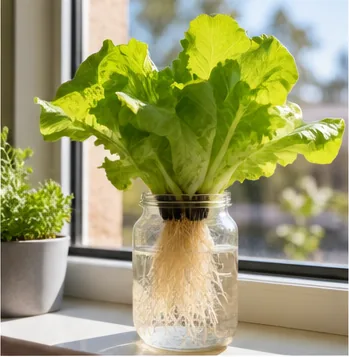
- Kratky: a jar, a solution, no pump or air pump. On a windowsill, zero watts. See DWC and air pumps to choose between the two.
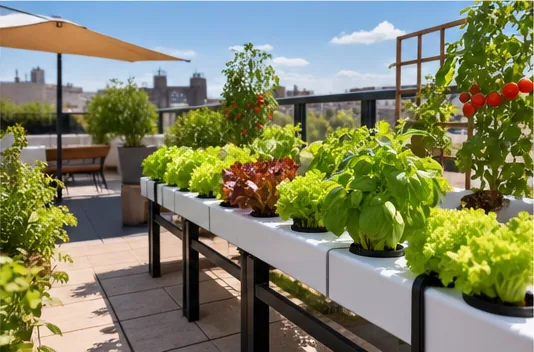
3. Water: the strong point
In hydroponics, water does not seep into the ground: it circulates in a closed loop, and whatever the plant does not drink returns to the reservoir. Losses come from evaporation and above all from draining, when you change the solution.
Should you keep it longer to save water? Not indefinitely. Researchers at Purdue University (Miller et al., 2020) recycled a solution made with hard tap water: calcium, magnesium and bicarbonates built up, skewing the EC, while nitrogen, phosphorus, potassium and iron ran short. The result: 22 to 36% less lettuce. They recommend changing the solution after two weeks, or using low-mineral water (reverse osmosis water in their trial). Oklahoma State also recommends a change about every two weeks.
- Top up rather than drain between two changes, and check pH and EC. See pH and EC.
- Cover the reservoirs: less evaporation, no light, no algae.
- Rainwater, low in minerals and free. See rainwater and what size tank to plan for.
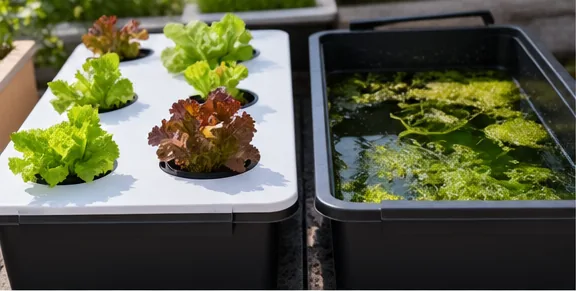
4. Nutrients: dose accurately, dump nothing into waterways
A nutrient solution contains nitrates and phosphates. In a pond or a stream, they feed algae. To protect water bodies, the European Union adopted the “Nitrates” Directive (91/676/EEC), and drinking water must not exceed 50 mg of nitrates per liter (Directive 2020/2184).
- Dose accurately: not too much, and not “just in case.” The nutrient calculator gives the dose for your reservoir and your plants.
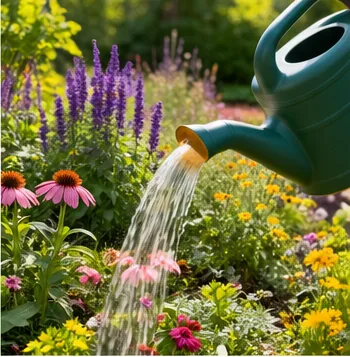
- Spent solution is a fertilizer: water garden plants, pots and hedges with it. Never into a ditch, a pond or a storm drain.
- Leftover concentrate keeps capped, in a cool place, away from light and children. See nutrients in hydroponics.
5. Equipment: make it last
Reservoirs, tubing, net cups, pump, light: a hydroponic garden means plastic and electronics. The best footprint is equipment that lasts for years.
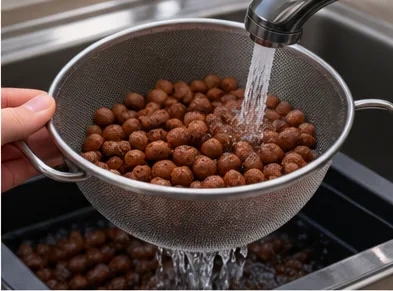
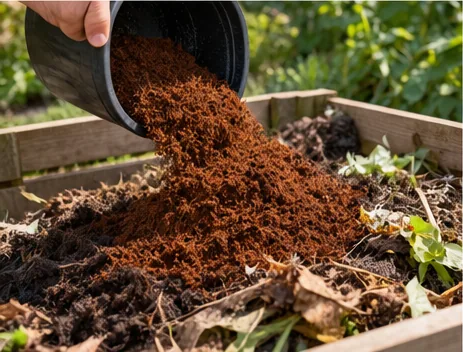
- Growing media: clay pebbles can be reused for years, coco coir ends up in the compost; rockwool does not break down, and peat comes from bogs that regenerate very slowly. See growing media.
- Containers: a food-grade bucket or a reclaimed tub, well chosen, makes an excellent reservoir. See tubs and reservoirs.
- Small parts can be repaired or reprinted instead of buying everything again. See 3D printing for hydroponics.
- Cleaning between crops extends the life of pumps and reservoirs. See maintenance routines.
6. The calculator: your garden’s footprint
CO₂e: Belgian grid 2025, 131 g per kWh (Université de Liège, based on Elia). The default values are an example: replace them with those of your own devices. The online logbook has a harvest section to weigh your kilos: see my logbook.
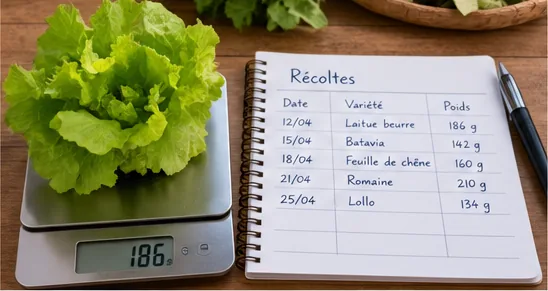
7. What about transport and packaging?
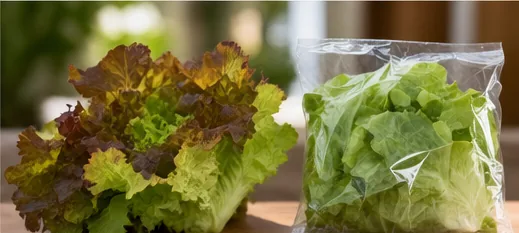
A salad picked on your balcony does not travel, is not packaged and does not end up forgotten at the back of the fridge: you harvest what you eat, when you eat it. This gain is not in the calculator, for lack of a reliable figure for a home garden, but it is real. To waste nothing, see harvesting continuously.
8. Common mistakes
| Mistake | Consequence | The fix |
|---|---|---|
| Running the light in midsummer in front of a sunny window | kWh for nothing | Daylight first, light as a supplement |
| Light without a timer | On too long, or forgotten | Timer set to the useful duration |
| An air pump on a Kratky jar | Wasted power | Kratky works without air |
| Dumping the solution into a ditch | Nitrates and phosphates in the water | Water the garden plants |
| Doubling the nutrient dose | Waste, stressed plants | Dose with the calculator, measure the EC |
| Keeping the same solution for months | Deficiencies, salt buildup, lower harvest | Change it about every two weeks |
| Throwing out rockwool after every crop | Waste that does not break down | Reusable clay pebbles, compostable coco coir |
9. Key takeaways
Worked out your footprint? Share your figures on the forum: light, kWh, kilos harvested.
Making the garden energy self-sufficient with a small solar panel: see an energy self-sufficient garden.
Frequently asked questions
Does hydroponics use less water than soil?
Yes, by far. In a study from Arizona State University (Barbosa et al., 2015), hydroponic greenhouse lettuce needs about 20 liters (5 gal) of water per kilo, versus 250 liters (66 gal) in the open field, because the water circulates in a closed loop instead of seeping away or evaporating from the soil.
What about electricity, isn't that a problem?
It is the weak point. The same study calculates 82 times more energy per kilo for a heated, cooled and lit greenhouse. At home, with no heating, it is mostly the grow light that counts: use daylight first, an efficient LED and a timer. A Kratky jar on a windowsill uses nothing.
How much CO₂ does a grow light produce in Belgium?
Multiply the kWh by about 131 g of CO₂e, the value for the Belgian grid in 2025 according to the Université de Liège (based on Elia). A 30 W LED on 14 hours a day all year uses about 153 kWh, or about 20 kg of CO₂e.
What should I do with spent nutrient solution?
It is a diluted fertilizer: water your garden plants or pots with it. Do not pour it into a ditch, a pond or a stream: nitrates and phosphates feed algae there. The European Union limits nitrates in drinking water to 50 mg per liter.
Can I keep the same solution longer to save water?
Not indefinitely. Purdue researchers showed that a solution recycled with hard tap water builds up calcium, magnesium and bicarbonates, and runs short of nitrogen, phosphorus, potassium and iron: lettuce growth dropped by 22 to 36%. They recommend changing it after two weeks, or using low-mineral water. Oklahoma State also recommends a change about every two weeks.
- Barbosa G. L. et al., Comparison of Land, Water, and Energy Requirements of Lettuce Grown Using Hydroponic vs. Conventional Agricultural Methods, International Journal of Environmental Research and Public Health 12(6), 6879-6891, 2015
- Attia S., Belgian Electricity Grid Greenhouse Gas Emission Factors, Université de Liège, 2026 (Elia values for 2024 and 2025)
- Miller A., Adhikari R., Nemali K., Recycling Nutrient Solution Can Reduce Growth Due to Nutrient Deficiencies in Hydroponic Production, Frontiers in Plant Science, 2020 (Purdue University)
- Oklahoma State University Extension, Hydroponic Nutrient Solutions (HLA-6722)
- Directive 91/676/EEC (nitrates) and Directive (EU) 2020/2184 (drinking water)
- Selectra, price per kWh in Belgium, September 2026